
Did you take your Xarelto this morning on an empty stomach, with just a cup of coffee? Plenty of people do, and the label says that is a problem for the two most common strengths. A blood thinner only protects you if your body actually absorbs it.

This guide uses the Janssen label on DailyMed and CMS pricing pages to explain what Xarelto does, the food rule, missed doses, and what changed for Medicare in 2026 and 2027. If you are deciding between Xarelto and Eliquis, take a closer look at the comparison near the end.
What Xarelto is used for
Xarelto (rivaroxaban) is a factor Xa inhibitor, first approved in 2011. Its adult uses on the label include:
- lowering the risk of stroke and systemic embolism in nonvalvular atrial fibrillation
- treating DVT and PE, and lowering the risk they return after at least 6 months of treatment
- preventing DVT after hip or knee replacement surgery
- preventing clots in some acutely ill hospitalized patients, during and after the stay
- lowering the risk of major heart and vascular events in coronary artery disease (CAD) and peripheral artery disease (PAD), at 2.5 mg twice daily together with low-dose aspirin
The label also covers some children with clots and children 2 and older after the Fontan heart procedure. For background, see atrial fibrillation and stroke.

Doses and the food rule
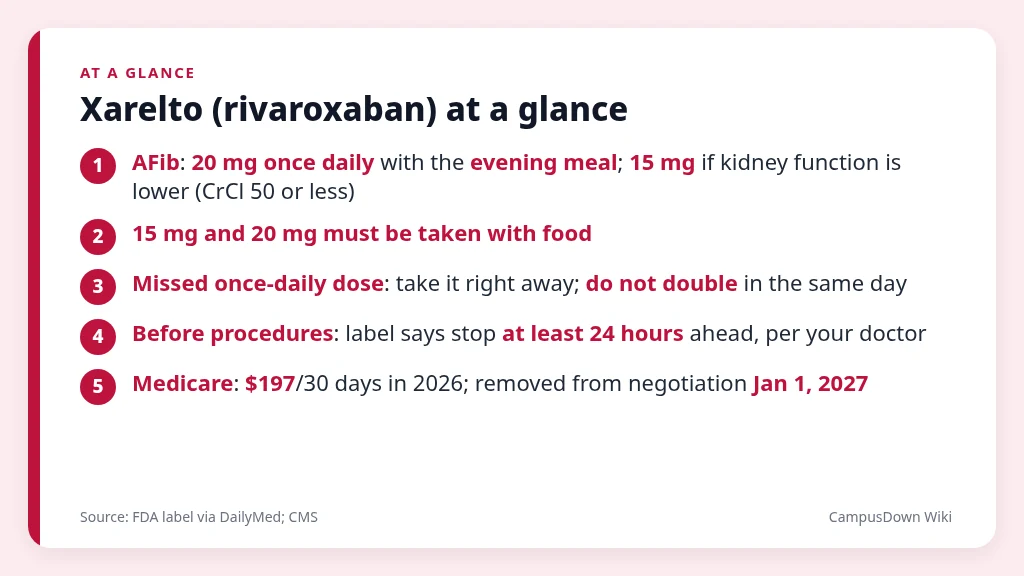
For AFib, the label lists 20 mg once daily with the evening meal when creatinine clearance (a kidney measure) is above 50 mL/min, and 15 mg once daily with the evening meal when it is 50 or lower. For DVT or PE treatment, the label lists 15 mg twice daily with food for 21 days, then 20 mg once daily with food. After at least 6 months, 10 mg once daily may be used to lower the risk of a repeat clot.
The 15 mg and 20 mg tablets must be taken with food. The 2.5 mg and 10 mg tablets can be taken with or without food. If swallowing is hard, the label allows crushing and mixing with applesauce; a crushed 15 mg or 20 mg tablet should be followed right away by food. Ask your pharmacist before changing how you take it.
Because the dose depends on kidney function, your doctor rechecks labs over time. Our kidney function guide explains the numbers.
Example scenario: breakfast, coffee and a pill
- Who
- Hector, 69, a retired long-haul truck driver in Texas with AFib, was prescribed Xarelto 20 mg and told to take it with dinner.
- What happened
- Out of habit from decades on the road, he took all his pills at 6 a.m. with black coffee and skipped breakfast. At a follow-up, his daughter Marisol read the pharmacy leaflet out loud and stopped at the line about food.
- How it felt
- Hector felt embarrassed, then worried: had he been unprotected for months? He admitted he was afraid of another dizzy spell like the one that sent him to the ER.
- What they did
- Marisol called his pharmacist, who explained the food rule without blame, checked his other medicines, and suggested moving the dose to dinner with a phone alarm. His doctor's office confirmed the plan and rechecked his kidney labs.
- How it turned out
- Hector now keeps the bottle next to the salt shaker, takes it with his evening meal every day, and his daughter checks in once a week. He says the alarm makes him feel like he is "back on a route schedule."
This is an illustrative example, not a real patient or a review.
Hector is an illustrative example, not a real patient. Always ask your own pharmacist how to time your doses.
Missed doses and stopping
For once-daily doses of 20 mg, 15 mg or 10 mg, the label says take the missed dose immediately and do not double the dose within the same day. For the 15 mg twice-daily phase, it says take it immediately so you get 30 mg that day. For 2.5 mg twice daily, skip the missed dose and take the next one at the scheduled time.
The label's boxed warning says stopping early, without another blood thinner in place, raises the risk of clots, and an increased rate of stroke was seen when people switched from Xarelto to warfarin in AFib trials. A second boxed warning covers spinal or epidural blood clots with spinal procedures.
Before surgery or other procedures, the label says to stop Xarelto at least 24 hours ahead if your doctor decides it should be paused, and restart once bleeding is controlled. Never hold a dose on your own.
Side effects and warning signs
The label says the most common adverse reaction in adults is bleeding.
Get help now if
Get emergency care for bleeding that will not stop, red or black stools, pink or brown urine, coughing or vomiting blood or coffee-ground material, a sudden severe headache, weakness, or after a fall or hit to the head. Call your doctor about unusual bruising, heavy periods or frequent nosebleeds.
The label also says Xarelto is not recommended in people with prosthetic heart valves or triple-positive antiphospholipid syndrome. Aspirin, NSAIDs, some antidepressants and certain drugs that change rivaroxaban levels can raise bleeding risk or lower its effect. The label says a specific agent to reverse rivaroxaban "is not available" and it is not removed by dialysis; hospitals use other blood products if needed.
Generic rivaroxaban and Medicare price
CMS negotiated a Medicare maximum fair price of $197 for a 30-day supply of Xarelto, effective January 1, 2026 (2023 list price: $517). CMS later listed Xarelto among drugs with a deselection determination: the negotiated price applies in 2026 and Xarelto is removed from the program effective January 1, 2027. CMS says deselection happens in situations such as when FDA has approved a generic that is marketed. DailyMed now lists many generic rivaroxaban labels. What you pay in 2027 depends on your plan's formulary; see the Part D cap guide and ask your pharmacist whether a generic is covered.
Most-asked questions about Xarelto
Is there a generic for Xarelto?
Yes, generic rivaroxaban labels from several manufacturers are listed on DailyMed, and CMS removed brand Xarelto from Medicare negotiation starting 2027, a step CMS takes in cases such as when a generic is approved and marketed. Whether your pharmacy has a generic for your strength, and what your plan pays, can differ, so ask your pharmacist.
Why people ask: "xarelto generic" is the #2 Google suggestion for "xarelto," and "rivaroxaban generic" is #5 for "rivaroxaban" (US autocomplete, November 2026).
Xarelto vs Eliquis: which is better for AFib?
Both lower stroke risk in nonvalvular AFib. Xarelto is once daily with the evening meal; Eliquis is twice daily with or without food. Kidney function, other medicines, bleeding history and cost all shape the choice, so this is a decision for you and your doctor. See our Eliquis guide.
Why people ask: "xarelto vs eliquis" is #5 for "xarelto," with "for afib" at #3 and "bleeding risk" at #5 for "xarelto vs eliquis" (US, November 2026).
What are the side effects of Xarelto?
Bleeding is the most common adverse reaction on the label. Report unusual bruising, nosebleeds or heavy periods, and get emergency care for signs of serious bleeding.
Why people ask: "xarelto side effects" is #3 for "xarelto" (US, November 2026).
Does Xarelto 20 mg have to be taken with food?
Yes. The label says the 15 mg and 20 mg tablets should be taken with food, and the AFib dose with the evening meal.
Why people ask: "xarelto 20 mg" is #8 and "xarelto dosing" is #6 for "xarelto" (US, November 2026).
What is the brand name of rivaroxaban?
Xarelto is the brand name; rivaroxaban is the generic ingredient name.
Why people ask: "rivaroxaban brand name" is #2 for "rivaroxaban" (US, November 2026).
You can check it for yourself tonight: is your Xarelto bottle next to your dinner plate, or next to your morning coffee?
Related on CampusDown
You can learn more in our guides to warfarin, blood thinners for AFib in older adults and INR and PTT tests.
Frequently asked questions
- What strengths does Xarelto come in?
- The label lists 2.5 mg, 10 mg, 15 mg and 20 mg tablets, plus an oral suspension for children.
- Does Xarelto need INR checks?
- No routine INR monitoring is used, but kidney function is rechecked over time.
- Can I take ibuprofen with Xarelto?
- NSAIDs raise bleeding risk with blood thinners; ask your doctor or pharmacist which pain reliever fits you.
- How long before surgery do I stop Xarelto?
- The label says at least 24 hours if it needs to be stopped; your surgeon and prescriber decide.
Xarelto is a once-a-day habit that depends on one small detail: food. Learn more about your own dose and kidney checks from your doctor or pharmacist, and never stop it without a plan.
Browse more guides like this in the Medicines hub.
This article is for general education and does not replace advice from your own doctor, nurse or pharmacist.