
Is your mother "too old" for a blood thinner? Or are you afraid that if she falls, the blood thinner will make it worse? These are the two questions families ask most after an AFib diagnosis in someone over 75, and the answer is rarely a simple yes or no.

This guide summarizes how U.S. heart guidelines approach the decision, using the 2023 ACC/AHA/ACCP/HRS atrial fibrillation guideline, FDA labels on DailyMed and MedlinePlus. It is written for caregivers. If you are helping a parent prepare for a cardiology visit, take a closer look at the question list near the end.
Why AFib needs stroke prevention
In atrial fibrillation, the upper chambers of the heart quiver instead of squeezing normally. Blood can pool and form clots, and a clot that travels to the brain causes a stroke. NHLBI says untreated AFib can lead to serious complications, including stroke and heart failure. A blood thinner (anticoagulant) lowers that risk; it does not fix the rhythm itself.

How the risk is scored
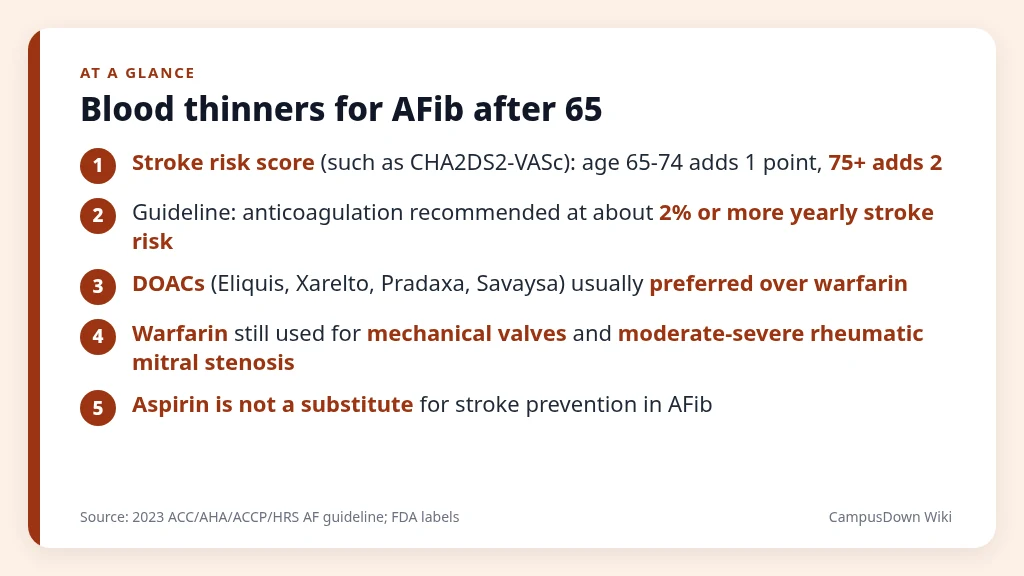
Doctors use a score such as CHA2DS2-VASc. Points come from heart failure, high blood pressure, age 65 to 74 (1 point) or 75 and older (2 points), diabetes, prior stroke, TIA or clot (2 points), vascular disease, and sex category.
The 2023 guideline moved away from fixed score cutoffs alone. It recommends anticoagulation based on yearly stroke risk, generally when the estimated risk is about 2% per year or higher. When risk is in the gray zone, it suggests looking at other factors, such as how much time is spent in AFib and blood pressure control, and deciding together through shared decision-making. Because age alone adds points, many people over 75 land in the range where a blood thinner is recommended.
Which blood thinner?
For most people with AFib, the guideline prefers the direct oral anticoagulants (DOACs) over warfarin. In the U.S. these include:
- Eliquis (apixaban): twice daily; lower 2.5 mg dose if at least 2 of: age 80+, weight 60 kg or less, creatinine 1.5+. See our Eliquis guide.
- Xarelto (rivaroxaban): once daily with the evening meal; 15 mg if kidney function is reduced. See our Xarelto guide.
- Pradaxa (dabigatran) and Savaysa (edoxaban): also FDA-approved for AFib, each with its own kidney rules.
Warfarin is still the choice for people with a mechanical heart valve or moderate to severe rheumatic mitral stenosis, and some people stay on it because it works well for them or for cost reasons. See our warfarin guide.
Aspirin is not a substitute for a blood thinner for AFib stroke prevention, and taking both raises bleeding risk. Our low-dose aspirin guide explains why.
Example scenario: Grandma's two fears
- Who
- Lillian, 86, a retired seamstress in Pennsylvania, learned she had AFib after a dizzy spell. She lives alone with a cat and uses a cane outdoors.
- What happened
- Her cardiologist recommended Eliquis. Lillian refused at first: she had fallen twice in the past year and remembered a friend who "bled into her brain" on warfarin. Her grandson Theo, 24, was the one who drove her to appointments.
- How it felt
- Lillian felt cornered, like her independence was being negotiated without her. Theo felt torn: he was terrified of a stroke but did not want to push her.
- What they did
- Theo asked for a longer follow-up visit. The cardiologist explained her stroke risk score, why age itself raised it, how her dose was chosen, and what bleeding signs meant an ER trip. A physical therapy referral and a home safety check were added to work on the falls.
- How it turned out
- Lillian chose to start the medicine after she felt heard. She now does balance exercises twice a week, has a grab bar in the shower, and keeps a card in her purse listing her blood thinner. She told Theo the falls plan mattered as much to her as the pill.
This is an illustrative example, not a real patient or a review.
Lillian and Theo are an illustrative example, not real patients. Your family's decision depends on the full picture your doctor sees.
Falls, frailty and bleeding
Falls are a real worry, but reviews of older adults with AFib note that falls and frailty are usually weighed alongside stroke risk rather than treated as automatic reasons to avoid a blood thinner. What families can do:
- Work on fall risk directly; our fall prevention checklist is a good start.
- Review all medicines for drugs that add bleeding or fall risk, such as NSAIDs and sedating pills; see the Beers Criteria guide.
- Keep kidney labs current, since DOAC doses depend on kidney function.
- For people who truly cannot take long-term blood thinners, the guideline discusses left atrial appendage occlusion devices as an option to ask about.
Get help now if
Call 911 after a fall with a head strike, a new severe headache, confusion, or vomiting in someone on a blood thinner, even if they seem fine at first. Also call 911 for stroke signs: face drooping, arm weakness, speech trouble.
Most-asked questions about AFib blood thinners in older adults
What blood thinners are used for AFib?
The main ones in the U.S. are apixaban (Eliquis), rivaroxaban (Xarelto), dabigatran (Pradaxa), edoxaban (Savaysa) and warfarin. The 2023 guideline generally prefers the first four (DOACs) over warfarin, except for mechanical valves and moderate to severe rheumatic mitral stenosis.
Why people ask: "blood thinners for afib list" is the #2 Google suggestion for "blood thinners for afib," and "afib blood thinner medication" is #2 for "afib blood thinner" (US autocomplete, November 2026).
What score decides whether you need a blood thinner for AFib?
A clinical risk score such as CHA2DS2-VASc estimates yearly stroke risk; the 2023 guideline recommends anticoagulation at about 2% per year or more and shared decision-making in the gray zone.
Why people ask: "afib blood thinner score" is #3 and "afib blood thinner calculator" is #5 for "afib blood thinner" (US, November 2026).
Is there a "best" blood thinner for AFib?
There is no single best for everyone. Kidney function, other medicines, bleeding history, how many pills a day someone can manage, and Part D coverage all matter. Ask the doctor why a specific one was chosen.
Why people ask: "best blood thinners for afib" is #7 for "blood thinners for afib" (US, November 2026).
How is AFib treated in the elderly?
Treatment usually combines stroke prevention (a blood thinner if risk is high enough), controlling heart rate or rhythm, and managing blood pressure, weight, sleep apnea and other conditions.
Why people ask: "atrial fibrillation elderly treatment" is #3 for "afib elderly" (US, November 2026).
You can check it for yourself before the next visit: write down your parent's latest kidney labs, every medicine and supplement, and any falls in the last year.
Questions to bring to the cardiologist
- What is my yearly stroke risk estimate, and what score did you use?
- Why this blood thinner and this dose? Does it depend on my kidneys or weight?
- What should we do about my falls?
- What bleeding signs mean an ER trip?
- What will this cost on my Part D plan? See the Part D cap.
Frequently asked questions
- Is someone ever "too old" for a blood thinner?
- Age raises both stroke and bleeding risk; guidelines do not set an upper age limit, and the decision is individual.
- Can a blood thinner be stopped if AFib goes away?
- Do not stop on your own; stroke risk can remain even when the rhythm seems normal.
- Do DOACs need blood tests?
- Not routine INR checks, but kidney function and blood counts are checked periodically.
- Who decides if the dose is lowered?
- The prescriber, based on the label's age, weight and kidney criteria.
For many older adults with AFib, a blood thinner is one of the most important stroke-prevention steps, and the fear of falling can be managed rather than ignored. Go over your own family's options in detail with the doctor and pharmacist, and never stop a blood thinner without a plan.
Browse more guides like this in the Senior Health and Medicare hub.
This article is for general education and does not replace advice from your own doctor, nurse or pharmacist.