
Your patient's creatinine is high. Is this a kidney that suddenly got hurt, or one that's been slowly failing for years? The answer changes what you watch and what you ask.

The difference between acute kidney injury (AKI) and chronic kidney disease (CKD) is mostly about time and trend. This guide uses the National Kidney Foundation's AKI and CKD pages, NIDDK's CKD pages and MedlinePlus's acute kidney failure article. It is a study aid, not orders; your instructor, your facility's policy and the provider's orders decide care. To learn more about the lab numbers, take a closer look at eGFR and kidney function.
The core difference
| AKI | CKD | |
|---|---|---|
| Speed | Sudden: hours to days | Slow: damage over time |
| Definition | Sudden loss of the kidneys' ability to filter waste | Kidney damage or reduced function for at least 3 months |
| Often found by | Rising creatinine, falling urine output | eGFR under 60 and/or urine albumin-creatinine ratio over 30 for 3 months or more |
| Symptoms | May be none, or low urine, swelling, confusion | Often none early; foamy urine, tiredness, itching later |
| Outlook | May recover once the cause is treated | Long-lasting; focus is slowing progression |
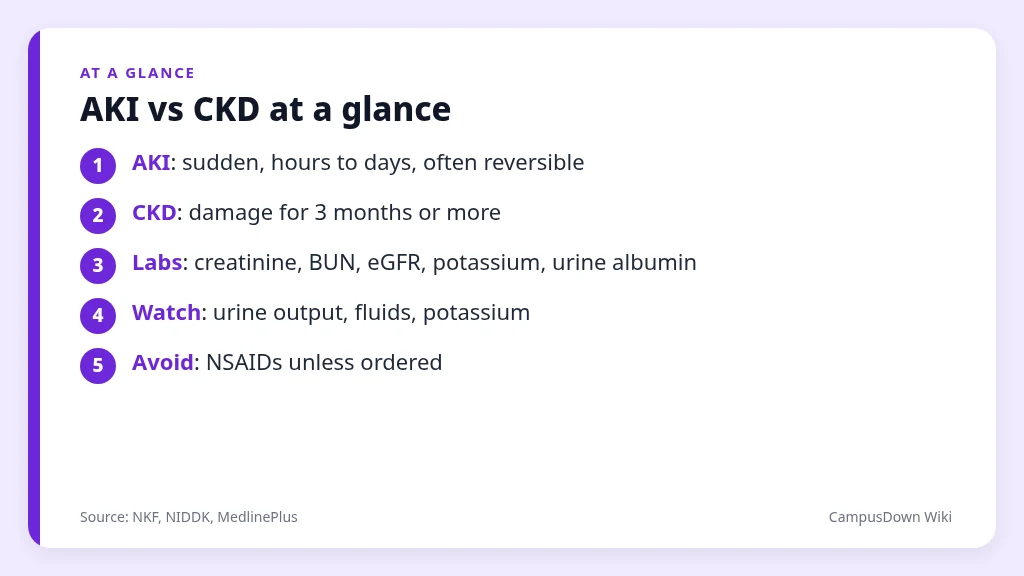
The NKF says AKI usually develops within 48 hours, but sometimes takes up to 7 days, and replaces the older term "acute renal failure." It says CKD means damaged or not working well for at least 3 months, and that CKD usually develops slowly. NIDDK adds that advanced, long-lasting CKD typically can't be reversed, and that people with CKD have a higher risk of AKI, which can worsen kidney function in the short and long term. See chronic kidney disease for the longer picture.

Common causes of AKI
The NKF and MedlinePlus list causes including:
- reduced blood flow from severe dehydration, hemorrhage, very low blood pressure, shock or sepsis; see types of shock
- direct kidney damage, such as acute tubular necrosis, infection or autoimmune disease
- urinary tract blockage, such as kidney stones
- medicines and contrast dye, including NSAIDs, certain antibiotics, some blood pressure medicines (the NKF names ACE inhibitors, ARBs and diuretics), and iodine-based contrast
- major surgery, trauma, burns and pregnancy complications
The NKF notes AKI usually happens through a combination of factors, especially in older adults, and that these medicines may not cause AKI alone but raise risk when combined with other stressors.
Common causes of CKD
The NKF lists diabetes, high blood pressure, heart disease, obesity, age over 60, family history, previous AKI and smoking as risk factors, along with glomerular disease, inherited conditions such as polycystic kidney disease, autoimmune disease, kidney stones and long-lasting infections.
Symptoms
- AKI (MedlinePlus, NKF): little or no urine, swelling in the legs, ankles or feet, fatigue, nausea, confusion, high blood pressure, shortness of breath and flank pain; sometimes no symptoms at all.
- CKD (NIDDK, NKF): most people have no symptoms early. Later: foamy urine, changes in how often you urinate, itching or dry skin, tiredness, nausea, appetite loss, weight loss, trouble concentrating, muscle cramps, swelling and shortness of breath. The NKF says symptoms alone can't tell you if you have CKD.
Labs and tests
- Serum creatinine and BUN: MedlinePlus lists BUN, serum creatinine, creatinine clearance and electrolytes (including potassium) and urinalysis for kidney failure. NIDDK says providers use blood creatinine to estimate GFR, and that as kidney disease gets worse, the creatinine level goes up.
- eGFR: NIDDK says a GFR of 60 or more is in the normal range and a GFR under 60 may mean kidney disease.
- Urine albumin-creatinine ratio (uACR): the NKF says CKD testing usually starts with eGFR and uACR, and that both are needed.
- Urine and imaging: MedlinePlus says a kidney or abdominal ultrasound is the preferred test for a urinary tract blockage; CT or MRI can also help.
Trend the numbers: a creatinine that jumped over days points to AKI; a slowly rising one over months points to CKD. For potassium in particular, see the potassium range guide.
Fluids and potassium
MedlinePlus says in AKI the amount you drink may be limited to the amount of urine you make, and diet may need to be low in protein, salt and potassium; diuretics may be used to remove fluid, and medicines through a vein may control blood potassium. For CKD, the NKF says nutrition needs change with the stage and lab results and that a kidney dietitian can advise on sodium, potassium, phosphorus and protein. Your role as a student is to monitor intake, output, daily weights, edema and lung sounds and report changes; see fluid volume excess vs deficit. Ask about water pills such as furosemide only as ordered.
Dialysis
MedlinePlus says dialysis does what healthy kidneys do, clearing wastes, extra salt and water, and can save a life if potassium is dangerously high. It is also used when mental status changes, pericarditis develops, too much fluid is retained, or waste products can't be removed. In AKI dialysis is usually short term, though sometimes permanent if kidney damage is great. The NKF adds that in AKI most dialysis treatments are only temporary until the kidneys can recover, and that after AKI you should have follow-up kidney tests, ideally within 3 months of finishing treatment.
Get help now if
Report very low or no urine output, new confusion, shortness of breath, severe weakness, an irregular heartbeat or chest pain to your instructor or the nurse immediately. High potassium can be dangerous.
Nursing watch points (student view)
- Urine output: amount and color, every measurement counted per policy
- Vital signs and weights, same scale and time each day
- Potassium and other electrolytes, plus creatinine and BUN trends
- Medicines: question NSAIDs and any nephrotoxic drugs, and verify orders against kidney function
- Hydration status and signs of overload
- Mental status and heart rhythm as potassium changes
For exam prep, see the lab values cheat sheet.
Study tips
- Memorize the time frame first, then causes in three buckets: not enough blood flow, direct damage or blockage.
- Make a two-column table of AKI vs CKD for cause, labs, symptoms and nursing priorities.
- Practice reading a creatinine trend and saying whether it looks acute or chronic.
- Connect each lab to a nursing action, such as reporting urine output or holding a nephrotoxic drug per order.
Questions for your instructor
- What urine output do we report on our unit?
- Which medicines get a kidney-function check before administration?
- How do we monitor patients on dialysis or at risk for high potassium?
- How does the exam distinguish AKI from CKD in case questions?
- Who teaches patients about avoiding NSAIDs?
Example scenario: the creatinine jump
- Who
- Jocasta, 26, a nursing student in Birmingham, Alabama, noticed an older patient's creatinine had climbed in two days after vomiting and a new pain medicine.
- What happened
- She wasn't sure whether it was chronic or acute, and worried she'd misread it.
- How it felt
- She felt unsure but curious.
- What they did
- She asked her nurse to walk her through the trend, the urine output and the medicine list, and learned that timing was the clue. The nurse told the provider about the urine output and the pain medicine. Jocasta added the trend to her study table.
- How it turned out
- Jocasta said timing made the difference click.
This is an illustrative example, not a real patient or a review.
Jocasta's story is an illustrative example. Real decisions come from the provider and your facility's policy.
Most-asked questions about AKI vs CKD
How is AKI vs CKD diagnosed?
Through blood and urine tests, trends over time and sometimes imaging; CKD needs findings for 3 months or more.
Why people ask: "aki vs ckd diagnosis" is #2 for "aki vs ckd" (US autocomplete, November 2026).
How is AKI vs CKD treated?
AKI treatment targets the cause and protects the kidneys while they recover; CKD treatment focuses on the cause, slowing progression and complications.
Why people ask: "aki vs ckd treatment" is #3 for "aki vs ckd" (US autocomplete, November 2026).
What are the symptoms of AKI vs CKD?
AKI may cause low urine, swelling, confusion and nausea; early CKD often has none.
Why people ask: "aki vs ckd symptoms" is #6 for "aki vs ckd" (US autocomplete, November 2026).
What are the nursing considerations for AKI vs CKD?
Monitor urine output, weights, electrolytes and medicines, and report changes promptly.
Why people ask: "aki vs ckd nursing" is #7 for "aki vs ckd" (US autocomplete, November 2026).
What labs differ in AKI vs CKD?
Both involve creatinine, BUN and eGFR; the timing and trend differ, and CKD testing also uses uACR.
Why people ask: "aki vs ckd labs" is #8 for "aki vs ckd" (US autocomplete, November 2026).
Does ultrasound help in AKI vs CKD?
MedlinePlus says ultrasound is the preferred test to check for a urinary blockage.
Why people ask: "aki vs ckd ultrasound" is #9 for "aki vs ckd" (US autocomplete, November 2026).
How does creatinine differ in AKI vs CKD?
In AKI it rises over days; in CKD it rises slowly over months to years.
Why people ask: "aki vs ckd creatinine" is #10 for "aki vs ckd" (US autocomplete, November 2026).
Related on CampusDown
You can learn more about the nursing student hub and check it for yourself in the chronic kidney disease guide. For the numbers in detail, see eGFR and kidney function.
Frequently asked questions
- Which is reversible?
- AKI may recover once the cause is treated; advanced CKD typically can't be reversed, per NIDDK.
- How long must damage last to be CKD?
- At least 3 months, per the NKF.
- Can NSAIDs cause AKI?
- MedlinePlus and the NKF list NSAIDs among medicines that can contribute.
- When is dialysis considered in AKI?
- When potassium is dangerously high, mental status changes, fluid builds up or wastes can't be cleared, per MedlinePlus.
- What should I report first?
- Very low urine output and any new confusion or breathing trouble.
AKI and CKD differ mostly by speed: sudden versus slow. Learn the timeline, the labs and the watch points, and report urine output changes early.
Browse more guides like this in the Nursing Student and NCLEX hub.
This article is for general education and does not replace advice from your own doctor, nurse or pharmacist.