
Your patient is back from dialysis, arm sleeve pushed up, and your shift is busy. Quick: which arm can you take a blood pressure on? And how do you know the fistula is still working?

An arteriovenous (AV) fistula is a patient's lifeline, and a few habits protect it. This guide uses OpenStax's Clinical Nursing Skills chapter 19.4, NIDDK's hemodialysis page and a nursing guideline on vascular access in adult hemodialysis patients (CANNT 2015). It is a study aid, not orders; your instructor and facility policy decide how you check and chart. To learn more about the kidney picture, take a closer look at AKI vs CKD.
What an AV fistula is
OpenStax says a more permanent hemodialysis access is a surgical connection between an artery and a vein, usually in the upper arm. If the artery and vein are sewn together directly, it is an AV fistula; if a graft (from a vessel or a synthetic one) is used, it is an AV graft. NIDDK adds that the vein grows wider and thicker, making it easier to place the dialysis needles, and calls the fistula the best long-term option because it provides the highest blood flow, is less likely to become infected or clot and lasts longer. Grafts, NIDDK says, are more likely to have infection and clot problems. A catheter in the neck, chest or groin can serve as temporary access.

The check: feel, listen, look
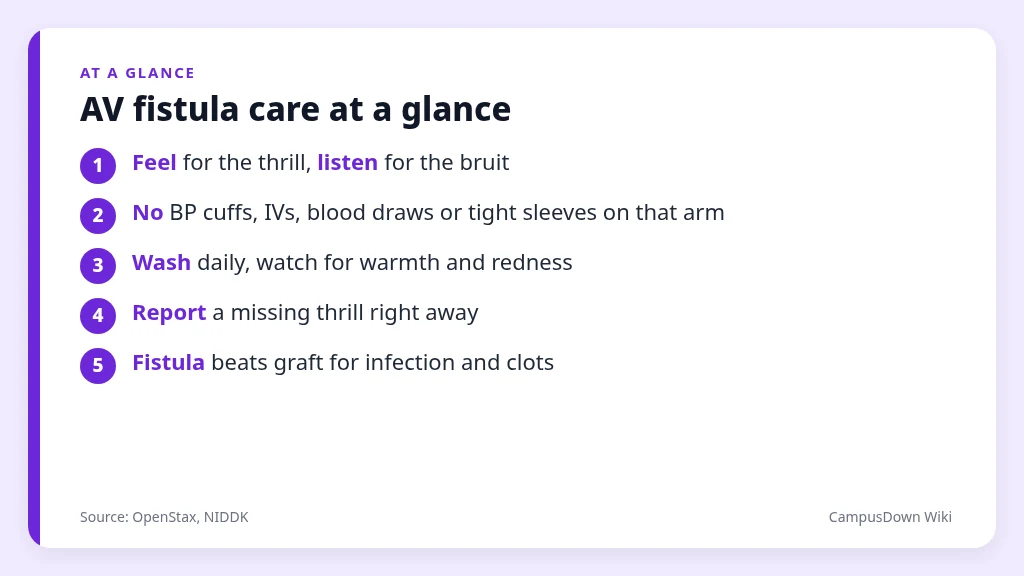
- Feel (thrill): OpenStax says to gently palpate the access site; a positive thrill feels like a vibration and means blood is flowing through it.
- Listen (bruit): use a stethoscope; a bruit sounds like a strong arterial whooshing.
- Look: the CANNT guideline describes assessment as inspection, auscultation and palpation, with the arm exposed, compared with the other arm, and positioned so you can see it. It lists signs of infection (warmth, redness, discharge, swelling), bruising, swelling and visible collateral veins.
OpenStax says that if the thrill and bruit are absent, the nurse or patient should contact the nephrologist and the dialysis unit or clinic. Treat that as an urgent report. Your instructor will teach the exact technique and how often to check.
Get help now if
A thrill that is weak or gone, a cold, pale or numb hand, new severe pain, redness or drainage at the site, fever or bleeding from the access needs immediate attention. Tell your instructor or the nurse right away and follow facility policy.
Arm precautions
OpenStax says to teach patients to avoid tight clothing or sleeves near the access, to avoid carrying purses or grocery bags on that arm, and that no blood pressure cuffs or tourniquets should be used on that arm. In the hospital, follow protocol to tell other staff and make sure no blood pressure, IV fluids or blood draws occur on the affected side. Many units use a sign or band; ask what yours does. See the head-to-toe assessment for where this fits in your exam.
Complications
OpenStax lists fistulas and grafts that can occlude, leaving the patient without access. Catheters carry risks of infection, sepsis and air embolism. The CANNT guideline also describes steal syndrome (poor blood flow to the hand) and the importance of comparing the access limb with the other limb. Report any of these.
After dialysis
OpenStax says that before dialysis patients may have fluid overload, high blood pressure and altered electrolytes, and right after dialysis they may be low in volume with low blood pressure and have nausea, vomiting, headache and cramps; many feel fatigued, so the nurse assesses and provides rest. Weigh and monitor as ordered; see fluid volume excess vs deficit and high potassium.
Teaching
NIDDK says to protect the access by washing the area with soap and warm water every day and checking for warmth or redness, and that when the access works well you can feel a vibration; the patient should let the dialysis center know if the vibration is gone. OpenStax says the patient should be taught to feel for the thrill too. NIDDK also notes that people on hemodialysis may need to limit sodium, high-phosphorus foods and the amount of liquid.
Charting and handoff
Chart which arm, whether thrill and bruit were present, the skin condition, any pain or numbness, and what you taught. Report concerns with a structured handoff; see SBAR and nursing charting basics. OpenStax also suggests giving a full report to the dialysis nurse.
Study tips
- Memorize "feel, listen, look."
- Learn the three nevers on the access arm: BP, IV and blood draw.
- Know the difference between a fistula, a graft and a catheter, and the main risk of each.
- Practice teaching in your own words: "Check for the buzz every day."
Questions for your instructor
- How do we mark the access arm on our unit?
- What do we do if the thrill is faint or absent?
- How is the access documented in our charting system?
- Who teaches patients about arm care?
- What is our policy for emergency situations when the access arm is the only IV site?
Example scenario: the missing buzz
- Who
- Barnaby, 29, a nursing student in Rochester, New York, helped a patient settle after dialysis and asked her to show him how she checked her fistula.
- What happened
- She said she hadn't felt the buzz that morning and hadn't wanted to bother anyone.
- How it felt
- He felt his stomach drop and worried about sounding alarmist.
- What they did
- He felt for a thrill himself, found it faint, told his nurse right away, and the nurse contacted the dialysis unit. Barnaby added the patient's own words to his SBAR.
- How it turned out
- Barnaby said asking her to show him first was what made her speak up.
This is an illustrative example, not a real patient or a review.
Barnaby's story is an illustrative example. Real situations follow your instructor and facility policy.
Most-asked questions about AV fistula nursing
What is AV fistula nursing care?
Check thrill and bruit, protect the arm from pressure, cuffs, sticks and tight clothing, watch for infection, and teach the patient.
Why people ask: "av fistula nursing care" is #2 for "av fistula nursing" (US autocomplete, November 2026).
How do nurses assess an AV fistula?
Feel for the thrill, listen for the bruit and look for redness, swelling or bruising, comparing both arms.
Why people ask: "av fistula nursing assessment" is #3 for "av fistula nursing" (US autocomplete, November 2026).
How do you document an AV fistula?
Note the arm, thrill and bruit, skin findings, symptoms, teaching and reports made, in your facility's format.
Why people ask: "av fistula nursing documentation" is #4 for "av fistula nursing" (US autocomplete, November 2026).
What are the nursing considerations for an AV fistula?
No BP, IV or blood draw on the access arm, and report a missing thrill immediately.
Why people ask: "av fistula nursing considerations" is #6 for "av fistula nursing" (US autocomplete, November 2026).
What are the nursing interventions for an AV fistula?
Assess each shift as ordered, protect the arm, monitor for infection and clotting signs, teach and report.
Why people ask: "av fistula nursing interventions" is #9 for "av fistula nursing" (US autocomplete, November 2026).
What is AV fistula post-op nursing care?
OpenStax says to assess for postsurgical complications and incision healing and to check the thrill.
Why people ask: "av fistula post op nursing care" is #8 for "av fistula nursing care" (US autocomplete, November 2026).
How do you care for an AV fistula at home?
Wash daily with soap and warm water, check for warmth or redness, feel for the vibration and call the dialysis center if it is gone.
Why people ask: "how to care for av fistula" is #10 for "av fistula nursing care" (US autocomplete, November 2026).
Related on CampusDown
You can learn more about the nursing student hub and check it for yourself in the chronic kidney disease guide. For reports in detail, see SBAR handoff.
Frequently asked questions
- Can I take a blood pressure on the fistula arm?
- No; OpenStax says no cuffs or tourniquets on that arm.
- What is a thrill?
- A vibration felt over the access that shows blood is flowing.
- What is a bruit?
- A strong whooshing sound heard with a stethoscope.
- What if the thrill is missing?
- Contact the nephrologist and the dialysis unit; treat it as urgent.
- Is a fistula better than a graft?
- NIDDK says it is less likely to become infected or clot and lasts longer.
A fistula needs feel, listen, look and the three nevers on that arm. Know the signs of trouble and report a missing thrill right away.
Browse more guides like this in the Nursing Student and NCLEX hub.
This article is for general education and does not replace advice from your own doctor, nurse or pharmacist.