
Your skills lab starts in five minutes, and you realize you can't remember whether you check the lungs before the abdomen. How do you build an order that sticks under pressure?
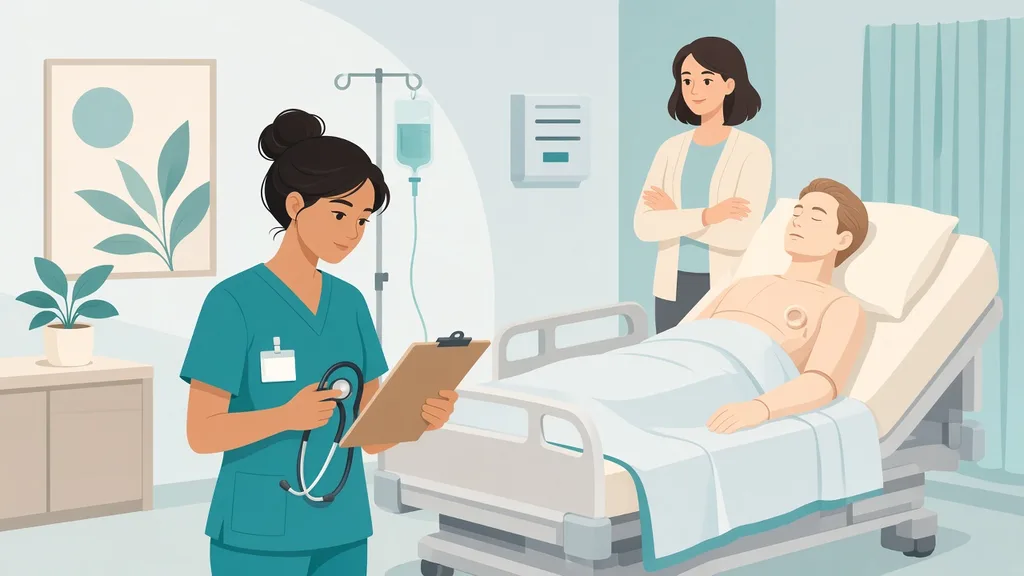
A head-to-toe assessment is less about memorizing every step and more about using the same order every time so nothing gets skipped. This checklist follows OpenStax's Medical-Surgical Nursing and Clinical Nursing Skills textbooks. It is a study aid; follow your school's skills checklist and your clinical site's policies and forms. To learn more about the thinking behind the data, take a closer look at the nursing process.
What it is, and when it's done
OpenStax describes a head-to-toe assessment as a systematic review of the patient's major body systems, often done on admission or at the beginning of a shift, to establish a baseline and identify issues that may need further investigation. A focused assessment, by contrast, starts with the patient's chief complaint and centers the exam on the reason for care; for example, a sore throat focuses on the head, eyes, ears, nose and throat.

Safety and surroundings first
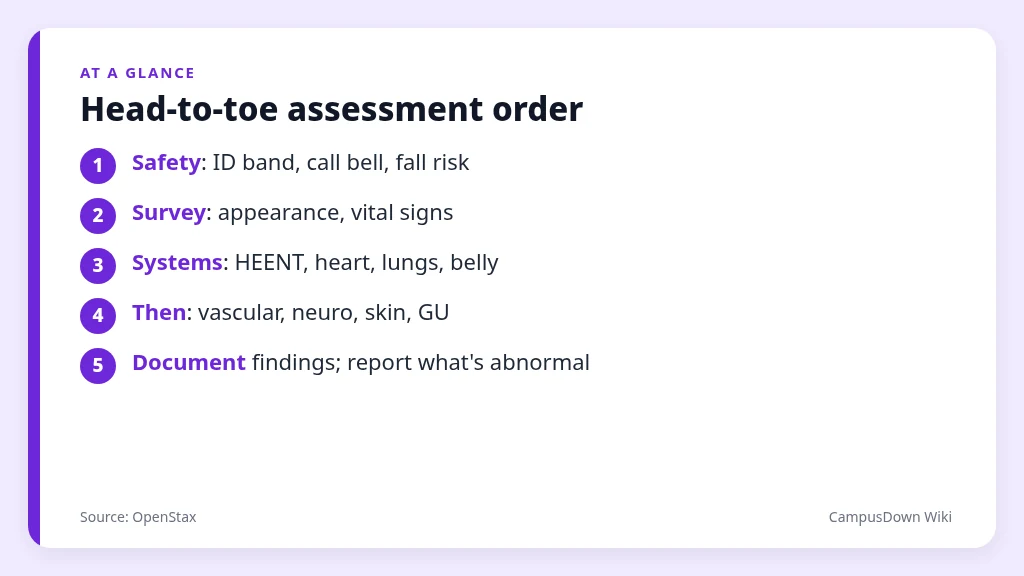
OpenStax describes a safety and surroundings assessment as critical to preventing adverse outcomes. It includes confirming identity by wristband, assessing fall risk and ambulatory aids, environmental concerns and other safety risks, and checking details such as:
- IV sites, drains and pumps
- oxygen delivery
- allergy wristband
- isolation precautions
- bed position, side rails and call bell within reach
Make this your habit before you touch anything else. For handoff use, see SBAR handoff.
The order of systems
OpenStax lists the bedside assessment as: general survey, HEENT, cardiac, respiratory, abdominal (gastrointestinal), peripheral vascular, neuromuscular, skin, genitourinary and activity. Use this as a template.
1. General survey
Height, weight, physical appearance, chronic wounds, hygiene and behavior, plus vital signs (blood pressure, heart rate, oxygen saturation, temperature and respiratory rate). Consider verbal and nonverbal communication and whether the patient needs a communication aid, such as a translation device. OpenStax's general survey chapter emphasizes noticing appearance, nonverbal cues such as pain, anger or fear and mobility.
2. HEENT
- Head: inspect and palpate for abnormalities; note hair changes.
- Eyes: pupils equal, round, reactive to light and accommodation (PERRLA); visual acuity and whether glasses are needed; conjunctivae.
- Ears: hearing loss, and whether hearing aids are present and worn.
- Nose: smell changes, congestion, irritation.
- Throat: gums, teeth, mucosa, tongue, pharynx and tonsils.
3. Cardiac
Inspection, palpation and auscultation: rhythm, heart sounds, arterial pulses, capillary refill, edema, circulation and sensation, cyanosis. Pair this with ECG rhythm basics when you're ready.
4. Respiratory
Inspection, palpation, auscultation and percussion: breath sounds, effort and quality of respirations, cough, sputum, masses, current respiratory treatment and oxygen delivery.
5. Abdominal
Appearance, bowel sounds and stool, plus nutrition and appetite. OpenStax lists inspection, palpation, auscultation and percussion for this system.
6. Peripheral vascular
Pain, pallor, temperature regulation, pulses, paresthesia and paralysis.
7. Neuromuscular
Orientation (person, place, time), level of consciousness, Glasgow Coma Scale, speech, gait, strength and movement of the extremities, and pain.
8. Skin
Turgor, integrity, color, temperature, chronic wounds and breakdown, and a risk tool such as the Braden scale for pressure injury risk. OpenStax notes that in older adults, skin turgor is best checked over the sternum or the antecubital area rather than the back of the hand.
9. Genitourinary
Character of voiding, urinary difficulty, a catheter if present, and reproductive health concerns relevant to the patient.
10. Activity
What the patient can do and what assistance they need.
Documentation and reporting
OpenStax says findings should be documented in the physical assessment area of the chart. Use the exact words you observed rather than "normal" without a description, and keep to your facility's template. See nursing charting and documentation. When something is abnormal or changed from baseline, tell your instructor or nurse; for lab context, see the lab values cheat sheet.
How to practice
- Say it out loud in the same order, like a script.
- Practice on a classmate or mannequin with a checklist, then without.
- Make a one-page sheet with the ten systems in order, adding the abnormal findings you've learned.
- Link findings to clinical judgment: for each finding, ask what it might mean and what you'd do next; see Tanner's model.
- Practice the fluid findings with the fluid volume guide.
Questions for your instructor
- Which order does our program expect for the skills check-off?
- What phrases do we use to describe normal findings?
- When do we perform a focused assessment instead of the full one?
- Which findings do we report immediately on clinical days?
- Where do we document and in what format?
Example scenario: the skipped step
- Who
- Yusuf, 21, a first-semester nursing student in Phoenix, Arizona, kept skipping the safety check and the lungs during his skills check-off.
- What happened
- He thought he knew each piece but fumbled the order when someone watched.
- How it felt
- He felt embarrassed and discouraged.
- What they did
- He wrote the ten systems on an index card, practiced saying them out loud on a classmate and added the safety check at the start. At his retake he followed the same sequence and received feedback on only small details.
- How it turned out
- Yusuf said the order mattered more than memorizing the details.
This is an illustrative example, not a real patient or a review.
Yusuf's story is an illustrative example. Always follow your program's own requirements.
Most-asked questions about the head-to-toe assessment
What is the head-to-toe assessment in nursing?
A systematic review of major body systems, often done on admission or at the start of a shift to set a baseline.
Why people ask: "head to toe assessment nursing" is #2 for "head to toe assessment" (US autocomplete, November 2026).
Is there a head-to-toe assessment checklist?
Yes; see the order above, and follow your school's checklist.
Why people ask: "head to toe assessment checklist" is #3 for "head to toe assessment" (US autocomplete, November 2026).
How do I make a head-to-toe assessment cheat sheet?
Put the systems in order on one page with key findings for each, and update it as you learn.
Why people ask: "head to toe assessment cheat sheet" is #4 for "head to toe assessment" (US autocomplete, November 2026).
What belongs in a head-to-toe assessment template?
Safety check, general survey, HEENT, cardiac, respiratory, abdominal, peripheral vascular, neuromuscular, skin, GU and activity.
Why people ask: "head to toe assessment template" is #5 for "head to toe assessment" (US autocomplete, November 2026).
What are the steps in a head-to-toe assessment?
Follow the ordered list above; your program may add or reorder steps.
Why people ask: "head to toe assessment step by step" is #6 for "head to toe assessment" (US autocomplete, November 2026).
Where can I find a head-to-toe assessment script?
Your program's lab guide is the best source; practicing the order out loud builds your own script.
Why people ask: "head to toe assessment script" is #8 for "head to toe assessment" (US autocomplete, November 2026).
Related on CampusDown
You can learn more about the nursing student hub and check it for yourself in the nursing process guide. For documentation in detail, see nursing charting.
Frequently asked questions
- When is a head-to-toe assessment done?
- Often on admission or at the beginning of a shift, per OpenStax.
- What's the difference from a focused assessment?
- A focused assessment centers on the chief complaint; a head-to-toe covers all major systems.
- What should I check first?
- Safety and surroundings, including identity by wristband, then the general survey.
- Do I need to follow my school's order?
- Yes. Use your program's checklist for check-offs and your site's policy in clinical.
- What should I report?
- Anything abnormal or changed from baseline, to your instructor or nurse.
A head-to-toe assessment works when the order is automatic. Start with safety, move through the systems the same way each time, document what you see and report what's abnormal.
Browse more guides like this in the Nursing Student and NCLEX hub.
This article is for general education and does not replace advice from your own doctor, nurse or pharmacist.