
Who would talk to your doctors if you couldn't? Without a signed document, NIA says state law usually decides, and the person it picks may not be the one you'd choose.

This guide is based on the National Institute on Aging (NIA) and Medicare.gov. It explains in detail how a durable power of attorney for health care works and how to choose the right person. State rules vary greatly; confirm yours with your state legal aid office or bar association.
What a health care power of attorney is
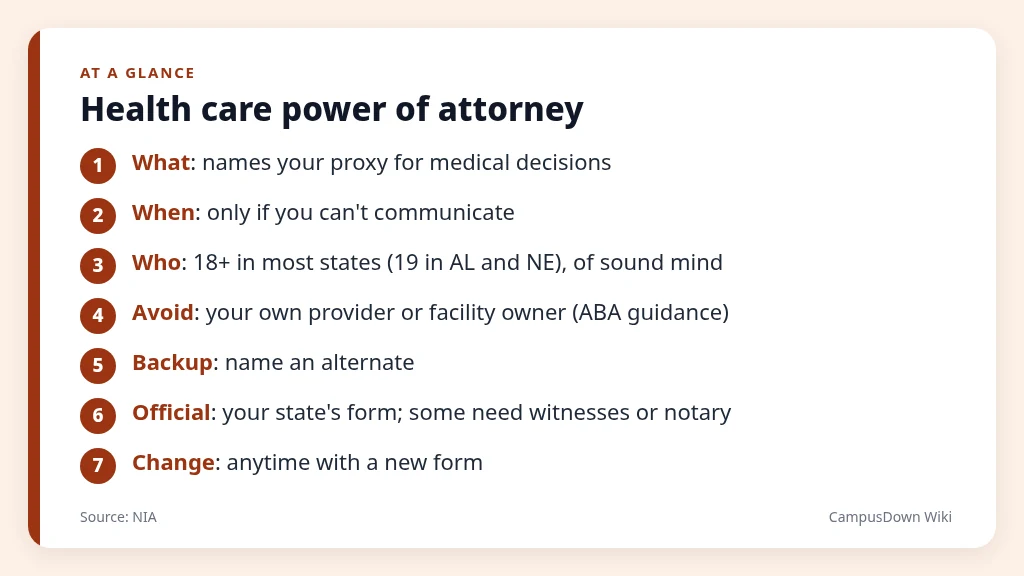
NIA says a durable power of attorney for health care is an advance directive that names your health care proxy, also called a representative, surrogate or agent. Your proxy can make decisions only if you're too sick to make them yourself. People also call it a medical power of attorney or health care power of attorney.

Health care power of attorney vs living will
- Living will: your written treatment wishes.
- Health care power of attorney: the person who speaks for you.
NIA says you can choose a proxy in addition to or instead of a living will. A proxy helps with situations no document can predict, such as a serious car accident or stroke. You can learn more in our advance directive vs living will guide.
A financial power of attorney is a separate document for money matters. Ask an attorney if you need one.
Who can be your proxy
NIA says that in most states a proxy must be 18 or older; in Alabama and Nebraska, 19 or older. A proxy must be of sound mind. Many people choose a family member, but a trusted friend, neighbor or lawyer can serve.
The American Bar Association generally recommends not choosing:
- Your health care provider, or their spouse or employee
- The owner or operator of your health or residential care facility
- Someone at a government agency financially responsible for your care
- A professional evaluating your ability to make decisions
- Your court-appointed guardian or conservator
- Someone who already serves as proxy for 10 or more other people
Questions to ask before choosing
NIA suggests asking yourself:
- Am I comfortable talking with this person about my wishes?
- Will they honor my wishes, even if they'd choose differently?
- Can they handle conflicting opinions from family and doctors?
- Do they live nearby, or would they travel if needed?
Then ask them directly if they're willing to take on the role. Name an alternate proxy too.
What your proxy can decide
NIA says responsibilities, which vary by state, can include:
- The types of medical care, procedures and treatments you receive
- Which providers and where you get care
- Access to your medical and hospital records
- Decisions about autopsy, organ and tissue donation
- Becoming your guardian if one is needed
You can widen or limit their authority, such as requiring them to talk with certain family members first. NIA suggests leaving some flexibility so they can respond to the unexpected.
Get help now if
NIA says you may need your form witnessed or notarized, depending on your state. Read the directions closely. A form that isn't signed correctly may not be accepted when it matters.
How to make it official
- Get your state's durable power of attorney for health care form. Many are free; see the sources in our advance directive guide.
2. Fill it out, then sign with witnesses or a notary as your state requires. 3. Give your proxy a copy of the signed form, your living will and other key papers. 4. Share your providers' names and contacts with your proxy, and your proxy's contact with your providers. 5. Talk with your proxy at least once a year.
Medicare Part B covers voluntary advance care planning; it's $0 at your Welcome to Medicare or yearly Wellness visit if your provider accepts assignment. Bring your questions there.
Changing your proxy
NIA says you can change your proxy at any time. Fill out a new form, and tell your family, the old and new proxy, and your health care team.
Example scenario: the sister who asked first
- Who
- Octavius, 71, a retired high school band director in Albuquerque, New Mexico, had early memory changes his doctor was monitoring. He'd always assumed his wife would decide for him, but she had died two years earlier. His sister, Pilar, 68, lived ten minutes away.
- What happened
- His two adult children lived out of state and disagreed about almost everything. Octavius worried they'd argue over him in a hospital.
- How it felt
- He felt anxious about burdening anyone and guilty about not picking one of his kids. Pilar was honored but nervous about getting it wrong.
- What they did
- Octavius asked Pilar if she was willing, then named his son as alternate. He completed New Mexico's state form, followed the signing directions, and gave copies to Pilar, both children and his doctor. He also wrote a short letter about what mattered most to him: music, his dog and staying at home as long as possible.
- How it turned out
- Pilar said the letter made her feel she'd know his voice if the time came. His children said they were relieved not to be guessing, and the three of them now call each other after his yearly checkups.
This is an illustrative example, not a real patient or a review.
Octavius's story is an illustrative example. Your state's form and signing rules may differ.
Most-asked questions about health care power of attorney
Where do I get a healthcare power of attorney form?
Many states offer free forms through the Attorney General, your Area Agency on Aging, or groups like the American Bar Association.
Why people ask: "healthcare power of attorney form" is #2 for "healthcare power of attorney" (US autocomplete, November 2026).
Healthcare power of attorney vs living will: which do I need?
Many people have both. The power of attorney names who decides; the living will states what you want.
Why people ask: "healthcare power of attorney vs living will" is #5 for "healthcare power of attorney" (US autocomplete, November 2026).
What does healthcare power of attorney mean?
It's a legal document naming someone to make medical decisions for you only if you can't communicate.
Why people ask: "healthcare power of attorney meaning" is #6 for "healthcare power of attorney" (US autocomplete, November 2026).
Is there a medical power of attorney form for Texas?
Yes, states including Texas have their own forms. Use your state's current form and follow its witness or notary rules.
Why people ask: "medical power of attorney form texas" is #3 for "medical power of attorney" (US autocomplete, November 2026).
Is there a medical power of attorney form for California?
Yes. Use California's current form and follow its signing directions closely.
Why people ask: "medical power of attorney california" is #5 for "medical power of attorney" (US autocomplete, November 2026).
Is a medical power of attorney form available as a PDF?
Most state forms can be downloaded and printed. Check that the form is current and legally recognized in your state.
Why people ask: "medical power of attorney form pdf" is #6 for "medical power of attorney" (US autocomplete, November 2026).
Related on CampusDown
Caring for a parent? Take a closer look at early signs of dementia, POLST forms and caregiver burnout.
Frequently asked questions
- Can my proxy make decisions while I can still speak for myself?
- No. NIA says a proxy decides only when you're too sick to decide yourself.
- Can I name more than one person?
- NIA says you can name an alternate proxy as a backup.
- Do I need a lawyer?
- Not necessarily. Free state forms exist, but read the witness and notary directions closely.
- Can I change my health care proxy?
- Yes, any time, with a new form. Tell everyone involved, and check it for yourself that your doctor's office has the new copy.
Choosing a health care proxy is choosing who carries your voice. Ask them first, put it in writing on your state's form, share copies, and keep talking with them over the years.
Browse more guides like this in the Senior Health and Medicare hub.
This article is for general education and does not replace advice from your own doctor, nurse or pharmacist.