
If you couldn't speak for yourself tomorrow, would your family know what you want? Most people assume they would. NIA cites a study in which people guessed nearly one out of three end-of-life decisions for their loved one incorrectly.

This guide is based on the National Institute on Aging (NIA) and Medicare.gov. It explains in detail what an advance directive is, how a living will differs, and how to make yours official. Laws vary by state; talk with your doctor and, if you wish, an attorney about your own situation.
Advance directive vs living will: the short answer
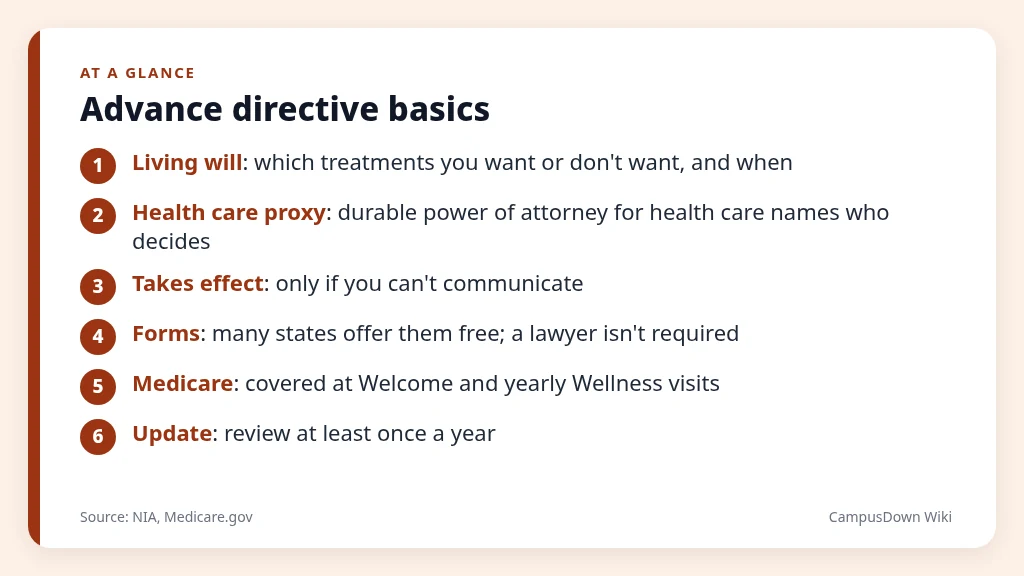
NIA says advance directives are legal documents that give instructions for medical care and only go into effect if you cannot communicate your own wishes. The two most common are:
- Living will: tells doctors which common treatments you would want or avoid, and under which conditions.
- Durable power of attorney for health care: names your health care proxy (also called a representative, surrogate or agent) to make decisions if you can't.
So a living will is one kind of advance directive. Medicare.gov describes an advance directive as having 2 parts: the health care proxy and the living will. A proxy can be chosen in addition to or instead of a living will. You can learn more about naming one in our health care power of attorney guide.

What a living will usually covers
Medicare.gov says a living will describes which treatments you want if your life is threatened, including:
- Dialysis
- Breathing machines
- Resuscitation (CPR)
- Tube feeding
It can also state whether you want your organs or tissues donated. NIA adds that you can document wishes about brain donation and learn about palliative and hospice care; see the Medicare hospice benefit.
Who decides if you don't have one
NIA says that without an advance directive, state law decides who makes medical decisions for you. This is typically your spouse, your parents if available, or your adult children. If you're unmarried and haven't named your partner, your partner could be excluded. Some states let a close friend help; others may assign a physician. Your state legal aid office or state bar association can explain your state's rules.
Get help now if
NIA says an advance directive is legally recognized but not legally binding. A provider may decline to follow it if it goes against their conscience, the institution's policy or accepted health care standards. In that case they must tell your proxy right away and consider transferring your care. Conversations with your family matter as much as the paper.
Other orders: DNR, DNI and POLST
NIA lists medical orders you can discuss with a doctor:
- DNR (do not resuscitate): no CPR if your heart and breathing stop. Also called DNAR or AND (allow natural death).
- DNI (do not intubate): no ventilator.
- DNH (do not hospitalize): for long-term care residents near the end of life.
- Out-of-hospital DNR: tells emergency crews your wishes outside the hospital.
- POLST or MOLST: portable medical orders for people who are seriously ill or frail, which professionals can act on immediately.
These are medical orders signed by a clinician, not forms you fill out alone. You can take a closer look in our POLST form guide.
How to make your advance directive, step by step
NIA suggests:
- Reflect on your values and what matters most.
2. Talk with your doctor about likely decisions given your health. 3. Choose a proxy you trust, and ask if they're willing. 4. Complete the forms for your state. 5. Share copies with your proxy, doctors and lawyer. 6. Review at least once a year, and after retirement, a move, or a big health change.
Where to get free forms
NIA says you can set up advance directives for little or no cost. Many states have free forms. Options include:
- Your State Attorney General's Office
- Your local Area Agency on Aging via the Eldercare Locator, 800-677-1116
- National groups such as AARP, the American Bar Association and the National Hospice and Palliative Care Organization
- The VA, which offers an advance directive for veterans
- Free programs such as PREPARE for Your Care (English and Spanish) and The Conversation Project (English, Spanish and Chinese)
NIA says a lawyer can help but isn't required. If a website charges fees, remember free options exist, and check that its forms are legally recognized in your state. If you split time between two states, NIA suggests completing each state's form.
Medicare coverage for advance care planning
Medicare.gov says Part B covers voluntary advance care planning:
- $0 when it's part of your "Welcome to Medicare" or yearly "Wellness" visit and your provider accepts assignment.
- As part of other treatment, the Part B deductible and 20% coinsurance apply.
Bring your questions to your annual wellness visit. If a hospital stay is coming, keep copies handy for discharge planning too.
Example scenario: the conversation on the porch
- Who
- Cosmo, 74, a retired bus mechanic in Dayton, Ohio, had high blood pressure and a brother who had spent weeks on a ventilator after a stroke. His daughter, Evangeline, 45, a school librarian, kept asking him to "get something in writing."
- What happened
- Cosmo kept saying his kids "knew what he'd want." When Evangeline asked whether he'd want a breathing machine, he realized he'd never actually said it out loud.
- How it felt
- He felt uneasy and a little embarrassed. Evangeline was afraid of guessing wrong and arguing with her brother in a hospital hallway.
- What they did
- At his yearly wellness visit, Cosmo asked his doctor about likely decisions after a stroke. He completed Ohio's living will and health care power of attorney forms, named Evangeline with her brother as backup, and gave copies to both and to his doctor's office.
- How it turned out
- Cosmo said the hardest part was the first ten minutes on the porch. Evangeline said she slept better knowing his words, not her guesses, would guide any decision. They agreed to look at the forms again each spring.
This is an illustrative example, not a real patient or a review.
Cosmo's story is an illustrative example. Your choices and your state's forms may differ.
Most-asked questions about advance directives and living wills
What is the difference between an advance directive and a living will?
A living will is one type of advance directive. An advance directive can also include a durable power of attorney for health care that names your proxy.
Why people ask: "advance directive vs living will" is #6 for "advance directive" (US autocomplete, November 2026).
Where can I get an advance directive form?
Many states offer free forms through the Attorney General, your Area Agency on Aging, or groups like AARP and the American Bar Association.
Why people ask: "advance directive form" is #2 for "advance directive" (US autocomplete, November 2026).
What does advance directive mean?
It's a legal document with instructions for your medical care that only takes effect if you can't communicate your wishes.
Why people ask: "advance directive means" is #3 for "advance directive" (US autocomplete, November 2026).
Is there an advance directive in Spanish?
Yes. NIA notes PREPARE for Your Care is available in English and Spanish, and The Conversation Project offers Spanish guides.
Why people ask: "advance directive in spanish" is #5 for "advance directive" (US autocomplete, November 2026).
What is a living will?
A legal document telling doctors which treatments you would want or avoid if you can't decide, and under which conditions.
Why people ask: "living will definition" is #3 for "living will" (US autocomplete, November 2026).
How is a living will different from a living trust?
A living will is about medical care. A living trust is a financial and estate document, so ask an attorney about that one.
Why people ask: "living will vs living trust" is #4 for "living will" (US autocomplete, November 2026).
Advance directive vs living will vs power of attorney: how do they fit?
The advance directive is the umbrella. The living will states treatment wishes, and the health care power of attorney names who decides.
Why people ask: "advance directive vs living will vs power of attorney" is #2 for "advance directive vs living will" (US autocomplete, November 2026).
Related on CampusDown
Planning ahead for care? You can learn more about assisted living vs nursing homes and caregiver burnout.
Frequently asked questions
- Do I need a lawyer to make a living will?
- No. NIA says a lawyer can help but isn't required, and many states offer free forms.
- When does an advance directive take effect?
- Only if you can't communicate your own wishes, according to NIA.
- Does Medicare pay for advance care planning?
- Yes. Part B covers it, at no cost during your Welcome to Medicare or yearly Wellness visit if your provider accepts assignment.
- How often should I update my advance directive?
- NIA suggests reviewing it at least once a year and after major life events.
An advance directive puts your voice in the room when you can't speak. Name a proxy, write down your treatment wishes, share copies, and talk it through with your family and your doctor.
Browse more guides like this in the Senior Health and Medicare hub.
This article is for general education and does not replace advice from your own doctor, nurse or pharmacist.