
When paramedics arrive, how would they know what you want? In an emergency, crews are expected to try everything reasonably possible to save a life. For some people living with serious illness, that isn't the care they'd choose.
This guide is based on the National POLST Collaborative's patient FAQs and the National Institute on Aging (NIA). It explains in detail what a POLST form does, how it differs from a DNR, and who should consider one. POLST is a medical order; it starts with a conversation with your own clinician.
What POLST means
National POLST says POLST stands for "portable medical orders." Nationally it's no longer an acronym, and states use different names. NIA lists POLST, MOLST (medical orders for life-sustaining treatment) and POST (physician orders for scope of treatment). National POLST says programs are run by each state, and its directory covers every state and DC.

What's on a POLST form
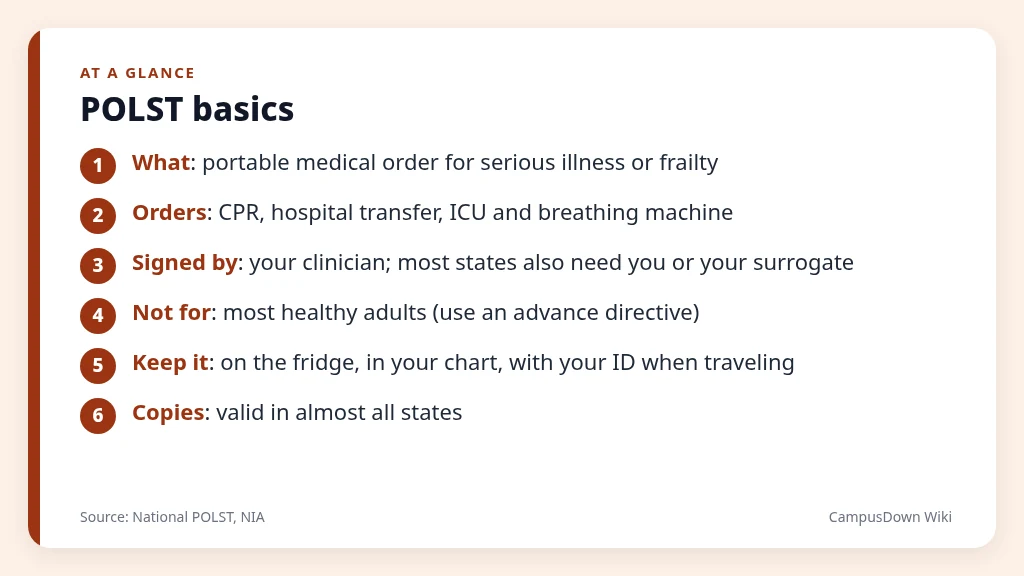
National POLST says orders on the form include:
- Whether you want CPR attempted
- Whether you want to go to the hospital or stay where you are
- Whether you want intensive care and a breathing machine, if needed
The form also records your general goals of care, so providers can match other treatments, such as antibiotics or artificial nutrition, to those goals.
POLST vs DNR vs advance directive
| POLST | DNR | Advance directive | |
|---|---|---|---|
| What it is | Medical order | Medical order | Legal document |
| Who it's for | Serious illness or advanced frailty | People who don't want CPR | Any adult |
| What it covers | CPR, hospital transfer, ICU and breathing machine, goals | CPR only | Treatment wishes and/or a proxy |
| Who completes it | Your clinician, with you | Your clinician | You |
NIA says POLST serves as a medical order in addition to your advance directive. Take a closer look at the legal side in our advance directive vs living will guide and our health care power of attorney guide.
Who should have one
National POLST says to talk with your provider if you are seriously ill or have advanced frailty. If you're healthy, an advance directive is appropriate instead. Some states don't allow providers to sign POLST forms for healthy patients, because it's a medical order on the clinician's license.
For people with significant disabilities, National POLST says POLST should be considered only when functioning has become severely impaired by a worsening health condition.
How a POLST form gets completed and signed
- It comes from your health care provider, not a download you fill out alone.
- It should never be completed without a conversation about your diagnosis, prognosis, options and goals.
- Your provider must sign it to be valid. Most states also require you or your surrogate to sign.
Get help now if
National POLST says patients shouldn't be handed a POLST form to complete on their own. If anyone offers you a "POLST" without a real conversation about your health, ask your own clinician first.
Where to keep it
National POLST suggests:
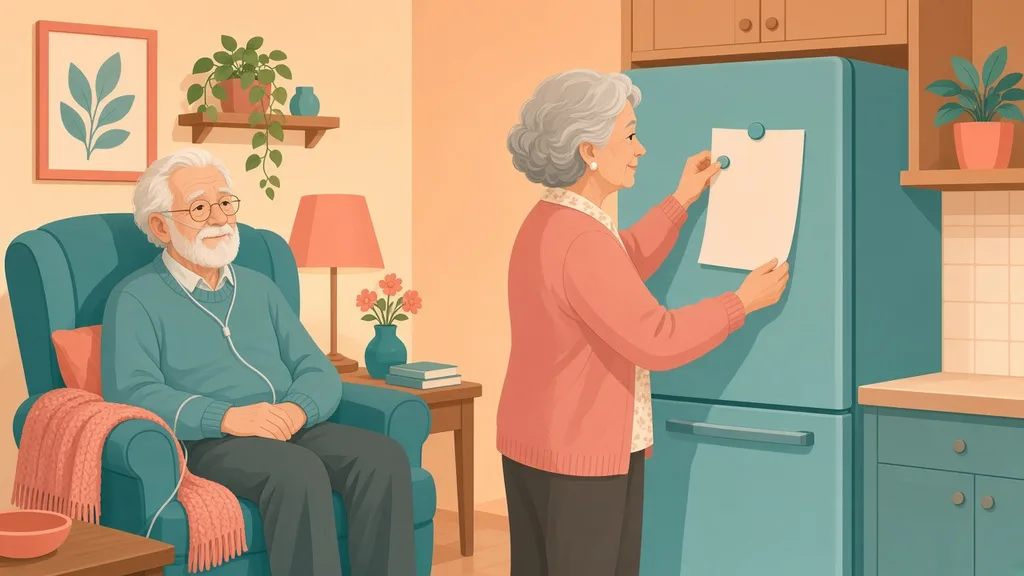
- At home: on the refrigerator or in the medicine cabinet.
- In a facility: in your chart; you get the original if you move between care settings.
- Traveling: a copy in your purse or wallet near your ID.
- Tell your family and friends so they can point emergency crews to it.
Your provider keeps a copy in your medical record. If you're heading home from the hospital, ask about it during discharge planning, and check it for yourself before you leave.
Example scenario: the form on the refrigerator
- Who
- Horatio, 86, a retired railroad dispatcher in Tacoma, Washington, had advanced heart failure and had been to the emergency room three times in a year. His wife, Adelaide, 82, had cared for him at home through each scare.
- What happened
- After the last visit, Horatio told Adelaide he never wanted to be on a breathing machine again. She didn't know whether that would matter if she called 911.
- How it felt
- Adelaide felt torn between honoring him and fearing she'd be blamed. Horatio felt anxious that he would lose his say.
- What they did
- At his cardiology visit, his clinician talked through what CPR and intensive care would likely mean with his heart condition. Horatio chose orders that matched his goal of staying comfortable at home, and he and the clinician signed the POLST form. Adelaide put the original on the refrigerator and a copy in his wallet.
- How it turned out
- Months later, when paramedics came for a fall, they saw the form right away. Adelaide said she felt relieved that Horatio's own choices were speaking for him. They later talked with his doctor about hospice care at home.
This is an illustrative example, not a real patient or a review.
Horatio's story is an illustrative example. Your clinician will help you decide what fits your health and goals. If comfort care at home is your goal, see the Medicare hospice benefit.
Most-asked questions about POLST forms
Is there a POLST form PDF I can print?
State programs post sample forms, but a POLST form is a medical order your clinician completes and signs with you.
Why people ask: "polst form pdf" is #2 for "polst form" (US autocomplete, November 2026).
What does a POLST form mean?
It's a portable medical order that tells all providers what treatment you want in an emergency, given your current condition.
Why people ask: "polst form meaning" is #4 for "polst form" (US autocomplete, November 2026).
Are POLST forms different by state?
Yes. Programs are run by each state and may use names like MOLST or POST; National POLST keeps a state directory.
Why people ask: "polst forms by state" is #6 for "polst form" (US autocomplete, November 2026).
What's the difference between a POLST form and an advance directive?
An advance directive is a legal document any adult can make; a POLST is a medical order for people who are seriously ill or frail.
Why people ask: "polst form vs advance directive" is #8 for "polst form" (US autocomplete, November 2026).
POLST vs DNR: what's the difference?
A DNR covers only CPR. A POLST also covers hospital transfer, intensive care and breathing machines, plus your goals of care.
Why people ask: "polst form vs dnr" is #10 for "polst form" (US autocomplete, November 2026).
Does a POLST include DNR and DNI choices?
It records whether CPR is attempted and whether you want intensive care with a breathing machine, if needed.
Why people ask: "polst vs dnr dni" is #3 for "polst vs dnr" (US autocomplete, November 2026).
Is a copy of a POLST valid?
National POLST says faxed or photocopied forms are valid in almost all states.
Why people ask: "is a copy of a polst valid" is #10 for "polst vs dnr" (US autocomplete, November 2026).
Related on CampusDown
Caring for someone with dementia? You can learn more about memory care units and caregiver burnout.
Frequently asked questions
- Can I fill out a POLST form myself?
- No. National POLST says your clinician completes and signs it after talking with you.
- Do healthy adults need a POLST?
- Usually not. National POLST says an advance directive is appropriate for healthy adults.
- Does a POLST replace my advance directive?
- No. NIA says it serves as a medical order in addition to your advance directive.
- Where should I keep my POLST at home?
- On the refrigerator or in the medicine cabinet, and tell family where it is.
A POLST form turns a conversation with your clinician into orders emergency crews can follow. If you or a loved one is seriously ill or frail, ask about it at your next visit and keep it where it can be found.
Browse more guides like this in the Senior Health and Medicare hub.
This article is for general education and does not replace advice from your own doctor, nurse or pharmacist.