
What does Medicare actually cover when a loved one chooses hospice? Families often wait until the final days to call hospice, partly because they don't understand the benefit. Knowing the rules can mean more weeks of comfort, support and help at home.

This guide is based on Medicare.gov's hospice coverage page and the official Medicare Hospice Benefits booklet. It explains in detail who qualifies, what's covered and what families pay. Talk with your doctor and hospice team about your specific situation.
Who qualifies
You must have Medicare Part A and meet all of these:
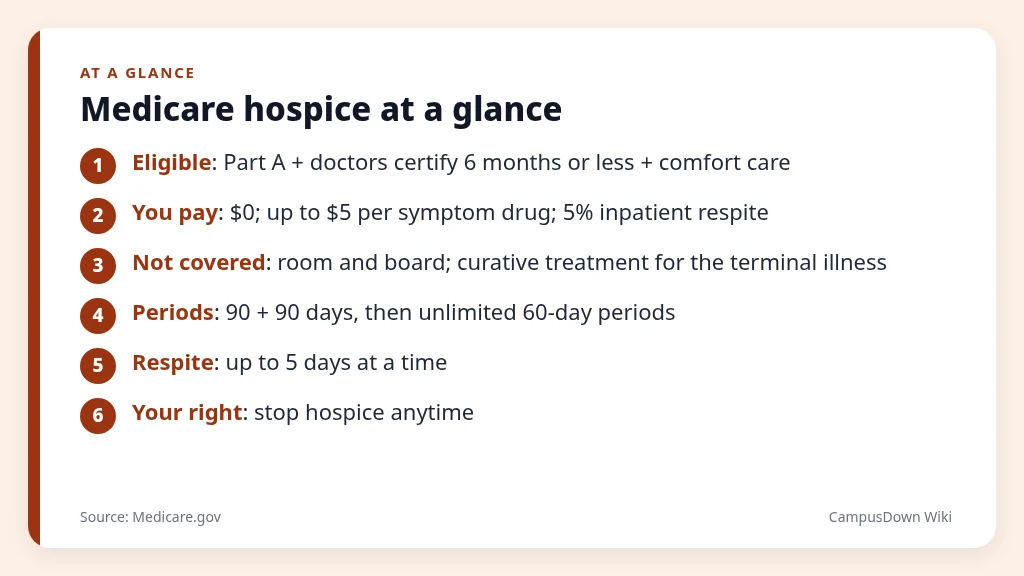
- Your hospice doctor and regular doctor (if you have one) certify you're terminally ill, with a life expectancy of 6 months or less.
- You accept comfort (palliative) care instead of curative treatment for your illness.
- You sign a Hospice Election Statement choosing hospice instead of other Medicare treatments for the terminal illness.
Before choosing, the booklet says you can get a one-time consultation with a hospice medical director or doctor, even if you decide not to enroll.

What hospice covers
The hospice team's plan of care can include:
- Doctor services and nursing care
- Medical equipment (wheelchairs, walkers) and supplies
- Prescription drugs for pain and symptoms
- Hospice aide and homemaker services
- Physical, occupational and speech therapy
- Social work and dietary counseling
- Grief and loss counseling for you and your family; see grief after losing a spouse
- Short-term inpatient care for symptoms
- Short-term respite care
What you pay
| Item | Your cost |
|---|---|
| Hospice care from a Medicare-approved provider | $0 |
| Outpatient drugs for pain and symptoms | Up to $5 per prescription |
| Inpatient respite care | 5% of the Medicare-approved amount (capped at the inpatient deductible) |
| Room and board at home or in a nursing home | Not covered |
Source: Medicare.gov. Original Medicare still pays for unrelated health problems, with normal deductibles and coinsurance.
What Medicare won't cover in hospice
- Curative treatment for the terminal illness
- Care from a hospice not arranged by your hospice team
- Room and board
- ER visits, hospital stays or ambulance rides for the terminal illness unless arranged by the hospice team
Get help now if
Call your hospice team first, before calling 911 or going to the ER for symptoms of the terminal illness, unless it's a true emergency your team advised on. Otherwise you might pay the entire cost.
Benefit periods
You can get two 90-day benefit periods, followed by an unlimited number of 60-day periods. After 6 months, the hospice doctor must recertify you after a face-to-face visit. You can change hospice providers once per benefit period.
Respite care for caregivers
If your usual caregiver needs rest, the booklet says hospice can arrange inpatient respite in a Medicare-approved facility for up to 5 days each time, on an occasional basis. Learn more in respite care and caregiver burnout.
Medicare Advantage and stopping hospice
The booklet says once hospice starts, Original Medicare covers everything related to your terminal illness, even if you remain in a Medicare Advantage Plan. Your plan must help you find a Medicare-approved hospice.
You always have the right to stop hospice at any time, for example if your health improves, and can return later if eligible. No one should ask you to sign a form to stop hospice unless you asked.
Example scenario: choosing comfort
- Who
- Fitzroy, 88, a retired orchard farmer in Wenatchee, Washington, had end-stage COPD and three hospital stays in four months. His wife, Elowen, 84, was exhausted from nights awake listening to him breathe.
- What happened
- His lung doctor raised hospice. Elowen feared it meant "giving up" and worried about cost.
- How it felt
- Fitzroy felt relief at the idea of no more ambulance rides; Elowen felt guilty for feeling relieved too.
- What they did
- They had the one-time hospice consultation, compared providers on Care Compare, and enrolled. A nurse visited regularly, an aide helped with bathing, oxygen and medicines came to the house, and the team set up a phone line for night symptoms. When Elowen hit a wall, Fitzroy spent four days in inpatient respite.
- How it turned out
- Fitzroy died at home in early winter, with Elowen and his grandchildren nearby. Afterward the hospice bereavement team called her for months. She said she wished they'd called hospice sooner.
This is an illustrative example, not a real patient or a review.
Fitzroy's story is an illustrative example. Every family's situation is different.
Most-asked questions about Medicare hospice
What does Medicare hospice coverage include?
Nursing, doctor services, equipment, supplies, symptom drugs, aide services, therapy, social work, grief counseling and respite, all related to the terminal illness.
Why people ask: "medicare hospice coverage" is #1 for "medicare hospice" (US autocomplete, November 2026).
How do Medicare hospice benefit periods work?
Two 90-day periods, then unlimited 60-day periods, with recertification that you're still terminally ill.
Why people ask: "medicare hospice benefit periods" is #2 for "medicare hospice benefit" (US, November 2026).
Does the Medicare hospice benefit include respite care?
Yes, inpatient respite up to 5 days at a time, occasionally; you may pay 5% of the approved amount.
Why people ask: "medicare hospice benefit respite care" is #8 for "medicare hospice benefit" (US, November 2026).
How does hospice work with Medicare Advantage?
Original Medicare covers hospice care for the terminal illness even if you stay in your Advantage plan, which must help you find a Medicare-approved hospice.
Why people ask: "hospice care medicare advantage" is #4 for "hospice care medicare" (US, November 2026).
How do I compare Medicare hospice providers?
Use Medicare Care Compare, talk to your doctor, or call 1-800-MEDICARE for your state hospice organization.
Why people ask: "medicare hospice compare" is #8 for "medicare hospice" (US, November 2026).
Related on CampusDown
To take a closer look at documenting your wishes ahead of time, read advance directives and living wills. Before hospice, skilled care at home may come through Medicare home health.
Frequently asked questions
- Does hospice mean giving up?
- No. Hospice focuses on comfort and quality of life, and you can stop it anytime.
- Does Medicare pay for a nursing home during hospice?
- Medicare covers hospice services there, but not room and board.
- Does Medicaid help with hospice?
- Medicaid may help with some costs depending on your state; check it for yourself with your state Medicaid office.
The Medicare hospice benefit covers comfort-focused care, equipment, medicines, family support and respite at little or no cost. Learning the rules early gives families time to use it fully.
Browse more guides like this in the Senior Health and Medicare hub.
This article is for general education and does not replace advice from your own doctor, nurse or pharmacist.