
What would you do with one free afternoon a week, or a full weekend away? For many family caregivers, that question feels impossible. Respite care exists to make it possible, giving you time to rest, see a doctor, or simply breathe, while someone else safely takes over.

This guide is based on the National Institute on Aging (NIA) page on respite care and Medicare.gov. It explains in detail how respite works and who may pay. Programs and costs vary by state and provider.
What respite care is
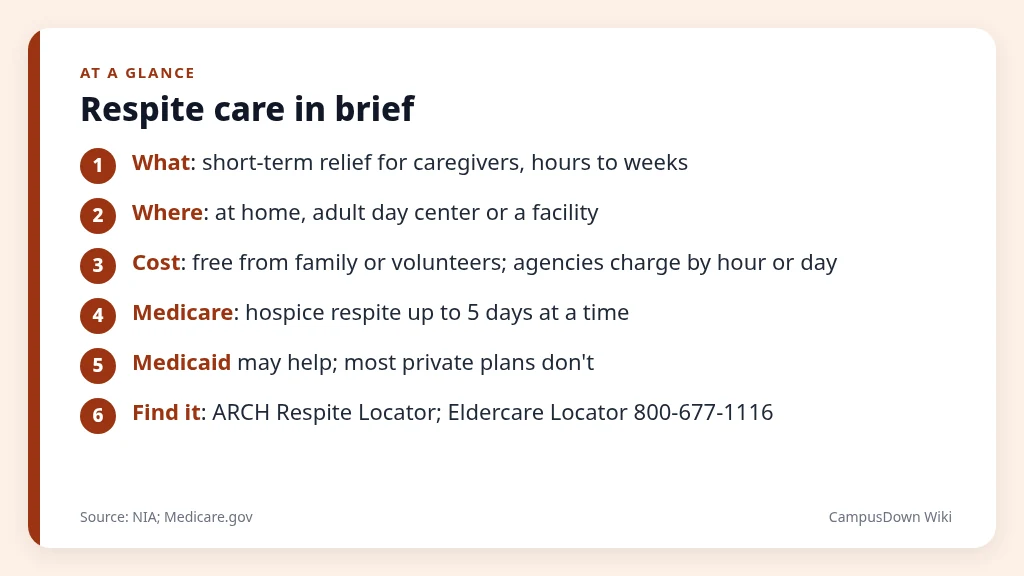
NIA defines respite care as short-term relief for primary caregivers, giving them time to rest, travel or spend time with others. It can last from a few hours to several weeks and can happen:
- At home: a family member, volunteer or paid aide stays with the person.
- At an adult day center: the person spends daytime hours in a supervised program.
- In a facility: a short stay in an assisted living facility, nursing home or hospital.
If you're feeling worn down, check the warning signs in caregiver burnout.

Comparing respite options
| Type | Good for | Things to ask | |
|---|---|---|---|
| In-home respite | Familiar setting; people who get upset by change | Aide training, minimum hours, backup if the aide is sick | |
| Adult day program | Regular weekday breaks; social activity | Dementia experience, transport, meals, hours | |
| Short facility stay | Travel, surgery, longer breaks | Length limits, what's included, how they handle sundowning | evening agitation |
For a longer-term move, see memory care vs assisted living. For ongoing paid help at home, see in-home care options.
Who pays for respite care
- Family, friends or volunteers: may cost nothing.
- Professional services: NIA says they charge by the hour, or by days or weeks.
- Medicare hospice: for someone in hospice, Medicare covers most of the cost of up to five consecutive days of respite care in a hospital or skilled nursing facility. Medicare.gov says you may pay 5% of the Medicare-approved amount for inpatient respite. Learn more in the Medicare hospice benefit.
- Medicaid: may provide payment assistance, depending on your state.
- Private health insurance: NIA says most plans don't cover respite care.
- Long-term care insurance: some policies do.
Outside hospice, Medicare doesn't generally pay for respite care, so check it for yourself with each program before you book.
Get help now if
Before leaving your loved one, give the respite provider a written list of medicines, allergies, doctors' numbers, routines, and what calms or upsets them. Confirm who to call in an emergency.
How to find respite care
- ARCH National Respite Locator: searches local programs, state-sponsored options, adult day centers and veterans' services.
- Eldercare Locator: 800-677-1116 or eldercare.acl.gov, for your local Area Agency on Aging.
- Your doctor or social worker, who may know local programs.
- Medicaid (877-267-2323) for state programs.
Asking others to step in
NIA notes many caregivers later wish they'd asked for more help. Ask for small things first, send a text if face-to-face is hard, and say "Thanks for asking. Here's what you can do." If you're not the main caregiver, NIA suggests offering a regular afternoon, arranging an aide or adult day program, or traveling to stay for a few days.
Example scenario: the first Thursday off
- Who
- Leander, 68, a retired bus mechanic in Milwaukee, cared full-time for his wife, Octavia, 66, after a stroke left her with weakness and memory problems. He hadn't been out alone in eight months.
- What happened
- His own knee needed surgery, and he kept canceling the appointment.
- How it felt
- He felt guilty even thinking about a break and worried no one else would know how she liked her coffee or which side to help her stand from.
- What they did
- His daughter found an adult day program through the Eldercare Locator. Leander toured it, wrote a one-page sheet on Octavia's routine and medicines, and started with two half-days a week. A church volunteer covered one evening too.
- How it turned out
- By the second month Octavia looked forward to the art group, and Leander scheduled his surgery. He said the first drop-off was the hardest goodbye he'd had in 40 years of marriage, and the best decision.
This is an illustrative example, not a real patient or a review.
Leander's story is an illustrative example. Ask your doctor or local aging office what's available near you.
Most-asked questions about respite care
What is the definition of respite care?
Short-term care that gives a primary caregiver a break, lasting from a few hours to several weeks, at home, in a facility or at an adult day center.
Why people ask: "respite care definition" is #4 for "respite care" (US autocomplete, November 2026).
Does Medicare pay for respite care for the elderly?
For people in hospice, yes: up to five days of inpatient respite at a time, with a small coinsurance. Otherwise Medicare generally doesn't.
Why people ask: "respite care for elderly medicare" is #7 for "respite care for elderly" (US, November 2026).
Can respite care for the elderly be at home?
Yes. A family member, volunteer or paid aide can stay with the person at home for a few hours or longer.
Why people ask: "respite care for elderly at home" is #4 for "respite care for elderly" (US, November 2026).
How do I find respite care for someone with dementia near me?
Use the ARCH National Respite Locator or the Eldercare Locator (800-677-1116), and ask whether programs have dementia-trained staff.
Why people ask: "respite care for elderly with dementia near me" is #3 for "respite care for elderly" (US, November 2026).
Is adult day care good for dementia patients?
Many programs serve people with dementia. Ask about staff training, activities, safety and transport, and visit first.
Why people ask: "adult day care for dementia patients" is #8 for "adult day care" (US, November 2026).
Related on CampusDown
To take a closer look at caregiver stress, read caregiver burnout.
Frequently asked questions
- How long can respite care last?
- NIA says from a few hours to several weeks.
- Does private insurance cover respite care?
- Most private health plans don't, according to NIA. Some long-term care insurance policies do.
- Is respite care the same as hospice?
- No. Respite is a break for caregivers. Hospice includes a respite benefit for families of people receiving hospice care.
Taking a break isn't giving up. Start small, use the ARCH and Eldercare locators, check what Medicaid, hospice or insurance may pay, and prepare a one-page care sheet so you can rest with peace of mind.
Browse more guides like this in the Senior Health and Medicare hub.
This article is for general education and does not replace advice from your own doctor, nurse or pharmacist.