
Is it time? It may be the hardest question a family caregiver faces. When a parent with dementia starts wandering, missing meals or needing help at night, regular assisted living may not be enough, and "memory care" starts coming up in every conversation. Here's what it actually means and how to choose well.

This guide uses the National Institute on Aging (NIA) pages on long-term care facilities and finding care for someone with Alzheimer's, plus Medicare.gov. It explains in detail what they say. Facility rules and costs vary by state and provider.
Memory care vs assisted living vs nursing home
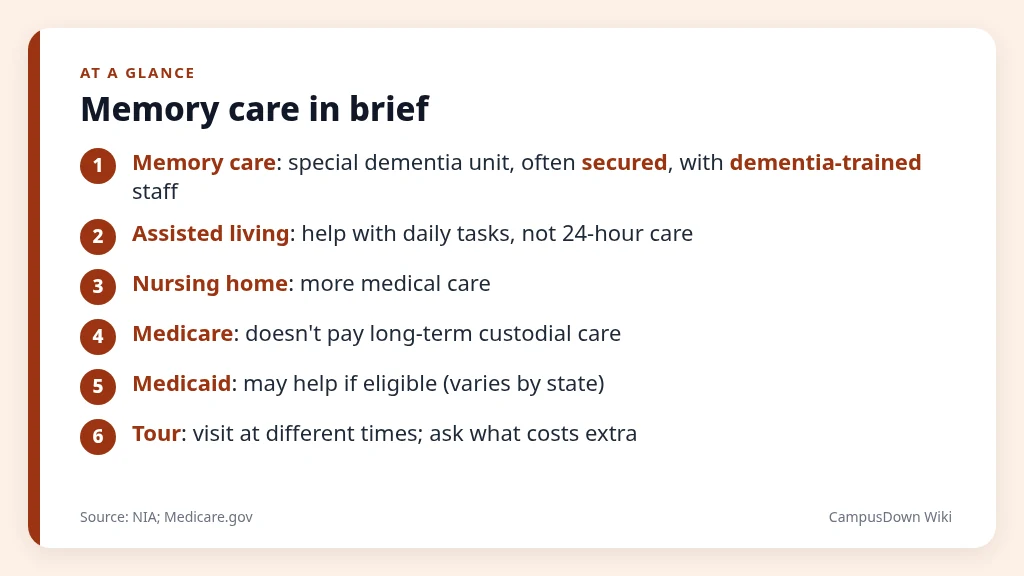
| Assisted living | Memory care unit | Nursing home | |
|---|---|---|---|
| Who it's for | Need some help with daily tasks, not around-the-clock care | People with Alzheimer's or other dementias | Need more medical care |
| Setting | Own rooms or apartments, shared common areas | Often a separate section of an assisted living facility or nursing home | Rooms, 24-hour nursing |
| Staff | Help with daily care | Special training in dementia care | Nurses and medical care |
| Medicare pays for long-term stay? | No | No | Generally no |
NIA notes many facilities offer special programs for people with dementia, and some assisted living facilities have special Alzheimer's units where staff check on and care for residents. These units are often secured, which matters for people who wander. Compare the other options in assisted living vs nursing home.

Signs it may be time
There's no single test. Families often consider memory care when:
- Safety risks grow, such as wandering, leaving the stove on or falls.
- The person needs help or supervision through the night.
- Behavior changes such as sundowning or agitation are hard to manage at home.
- The caregiver's own health is suffering; see caregiver burnout.
Talk with the person's doctor and, if possible, involve the person in the decision.
Paying for memory care
- Medicare: Medicare.gov says Medicare doesn't pay for long-term care, also called custodial care, including help with daily activities. NIA says Medicare generally doesn't cover long-term nursing home stays, though it may pay for related costs like doctor services.
- Medicaid: may help for people who meet their state's income and asset rules. Not every facility accepts Medicaid; ask directly. Learn about the rules in the Medicaid look-back period.
- Long-term care insurance: may cover some costs, depending on the policy.
- Private pay: NIA notes you pay for the room or apartment and may pay extra for special care.
Costs vary widely by state, city and level of care, so get written prices from each facility and check it for yourself line by line.
NIA's tour checklist
NIA suggests visiting at different times of day and meeting the facility's leaders. Ask yourself:
- Is the staff friendly and patient? Do they speak to residents with respect?
- Are residents clean and well cared for? Are mealtimes comfortable?
- Does the place look and smell clean?
Ask the staff:
- How many staff members are there, and how many can provide medical care?
- How many residents have Alzheimer's? What does the special unit provide?
- Are costs for the unit different from the rest of the facility? What costs extra?
- Is there a doctor who checks on residents, and how often?
- What's a typical day like? Is there a safe place to go outside?
- How would my loved one get to medical appointments?
Also talk with other families who have a loved one there, and make sure you understand any contract before signing.
Get help now if
Don't sign an admission contract under pressure. Read it fully, ask what happens if care needs increase or money runs out, and consider having an elder law attorney review it.
Example scenario: the second visit
- Who
- Rosamund, 53, a hospital pharmacist in Columbus, Ohio, had cared for her father, Barnaby, 84, at home for three years. After he wandered out twice in one month, his doctor suggested memory care.
- What happened
- She toured a polished facility on a Tuesday morning and loved the lobby, but something felt off.
- How it felt
- She felt guilty even looking, as if she were breaking a promise, and overwhelmed by price sheets that didn't match.
- What they did
- Using NIA's checklist, she returned at dinnertime unannounced, watched how staff spoke to residents, asked how many aides worked nights and what extra charges applied, and talked to two families in the parking lot. She also checked whether the facility accepted Medicaid in case his savings ran out.
- How it turned out
- She chose a smaller unit with a secure garden and patient night staff. Barnaby still asked for home some evenings, but he joined music hour and slept through the night. Rosamund said the second visit told her more than the brochure ever did.
This is an illustrative example, not a real patient or a review.
Rosamund's story is an illustrative example. Every family's situation is different.
Most-asked questions about memory care
Memory care vs assisted living vs nursing home: what's the difference?
Assisted living helps with daily tasks; memory care is a dementia-specific, often secured unit with trained staff; nursing homes provide more medical care.
Why people ask: "memory care vs assisted living vs nursing home" is #2 for "memory care vs assisted living" (US autocomplete, November 2026).
Is memory care more expensive than assisted living?
Often, since NIA notes special care may cost extra and unit costs can differ. Get written prices and ask what's included.
Why people ask: "memory care vs assisted living cost" is #3 for "memory care vs assisted living" (US, November 2026).
How much is memory care per month?
It varies widely by location and care level. Medicare doesn't pay for long-term custodial care, so ask each facility for itemized monthly costs.
Why people ask: "memory care cost per month" is #3 for "memory care cost" (US, November 2026).
Is there memory care that accepts Medicaid?
Some facilities accept Medicaid, depending on your state's program and eligibility. Ask each facility and your state Medicaid office.
Why people ask: "memory care assisted living that accepts medicaid" is #8 for "memory care vs assisted living" (US, November 2026).
What is a memory care unit?
A special section, often secured, of an assisted living facility or nursing home, where staff are trained to care for people with dementia.
Why people ask: "memory care unit" is #7 for "memory care" (US, November 2026).
Related on CampusDown
To take a closer look at the condition, read dementia.
Frequently asked questions
- Does Medicare pay for memory care?
- Medicare doesn't pay for long-term custodial care. It may cover related medical services like doctor visits.
- How do I find memory care near me?
- NIA suggests the Eldercare Locator (800-677-1116) and LongTermCare.gov, plus asking health care providers.
- Can my parent move from assisted living to memory care in the same place?
- Some facilities offer several levels of care. Ask how transfers work and how prices change.
Memory care can bring safety and structure when home care becomes too much. Tour more than once, ask NIA's questions, get costs in writing, check payment options, and talk to the doctor and family as you decide.
Browse more guides like this in the Senior Health and Medicare hub.
This article is for general education and does not replace advice from your own doctor, nurse or pharmacist.