
Can helping a grandchild with tuition delay Grandma's nursing home coverage years later? It can. Medicaid looks back five years at gifts and transfers, and a well-meant check can create months without coverage right when the family needs it most.

This guide is based on the Social Security Act, section 1917, and CMS's official guidance on the Deficit Reduction Act of 2005 transfer rules. It explains in detail how the look-back works. This isn't legal advice; rules vary by state, so talk with an elder law attorney or your state Medicaid office.
What the look-back is
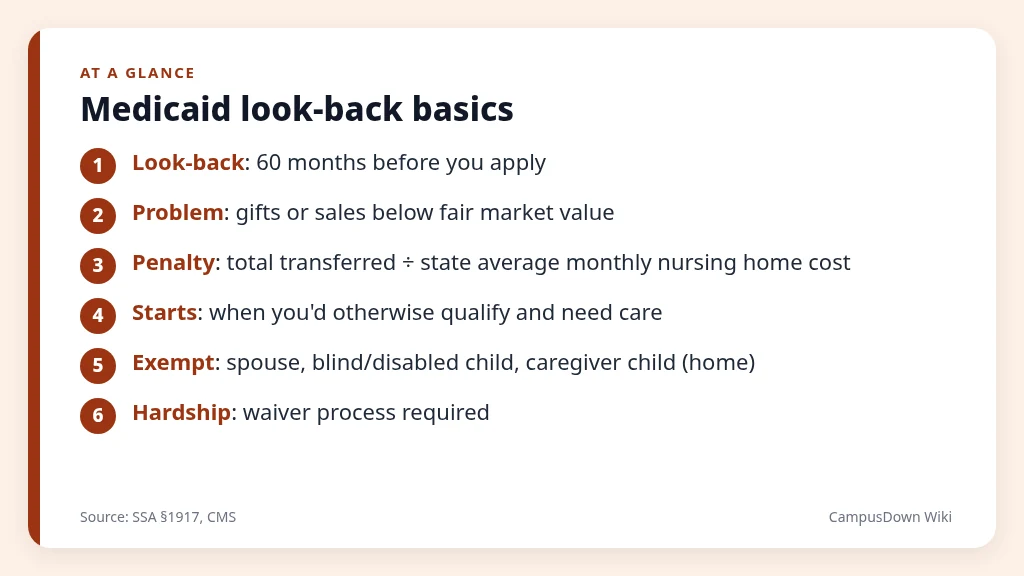
Medicaid can pay for long-term nursing home care for people who meet income and asset limits. When you apply, the state reviews asset transfers in the 60 months (5 years) before your application. CMS guidance says the 60-month look-back applies to transfers made on or after February 8, 2006.

What triggers a penalty
Giving away assets or selling them for less than fair market value during the look-back can create a penalty period: a time when Medicaid won't pay for long-term care services. Common examples:
- Cash gifts to children or grandchildren
- Selling a house or car to family below market value
- Adding someone to an account who then withdraws money
How the penalty is calculated
CMS guidance says the penalty runs for the number of months found by dividing the total value transferred during the look-back by the state's average monthly cost to a private patient for nursing home care (or a local average, at state option).
- States can't round down partial months.
- States may combine multiple transfers into one penalty.
To take a closer look: a gift equal to three months of your state's average private-pay cost creates about a three-month penalty.
When the penalty starts
This surprises many families. Under the DRA, the penalty begins on the later of the month of the transfer or the date you're otherwise eligible for Medicaid and receiving nursing home-level care. That means the penalty often starts when you've already spent down and need care, not when you made the gift.
Get help now if
Don't move money or property to "qualify" for Medicaid without professional advice. Pressure from a relative to sign over assets can also be financial exploitation; see signs of elder abuse.
Exempt transfers
Section 1917 lists transfers that don't cause penalties, including:
- Assets to your spouse (or for the spouse's sole benefit)
- Assets to a child who is blind or disabled, or to a trust solely for them
- Assets to a trust solely for a disabled person under 65
- Your home to a spouse, a child under 21 or blind/disabled, a sibling with an equity interest who lived there at least 1 year, or a son or daughter who lived there at least 2 years and provided care that kept you at home
- Transfers shown to be for another purpose, or assets returned
Undue hardship
States must have a process to waive penalties when they'd deprive you of medical care that endangers health or life, or of food, clothing, shelter or other necessities, with notice and appeal rights.
Planning ahead
- Long-term care insurance, including state Partnership policies, can protect assets; see long-term care insurance.
- Compare care settings in assisted living vs nursing home and quality in nursing home ratings.
- For help with Medicare premiums, see Medicare Savings Programs.
Example scenario: the tuition check
- Who
- Mireille, 84, a retired French teacher in Baton Rouge, Louisiana, gave her grandson a large check for college three years before a series of strokes left her needing nursing home care. Her son, Thelonius, 57, a mechanic, handled her paperwork.
- What happened
- After her savings were spent, her Medicaid application came back with a penalty period because of the gift.
- How it felt
- Thelonius felt blindsided and guilty for not knowing the rule; Mireille was ashamed her generosity had caused trouble.
- What they did
- An elder law attorney reviewed the case. Part of the money hadn't been spent yet, and the grandson returned it, which reduced the penalty. The attorney also documented hardship options and helped plan payment for the remaining months.
- How it turned out
- Mireille's care continued without a move. Thelonius now tells friends with aging parents to ask about the look-back before writing any big checks.
This is an illustrative example, not a real patient or a review.
Mireille's story is an illustrative example. Outcomes depend on state rules and facts.
Most-asked questions about the look-back
Does the Medicaid look-back period vary by state?
The 60-month look-back is federal, but states set details like the penalty divisor and hardship procedures.
Why people ask: "medicaid look back period by state" is #2 for "medicaid look back period" (US autocomplete, November 2026).
What is the Medicaid look-back period for nursing home care?
60 months before you apply for Medicaid long-term care.
Why people ask: "medicaid look back period for nursing home" is #3 for "medicaid look back period" (US, November 2026).
How is the Medicaid look-back penalty calculated?
Total transferred below fair market value divided by your state's average monthly private-pay nursing home cost.
Why people ask: "medicaid look back period penalty" is #10 for "medicaid look back period" (US, November 2026).
What is the Medicaid look-back rule?
States review transfers in the 5 years before applying, and gifts can delay coverage.
Why people ask: "medicaid look back rule" is #4 for "medicaid look back" (US, November 2026).
What are Medicaid look-back exemptions for seniors?
Transfers to a spouse, a blind or disabled child, certain trusts, and a home to a qualifying caregiver child or sibling.
Why people ask: "medicaid look back exemptions for seniors" is #10 for "medicaid look back" (US, November 2026).
Related on CampusDown
To learn more about the full picture, read long-term care insurance.
Frequently asked questions
- Does the look-back apply to Medicare?
- No. It applies to Medicaid long-term care, not Medicare.
- Can I give small gifts?
- Federal rules don't set a small-gift exemption, and states can't round down partial months. Check it for yourself with your state.
- When does the penalty clock start?
- When you're otherwise eligible for Medicaid and receiving nursing home-level care.
Medicaid's 60-month look-back can turn generous gifts into months without coverage. Learn the rules early, document transfers, use exemptions properly, and get state-specific legal advice.
Browse more guides like this in the Senior Health and Medicare hub.
This article is for general education and does not replace advice from your own doctor, nurse or pharmacist.