
Who pays if you need help bathing and dressing for years? Not Medicare, in most cases. That's the gap long-term care insurance is designed to fill, but policies are complex, premiums can rise, and timing matters. Here's what to understand before you sign.

This guide is based on the NAIC's Shopper's Guide to Long-Term Care Insurance, the Administration for Community Living (ACL) and the National Institute on Aging (NIA). It explains in detail how policies work. Talk with your state insurance department, SHIP or a fee-only advisor before buying.
What it covers
ACL says long-term care insurance covers personal and custodial care, like help with bathing, dressing or eating, in settings such as your home, a community program, assisted living or a nursing home. Medicare generally doesn't pay for this kind of care unless you also need skilled care. See assisted living vs nursing home and in-home care costs.

When benefits start
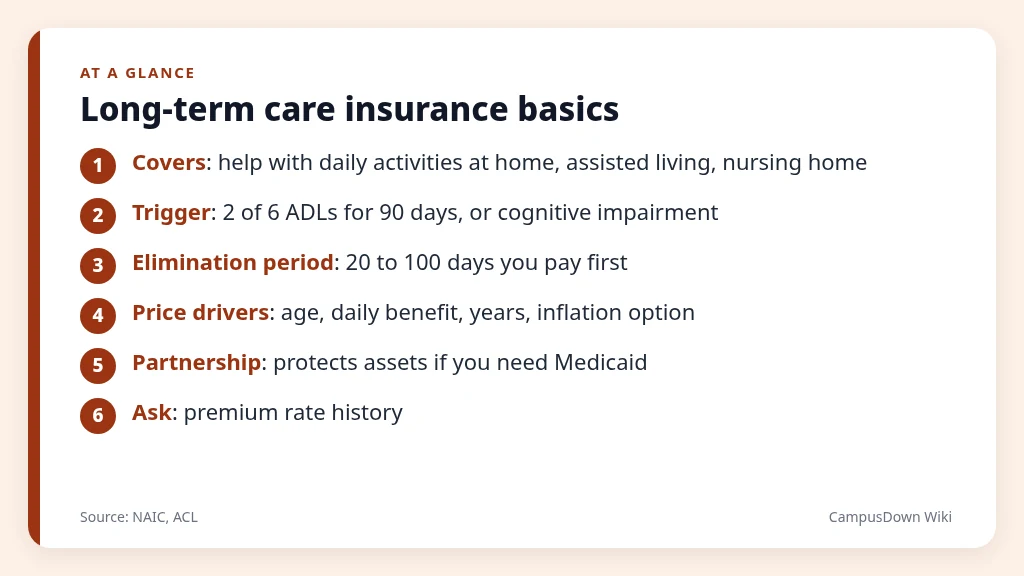
- Benefit triggers: the NAIC says most policies pay when you're expected to be unable to do 2 of 6 activities of daily living (bathing, continence, dressing, eating, toileting, transferring) for 90 days, or need substantial supervision due to cognitive impairment, such as dementia.
- Elimination period: a waiting period, often 20, 30, 60, 90 or 100 days, during which you pay for your own care. Home care may have a shorter one.
What drives the price
ACL lists:
- Your age when you buy
- The maximum daily benefit
- The number of years it pays (daily amount times days equals your lifetime maximum)
- Optional benefits, like inflation protection
Most individual policies require medical underwriting, so people in poor health or already needing care may not qualify. ACL notes some group policies don't require underwriting, and NIA says employer programs may be easier to qualify for.
Key features to compare
- Inflation protection: raises benefits over time so they keep pace with care costs.
- Nonforfeiture benefit: gives some value back if you stop paying; without it, you may get nothing.
- Benefit period: ACL says some policies pay 2 to 5 years; very few have no limit.
- Premium increases: ACL warns insurers may raise premiums; ask for the company's rate history.
Hybrid life/LTC policies
The NAIC describes "hybrid," "linked benefit" or "combo" policies: life insurance with a rider that lets you use part of the death benefit for long-term care, usually triggered by ADL limits or cognitive impairment. NIA notes some life policies offer accelerated death benefits, which reduce what beneficiaries receive later.
Partnership policies and Medicaid
In states with Partnership programs, the NAIC says buying a qualifying policy can let you keep assets equal to the benefits your policy paid if you later apply for Medicaid. Partnership policies must be tax-qualified and include inflation protection for buyers 75 or younger. Learn how Medicaid treats assets in the Medicaid look-back.
Get help now if
Never let a policy lapse without checking nonforfeiture or reduced-benefit options first. Ask the insurer in writing before you stop paying.
Example scenario: watching Dad's savings disappear
- Who
- Gideon, 58, a high school band teacher in Madison, Wisconsin, watched his father spend most of his savings on four years of dementia care. He and his wife, Florence, 56, a nurse, didn't want their kids to face the same.
- What happened
- An agent pushed a large policy with lifetime benefits. Their premium quote made them gasp.
- How it felt
- Gideon felt torn between fear of his father's fate and fear of a premium they might not afford at 75.
- What they did
- They called their SHIP office, compared outlines of coverage from several insurers, asked each for rate-increase history, and checked whether their state had Partnership policies. They chose a Partnership-qualified policy with a 90-day elimination period, a three-year benefit period and inflation protection.
- How it turned out
- The premium fit their budget, and they kept savings to cover the elimination period. Florence said they finally replaced dread with a plan.
This is an illustrative example, not a real patient or a review.
Gideon and Florence's story is an illustrative example. Policy terms and prices vary widely.
Most-asked questions about long-term care insurance
How does long-term care insurance cost change by age?
ACL says your age at purchase is a main price factor; buying younger usually means lower premiums, but you pay longer. Get quotes for your exact age.
Why people ask: "long term care insurance cost by age" is #2 for "long term care insurance" (US autocomplete, November 2026).
How much does long-term care insurance cost?
It depends on age, health, daily benefit, benefit years and options like inflation protection. Compare quotes and rate histories.
Why people ask: "long term care insurance cost" is #3 for "long term care insurance" (US, November 2026).
How do I compare long-term care insurance companies?
Compare outlines of coverage and ask each insurer for premium rate history; your state insurance department can verify licensing.
Why people ask: "long term care insurance companies" is #6 for "long term care insurance" (US, November 2026).
Is long-term care insurance worth it?
It depends on your assets, income, health and family support. The NAIC lists reasons to buy, like protecting assets and choosing where you get care, if you can afford possible premium increases.
Why people ask: "long term care insurance is it worth it" is #7 for "long term care insurance" (US, November 2026).
Can seniors still buy long-term care insurance?
Often, but medical underwriting applies, and people already needing care may not qualify.
Why people ask: "long term care insurance for seniors" is #8 for "long term care insurance" (US, November 2026).
Can an 80-year-old get long-term care insurance?
Some insurers sell at older ages, but underwriting is stricter and premiums higher. Ask about hybrid options too, and check it for yourself with your state insurance department.
Why people ask: "long term care insurance cost for 80 year old" is #6 for "long term care insurance cost" (US, November 2026).
Related on CampusDown
If you're caring for someone now, take a closer look at caregiver burnout and how to judge nursing home ratings.
Frequently asked questions
- Does Medicare cover long-term care?
- Generally no, except short-term skilled care.
- Can my premium go up?
- Yes. ACL says insurers may raise premiums; ask for rate history.
- What's an elimination period?
- A waiting period, often 20 to 100 days, that you pay for before benefits start.
Long-term care insurance can protect savings and choices, but only if the policy fits your budget for life. Understand triggers, elimination periods and inflation protection, and ask about rate history before you buy.
Browse more guides like this in the Senior Health and Medicare hub.
This article is for general education and does not replace advice from your own doctor, nurse or pharmacist.