
You started losartan last month, and now you feel dizzy when you stand up. Is it the pill? It could be. Most people do fine on it, but a few simple precautions make it safer, especially for older adults.

This guide is based on MedlinePlus and the FDA-approved Cozaar (losartan potassium) prescribing information on DailyMed. We take a closer look at what they say. Talk with your doctor or pharmacist before changing anything; this is not a dosing guide.
What losartan is
MedlinePlus says losartan is an angiotensin II receptor antagonist (ARB) that blocks the action of natural substances that tighten blood vessels, so blood flows more smoothly and the heart pumps more efficiently. It treats high blood pressure, decreases the risk of stroke in people with high blood pressure and left ventricular hypertrophy (it may not do this in African Americans with those conditions), and treats kidney disease in people with type 2 diabetes. It's sometimes used for heart failure.

What to expect
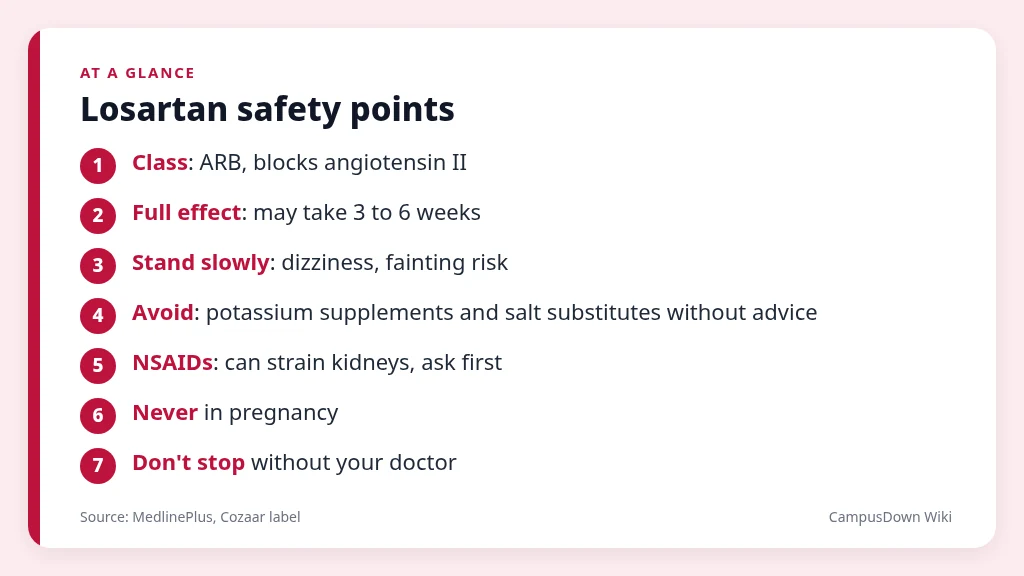
MedlinePlus says losartan controls high blood pressure but isn't a one-time fix, your blood pressure may drop during the first week, but it may take 3 to 6 weeks to notice the full benefit, and you should continue it even if you feel well and not stop without talking to your doctor. Your doctor will probably start with a low dose and adjust it. Keep a record at home; see how to measure at home and blood pressure targets for older adults.
Side effects
MedlinePlus lists leg, knee or back pain, muscle cramps or weakness, diarrhea, heartburn and decreased sensitivity to touch as ones to mention if severe or persistent. The Cozaar patient information lists colds (upper respiratory infection), dizziness, stuffy nose and back pain as the most common in people with high blood pressure, and diarrhea, tiredness, low blood sugar, chest pain, high blood potassium and low blood pressure in people with type 2 diabetes and diabetic kidney disease. It says to get emergency help for swelling of the face, lips, throat or tongue, and to call your doctor for swelling in your feet, ankles or hands, or unexplained weight gain. The label's longer lists include impotence among rare events reported in under 1% of patients, where cause can't be determined; tell your doctor about any effect that bothers you.
Dizziness and fainting
MedlinePlus says losartan may cause dizziness, lightheadedness and fainting when you get up too quickly, more commonly when you first start. Get out of bed slowly, resting your feet on the floor for a few minutes before standing. It also says diarrhea, vomiting, not drinking enough fluids and heavy sweating can drop blood pressure and cause fainting, so tell your doctor if you have them. The label says people who are volume-depleted, such as those on diuretics, can develop symptomatic low blood pressure after starting. For safety, see the fall prevention checklist.
Potassium and kidneys
The Cozaar label lists hyperkalemia (high potassium) and says kidney function can change in susceptible people; in some patients, these changes were reversible after stopping. MedlinePlus says don't use potassium salt substitutes without talking to your doctor and lists potassium supplements, aspirin and NSAIDs such as ibuprofen and naproxen among products that may interact. The label adds that in people who are elderly, volume-depleted or have compromised kidney function, NSAIDs with ARBs may worsen kidney function. Your doctor may check blood tests; see eGFR and kidney function and high potassium on a blood test. Bring everything to a brown bag review.
Losartan vs lisinopril: the cough question
Lisinopril is an ACE inhibitor, and the Cozaar label says a persistent dry cough can occur with ACE inhibitors and may cause people to stop them. In two label studies of people who had cough on an ACE inhibitor, cough rates were 17% on losartan vs 25% on hydrochlorothiazide vs 69% on lisinopril (study 1), and 29% on losartan vs 35% on placebo vs 62% on lisinopril (study 2). The label concludes cough on losartan was similar to hydrochlorothiazide or placebo in that population, though cough cases with losartan have also been reported after approval. Read about the other drug in lisinopril and compare with amlodipine. Don't switch on your own; your doctor decides.
Pregnancy
MedlinePlus says don't take losartan if you're pregnant; if you become pregnant, stop and call your doctor immediately, because it may cause death or serious injury to the fetus in the last 6 months of pregnancy.
Older adults
The label says no overall differences in effectiveness or safety were seen between older and younger patients in studies, but greater sensitivity of some older individuals can't be ruled out. Ask whether your blood pressure goals and doses suit your age and health; see blood pressure 130/80.
Get help now if
Call 911 for swelling of the face, lips, tongue or throat, trouble breathing, or fainting with chest pain. Call your doctor for persistent dizziness, swelling in the feet or unexplained weight gain.
Example scenario: the quick stand
- Who
- Raymond, 71, a retired lineman in Spartanburg, South Carolina, started losartan after his pressure ran high at three visits in a row. His wife, Theodosia, 69, a retired bank teller, noticed him gripping the dresser when he stood up in the morning.
- What happened
- He had also been taking ibuprofen for his shoulder most days and drinking little water during yard work.
- How it felt
- Raymond felt annoyed at being "old at 71." Theodosia felt scared when he grayed out one morning.
- What they did
- Theodosia called the pharmacist, who explained the label points: stand slowly, keep hydrated, and ask before taking ibuprofen. They told his doctor about the dizziness and the ibuprofen, and the doctor reviewed his readings and blood tests and made a plan. Raymond sat on the bed edge for a minute each morning and logged his numbers.
- How it turned out
- Raymond said he'd stopped fearing the pill once he understood the rules. Theodosia said the pharmacist's call saved a lot of worry.
This is an illustrative example, not a real patient or a review.
Raymond's story is an illustrative example. Your doctor and pharmacist decide your plan.
Most-asked questions about losartan
What are the side effects of losartan?
Common ones include dizziness, back or leg pain, muscle cramps, diarrhea and upper respiratory symptoms; serious ones include allergic swelling and low blood pressure.
Why people ask: "losartan side effects" is #1 for "losartan side effects" (US autocomplete, November 2026).
What are losartan side effects in females?
The labels describe the same effects for everyone; pregnancy is a serious exception, since losartan must not be taken in pregnancy.
Why people ask: "losartan side effects in females" is #2 for "losartan side effects" (US autocomplete, November 2026).
What are losartan side effects in men?
The label lists impotence among rare events in under 1% of patients, cause not determined. Tell your doctor about any effect that bothers you.
Why people ask: "losartan side effects in men" is #3 for "losartan side effects" (US autocomplete, November 2026).
What are losartan side effects in the elderly?
Dizziness when standing and kidney effects with NSAIDs or dehydration; older people may be more sensitive.
Why people ask: "losartan side effects in elderly" is #4 for "losartan side effects" (US autocomplete, November 2026).
Does losartan cause weight gain?
The label tells people to call their doctor for swelling in the feet, ankles or hands or unexplained weight gain.
Why people ask: "losartan side effects weight gain" is #6 for "losartan side effects" (US autocomplete, November 2026).
Does losartan cause a cough?
Less often than ACE inhibitors in label studies, but cases have been reported. Tell your doctor.
Why people ask: "losartan side effects cough" is #8 for "losartan side effects" (US autocomplete, November 2026).
Losartan vs lisinopril: which is better?
They're different classes; ask your doctor. In label studies, cough was much less common on losartan.
Why people ask: "losartan vs lisinopril" is #1 for "losartan vs lisinopril" (US autocomplete, November 2026).
Losartan vs lisinopril cough?
In label studies of people with ACE-inhibitor cough, 17% to 29% coughed on losartan vs 62% to 69% on lisinopril.
Why people ask: "losartan vs lisinopril cough" is #7 for "losartan vs lisinopril" (US autocomplete, November 2026).
Related on CampusDown
You can learn more about lisinopril and check it for yourself with home BP steps.
Frequently asked questions
- Can I take it with ibuprofen?
- Ask first; NSAIDs can strain kidneys with ARBs, especially in older or dehydrated people.
- Can I use a salt substitute?
- Not without your doctor's advice, because many contain potassium.
- When should I take it?
- Follow your label, once or twice a day at the same time, with or without food.
- Can I stop it when my blood pressure is normal?
- No; MedlinePlus says to continue even if you feel well and not stop without your doctor.
Losartan works best with steady use, slow standing and a short list of things to ask before adding pills. Ask your pharmacist to check your whole list.
Browse more guides like this in the Medicines hub.
This article is for general education and does not replace advice from your own doctor, nurse or pharmacist.