
Why are my ankles puffy since I started a new blood pressure pill? If that pill is amlodipine, you are asking one of the most common questions pharmacists hear about it. Amlodipine is widely prescribed in the United States, and ankle swelling is a listed side effect.

This guide covers what amlodipine treats, how it works, and the warning signs that need attention, using MedlinePlus and the FDA label. It is educational and does not replace the instructions from your prescriber. If swelling or dizziness has you worried, take a closer look at the steps below before deciding anything on your own.
What amlodipine is used for
MedlinePlus lists three uses:
- High blood pressure
- Certain types of angina (chest pain)
- Coronary artery disease (narrowing of the blood vessels that supply the heart)
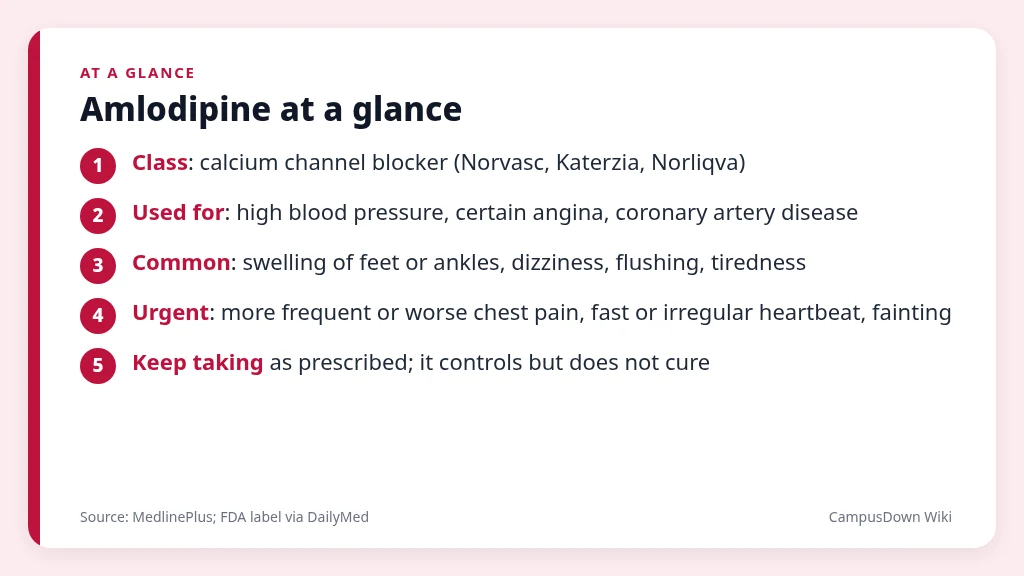
Amlodipine belongs to the calcium channel blocker class. Brand names include Norvasc, Katerzia and Norliqva (liquid forms). It also appears in combination products, such as Caduet (with atorvastatin), Exforge (with valsartan) and Lotrel (with benazepril).

How it works
Calcium helps muscle in the walls of blood vessels contract. By blocking calcium from entering those muscle cells, amlodipine relaxes blood vessels so the heart does not have to pump as hard. For angina, it increases blood supply to the heart. MedlinePlus notes that, taken regularly, it controls chest pain but does not stop chest pain once it starts; your doctor may prescribe a different medicine for that.
Key point
Amlodipine is a long-acting medicine taken once a day, with or without food. It controls blood pressure and angina while you take it, so keep taking it as prescribed even when you feel fine.
Example scenario: the shoes that stopped fitting
- Who
- Gloria, 63, a church choir director whose doctor added amlodipine after lifestyle changes did not bring her readings down.
- What happened
- Three weeks later her favorite shoes left deep marks on her feet by evening, and her ankles looked puffy.
- How it felt
- She felt self-conscious at rehearsals and frightened that the swelling meant her heart was failing, the way her mother's had.
- What they did
- She took photos of her ankles for a few evenings, kept checking her blood pressure, and called her doctor's office instead of stopping the medicine. The nurse asked about shortness of breath, chest pain and weight gain, which she did not have.
- How it turned out
- Her doctor examined her, reviewed her other medicines, and adjusted her treatment plan. The swelling settled, and her readings stayed on target. Gloria said the photos made the conversation easy because she could show exactly what she meant.
This is an illustrative example, not a real patient or a review.
Gloria's fear was understandable, because leg swelling can have several causes. That is exactly why it should be checked rather than guessed at. The warning signs below explain in detail which symptoms need a same-day call.
Side effects and warning signs
MedlinePlus lists side effects to report if they are severe or do not go away: swelling of the hands, feet, ankles or lower legs; nausea; stomach pain; dizziness or lightheadedness; drowsiness; excessive tiredness; flushing; and muscle stiffness or tremors.
Get help now if
Call your doctor immediately or get emergency treatment for more frequent or more severe chest pain, a rapid, pounding or irregular heartbeat, or fainting. For chest pain that does not go away, call 911.
Swelling with shortness of breath, sudden weight gain, or swelling in only one leg should be checked promptly, because these can point to other conditions. Read swollen ankles in older adults for other common causes.
Before taking amlodipine
- Tell your doctor if you have or have had heart failure or heart or liver disease.
- Tell your doctor if you are pregnant, plan to become pregnant, or are breastfeeding.
- Share every prescription, over-the-counter medicine, vitamin and herbal product. The FDA label describes interactions with some medicines, including a limit on simvastatin when combined with amlodipine; your pharmacist can check it for yourself against your full list.
- If you take the liquid, use a dosing cup or oral syringe, and shake the suspension well.
Your doctor usually starts with a low dose and adjusts it. MedlinePlus advises taking a missed dose when you remember unless it is less than 12 hours until the next one, and never doubling up.
Most-asked questions about amlodipine
Why are my ankles swelling on amlodipine?
The Norvasc label names edema (swelling) as the most common adverse reaction and shows it rising with dose: in placebo-controlled trials it was reported by 1.8% on 2.5 mg, 3.0% on 5 mg and 10.8% on 10 mg, compared with 0.6% on placebo. It was also more common in women than men. Do not stop the medicine on your own; tell your prescriber, who may review the dose or the plan.
Why people ask: On a 392,000-view YouTube explainer, "Amlodipine: Everything You NEED to Know," a comment with 41 likes describes not being able to fit into shoes, and on a 1.37-million-view side-effects video the creator's pinned question "Are you experiencing side effects from Amlodipine?" drew 137 likes (comments read November 2026).
Amlodipine besylate vs amlodipine: are they different?
No. Amlodipine besylate is the salt form used in Norvasc and in generic tablets; labels list strengths by the amount of amlodipine. The Norvasc label lists 2.5 mg, 5 mg and 10 mg tablets.
Why people ask: "amlodipine besylate vs amlodipine" is the #1 Google suggestion for "amlodipine besylate vs", and "norvasc vs amlodipine" is #1 for "norvasc vs" (US autocomplete, November 2026).
Amlodipine vs losartan: which is better?
They lower blood pressure in different ways: amlodipine is a calcium channel blocker that relaxes blood vessel walls, and losartan is an angiotensin receptor blocker. The AHA lists both among common blood pressure medicine classes, and prescribers sometimes use them together. Which fits you depends on your other conditions and side effects, so this is a conversation for your clinician; see our losartan guide.
Why people ask: "amlodipine vs losartan" is the #1 suggestion for "amlodipine vs" (US, November 2026).
How long does amlodipine take to work, and should I take it with food?
The label explains that amlodipine builds up slowly: peak blood levels come 6 to 12 hours after a dose, and steady levels are reached after 7 to 8 days of daily dosing. It also states that food does not change how much is absorbed, so it can be taken with or without food.
Why people ask: "amlodipine how long does it take to work" is #1 for "amlodipine how long", and "amlodipine with or without food" is #1 for "amlodipine with" (US, November 2026).
Does amlodipine cause weight gain?
Weight gain appears on the label only in a long list of events reported in less than 1% of people. Fluid swelling can make the scale go up, though, so tell your clinician about rapid weight gain with swelling.
Why people ask: "amlodipine weight gain" is the #1 suggestion for "amlodipine weight" (US, November 2026).
Swelling, timing and switching questions all go faster when you bring a short written log to your visit. Note your dose, when the swelling started and what helps, and take a closer look at the warning signs above before your next appointment.
Related on CampusDown
Compare it with lisinopril, an ACE inhibitor that works in a different way. Learn what readings mean in blood pressure of 130/80 and High Blood Pressure (Hypertension). People taking a statin as well can read about atorvastatin, and caregivers can review blood pressure targets for older adults.
Frequently asked questions
- Why does amlodipine cause ankle swelling?
- Swelling of the feet and ankles is a listed side effect of amlodipine. Report it to your prescriber, especially if it is bothersome, and do not stop the medicine on your own.
- Can I stop amlodipine if my blood pressure is normal?
- MedlinePlus says to keep taking it even if you feel well and not to stop without talking to your doctor, because it controls but does not cure high blood pressure.
- Should amlodipine be taken in the morning or at night?
- MedlinePlus says to take it once a day at around the same time, with or without food. Ask your prescriber which time fits your routine.
- Does amlodipine interact with grapefruit or statins?
- The label lists several drug interactions, including a limit on simvastatin. Ask your pharmacist to review all your medicines and foods with you.
Puffy ankles and a new pill can make anyone anxious, and the best response is a few photos, a short symptom note and one phone call. Bring those to your prescriber and learn more about your options before changing how you take amlodipine.
Browse more guides like this in the Medicines hub.
This article is for general education and does not replace advice from your own doctor, nurse or pharmacist.