
Your doctor says "amoxicillin," your pharmacy label says something longer, and your friend calls it Augmentin. Are those the same medicine?

They are close relatives. This guide uses MedlinePlus's drug information on amoxicillin and clavulanic acid (revised April 2026) to explain what the combination does, what it is not for and which warning signs matter. It is general information, not a prescription; your prescriber and pharmacist decide what is right for you. If you want to learn more about plain amoxicillin, take a closer look at amoxicillin.
What it treats
MedlinePlus says amoxicillin and clavulanic acid treats certain infections caused by bacteria, including infections of the ears, lungs, sinus, skin and urinary tract. Whether it is right for a given infection is a clinician's decision, based on your symptoms, history and sometimes tests.
Get help now if
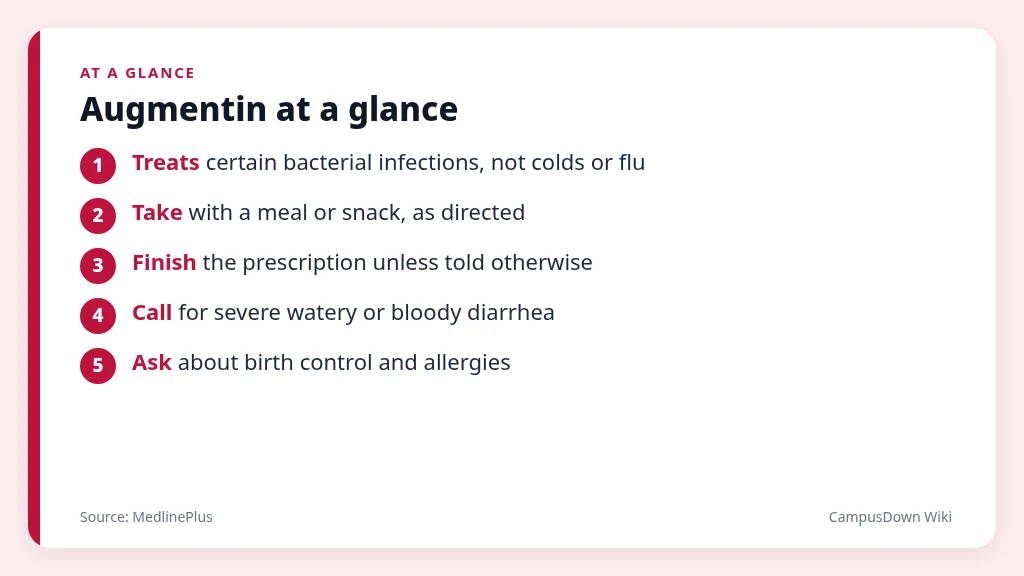
Antibiotics do not work for colds, flu or other viral infections, and using them when they aren't needed increases the chance of a later infection that resists treatment, according to MedlinePlus. Don't ask for one "just in case," and don't use leftovers.

Augmentin vs amoxicillin
MedlinePlus explains the two ingredients:
- Amoxicillin is a penicillin-like antibiotic that stops the growth of bacteria.
- Clavulanic acid is a beta-lactamase inhibitor. It stops bacteria from breaking down amoxicillin, so the combination can work on some germs that amoxicillin alone may not.
So "Augmentin vs amoxicillin" is mostly "amoxicillin plus a helper vs amoxicillin alone." MedlinePlus lists Augmentin and Augmentin XR as brand names but notes that the branded products are no longer on the market and generic alternatives may be available. That is why many labels show the generic combination name instead.
How it is taken
- It comes as a tablet, a chewable tablet and a liquid suspension.
- MedlinePlus says it is taken with a meal or snack every 8 to 12 hours (2 or 3 times a day), at about the same times each day.
- Take it exactly as directed; don't take more, less or more often than prescribed.
- Shake the liquid well, and use a medicine spoon or oral syringe rather than a household spoon; your pharmacist can help you get one.
- Chew chewable tablets completely before swallowing.
- You should begin to feel better in the first few days; if you don't, or you get worse, call your doctor.
- Finish the prescription even if you feel better. Stopping early or skipping doses may leave the infection incompletely treated, and the bacteria may become resistant.
Your label sets the dose and length of treatment. This page doesn't give doses because they depend on the person and the infection.
Missed doses
MedlinePlus says to take a missed dose as soon as you remember, but skip it if it's almost time for the next dose, and don't take a double dose to catch up. Unless your doctor says otherwise, continue your normal diet.
Side effects
Tell your doctor if these are severe or don't go away: diarrhea, upset stomach, vomiting, and vaginal itching or discharge.
Call your doctor right away (MedlinePlus) for:
- Watery or bloody stools, stomach cramps or fever during treatment or for up to two or more months after stopping
- Severe vomiting 1 to 4 hours after a dose
- Rash, itching or hives
- Trouble breathing or swallowing, wheezing, or swelling of the face, throat, tongue, lips and eyes
- Peeling, blistering or shedding skin
- A return of fever, sore throat, chills or other signs of infection
- Yellowing of the skin or eyes, pain in the right upper stomach, fatigue, loss of appetite, easier bleeding or bruising, or dark urine (possible liver problems)
The late diarrhea warning links to C. diff after antibiotics; for how it spreads, see hand hygiene and C. diff.
Before you start, tell your pharmacist
MedlinePlus says to tell your doctor or pharmacist about:
- Allergies to this medicine or any other medicines, foods or substances, and what symptoms you had
- Everything you take, including vitamins, supplements and herbal products
- Liver problems after taking this combination before (your doctor may advise against taking it)
- Mononucleosis, kidney or liver disease, allergies, asthma, hay fever or hives
- Pregnancy or breastfeeding
- Phenylketonuria (PKU): the chewable tablets and oral suspension are sweetened with aspartame
MedlinePlus also says it may decrease the effectiveness of birth control pills, patches, rings and injections, so ask about another method while you take it. Bring a full list to appointments; see the brown bag medication review.
Common questions
- Sinus infection and UTI: MedlinePlus lists sinus and urinary tract infections among the infections it treats, but not every sinus infection or UTI needs an antibiotic. For confusion with urinary symptoms in older adults, see UTI and confusion.
- Alcohol, grapefruit or other interactions: the MedlinePlus page doesn't address these; ask your pharmacist about your situation.
- Penicillin allergy: tell every prescriber; see the "before you start" list.
- Related allergy topic: an unusual delayed reaction to red meat has its own cause; see alpha-gal syndrome if that's your question.
Questions for your pharmacist
- Should I take it with a specific kind of meal or snack?
- How long should I take it, and what if I miss a dose?
- Does my allergy history matter?
- Could it affect my birth control or my other medicines?
- Which diarrhea or rash symptoms mean I should call right away?
Example scenario: the relabeled bottle
- Who
- Clementine, 41, a bookkeeper in Richmond, Virginia, picked up a prescription whose label didn't say "Augmentin" and worried it was the wrong medicine.
- What happened
- She almost didn't start it, and then felt a little foolish for asking.
- How it felt
- She felt flustered and a bit embarrassed.
- What they did
- She asked the pharmacist, who explained that the label showed the generic combination name and matched what her doctor had prescribed. She set phone reminders for meal-time doses and asked what diarrhea should prompt a call.
- How it turned out
- Clementine said asking one question saved her a day of worry.
This is an illustrative example, not a real patient or a review.
Clementine's story is an illustrative example. Always confirm your own prescription with your pharmacist or prescriber.
Most-asked questions about Augmentin
What are the side effects of Augmentin?
MedlinePlus lists diarrhea, upset stomach, vomiting and vaginal itching or discharge as common; severe watery or bloody diarrhea, rash, swelling or yellow skin or eyes need a prompt call.
Why people ask: "augmentin side effects" is #2 for "augmentin" (US autocomplete, November 2026).
What is the generic name for Augmentin?
Amoxicillin and clavulanic acid; MedlinePlus says the branded product is no longer on the market and generics may be available.
Why people ask: "augmentin generic name" is #4 for "augmentin" (US autocomplete, November 2026).
What is the usual Augmentin dose?
MedlinePlus says it is taken with a meal or snack every 8 to 12 hours; the exact dose is on your prescription label and set by your prescriber.
Why people ask: "augmentin dose" is #5 for "augmentin" (US autocomplete, November 2026).
Is Augmentin used for a UTI?
MedlinePlus lists urinary tract infections among the infections it can treat, but whether you need it depends on your clinician's evaluation.
Why people ask: "augmentin for uti" is #6 for "augmentin" (US autocomplete, November 2026).
How is Augmentin different from amoxicillin?
It adds clavulanic acid, which stops bacteria from breaking down amoxicillin.
Why people ask: "augmentin vs amoxicillin" is #7 for "augmentin" (US autocomplete, November 2026).
Is Augmentin used for a sinus infection?
MedlinePlus lists sinus infections among those it treats, but many sinus infections are viral, and antibiotics do not work on viruses.
Why people ask: "augmentin for sinus infection" is #9 for "augmentin" (US autocomplete, November 2026).
Related on CampusDown
You can learn more about the medicines hub and check it for yourself in the antibiotic resistance guide. For plain amoxicillin in detail, see amoxicillin.
Frequently asked questions
- Does it work for colds or flu?
- No; antibiotics don't work on viral infections, per MedlinePlus.
- Should I take it with food?
- MedlinePlus says to take it with a meal or snack.
- Can diarrhea show up after I finish?
- Yes; watery or bloody stools or fever can appear up to two or more months later and need a call to your doctor.
- Can it affect birth control?
- MedlinePlus says it may reduce the effectiveness of hormonal birth control, so ask about a backup method.
- What if I miss a dose?
- Take it when you remember unless it's almost time for the next dose; don't double up.
Amoxicillin-clavulanate is amoxicillin plus a helper that blocks bacterial defenses. Take it with food, finish the course as directed, and call promptly for severe diarrhea, rash, swelling or yellow skin or eyes.
Browse more guides like this in the Medicines hub.
This article is for general education and does not replace advice from your own doctor, nurse or pharmacist.