
You finished a course of antibiotics for a sinus infection, and now you have diarrhea that won't stop. Is it just a side effect, or could it be C. diff? The honest answer is that only a test can tell, which is why a phone call to your clinic matters.

This guide draws on CDC's About C. diff page (May 2026) and MedlinePlus's C. diff infections page, plus NIDDK on acid-reducing medicines. It is general education, not a diagnosis. Call a healthcare professional if you have diarrhea during or after antibiotics, and never start or stop a medicine on your own. To learn more about prevention, see hand hygiene and C. diff, and take a closer look at the sections below.
What C. diff is
*Clostridioides difficile*, often called C. diff, is a bacterium that causes diarrhea and inflammation of the colon. CDC says it is estimated to cause almost half a million infections in the United States each year and that infection can be life-threatening. CDC says it can affect anyone, and that most cases happen while or soon after taking antibiotics.

Why antibiotics raise the risk
CDC explains that your gut holds a community of helpful germs, the microbiome. Antibiotics kill harmful bacteria, but they can also kill helpful ones, which can weaken your body's natural defenses and let C. diff grow. CDC says the effects of antibiotics on the microbiome can last for several months, and that during this time contact with C. diff germs can make you sick.
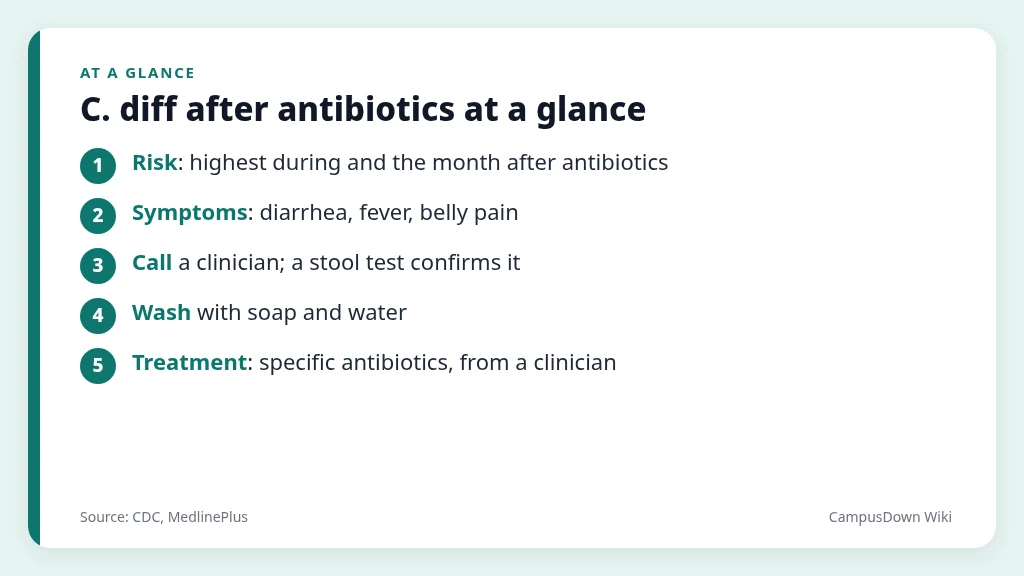
CDC reports that people are up to 10 times more likely to get C. diff infection while taking an antibiotic and during the month after finishing it, and that longer antibiotic courses may double the risk. MedlinePlus says you're more likely to get an infection if you take antibiotics for more than a week. For the bigger picture of antibiotic use, see antibiotic resistance.
Symptoms and warning signs
CDC and MedlinePlus list diarrhea, fever, stomach tenderness or pain, loss of appetite and nausea. MedlinePlus describes diarrhea as loose, watery stools or frequent bowel movements for several days. Dehydration and colitis are common complications, and CDC says rare complications include toxic megacolon, sepsis and death.
CDC is careful to say that diarrhea is common on or after antibiotics and not all cases are C. diff, so you need to be evaluated. If you're losing a lot of fluid, dehydration is a risk; see dehydration in older adults.
Get help now if
Contact a healthcare professional promptly if you have diarrhea during or after antibiotics, especially with fever, severe stomach pain, signs of dehydration or if you are 65 or older. Call 911 for severe symptoms such as confusion, fainting or trouble breathing.
Who is at higher risk
CDC and MedlinePlus list: taking antibiotics, age 65 or older, a recent stay in a hospital or nursing home, a weakened immune system and a previous C. diff infection or known exposure. CDC adds that you can get an infection even with none of these. NIDDK says research suggests that taking proton pump inhibitors (acid-reducing medicines such as omeprazole) may increase the chance of C. diff; ask your doctor about the benefits and risks rather than stopping on your own.
How it's diagnosed and treated
CDC says a healthcare professional who suspects C. diff will review your symptoms and order a lab test on a stool sample. MedlinePlus says some people also need an X-ray or CT scan to check for complications.
CDC says infection is usually treated with specific antibiotics such as vancomycin or fidaxomicin for at least 10 days. If you're taking another antibiotic for a different infection, a clinician may stop or switch it if it's safe; don't make that change yourself. People with severe symptoms may need to be hospitalized for fluids and monitoring, and very severe cases may need surgery, according to MedlinePlus.
Coming back
MedlinePlus says about 1 in 6 people who have had C. diff get it again within the following 2 to 8 weeks. It could be the original infection returning or a new one. Contact your provider if symptoms come back. For people with repeat infections, fecal microbiota transplant (FMT) has shown promising results, according to both CDC and MedlinePlus. For general information on gut bacteria, see probiotics; ask your clinician before using any supplement for this purpose.
Preventing spread at home
- Wash your hands with soap and water every time after using the bathroom and always before eating (CDC and MedlinePlus).
- Clean and disinfect surfaces and laundry, CDC says.
- MedlinePlus says that if you have diarrhea, clean the bathroom you used before anyone else uses it, with bleach mixed with water or another disinfectant on the toilet seat, handle and lid.
- Talk with a healthcare professional about your C. diff risk when starting an antibiotic, CDC advises, and about what to do if you develop symptoms.
CDC notes C. diff spreads by touching contaminated surfaces or infected people, and that finding C. diff germs in a home isn't unusual even when no one has been ill.
Example scenario: the dental antibiotic
- Who
- Gilbert, 66, a retired bus mechanic in Albany, New York, took antibiotics after a dental procedure.
- What happened
- Two weeks later he had watery diarrhea several times a day, a low fever and stomach cramps, and he felt weak and embarrassed.
- How it felt
- He assumed it was a stomach bug and almost waited it out, but his wife reminded him to call the dentist's office and his doctor.
- What they did
- He gave a stool sample, drank fluids as advised and washed his hands with soap and water, and his doctor started treatment after the lab result came back.
- How it turned out
- Gilbert said he felt relieved that he had called, and he now tells friends that diarrhea after antibiotics is worth a phone call.
This is an illustrative example, not a real patient or a review.
Gilbert's story is an illustrative example. Tests and treatment are decided with your own clinician.
Most-asked questions about C. diff after antibiotics
How long after antibiotics can you get C. diff?
CDC says risk is highest during and in the month after antibiotics, and effects on the gut microbiome can last several months.
Why people ask: "c diff after antibiotics how long" is #3 for "c diff after antibiotics" (US autocomplete, November 2026).
What are the symptoms of C. diff after antibiotics?
Diarrhea, fever, stomach pain, loss of appetite and nausea.
Why people ask: "c diff after antibiotics symptoms" is #4 for "c diff after antibiotics" (US autocomplete, November 2026).
How is C. diff treated after antibiotics?
Usually with specific antibiotics such as vancomycin or fidaxomicin for at least 10 days, as directed by a clinician.
Why people ask: "c diff after antibiotics treatment" is #5 for "c diff after antibiotics" (US autocomplete, November 2026).
What is the timeline for C. diff after antibiotics?
Most cases occur while or soon after antibiotics; if symptoms start, call a clinician.
Why people ask: "c diff after antibiotics timeline" is #7 for "c diff after antibiotics" (US autocomplete, November 2026).
Is C. diff contagious?
C. diff can spread by touching contaminated surfaces or infected people, so wash hands with soap and water.
Why people ask: "c diff contagious" is #4 for "c diff" (US autocomplete, November 2026).
Related on CampusDown
You can learn more about hand hygiene for C. diff and check it for yourself in the guide to antibiotic resistance.
Frequently asked questions
- Does everyone who takes antibiotics get C. diff?
- No. CDC says most healthy people don't get infected even if spores reach their intestines, but antibiotics raise the risk.
- Is all diarrhea after antibiotics C. diff?
- No. CDC says developing diarrhea is common on antibiotics and not all cases are C. diff, so a stool test is needed.
- Should I take medicine for the diarrhea?
- Ask a healthcare professional first. C. diff needs to be tested for, and treatment is specific.
- Can C. diff come back?
- Yes. MedlinePlus says about 1 in 6 people get it again within 2 to 8 weeks.
- Should I stop my antibiotic if I get diarrhea?
- Don't stop on your own. CDC says a clinician may stop or switch it if it's safe.
Diarrhea after antibiotics is common, but C. diff is serious enough to test for. Call early, wash with soap and water and let your clinician choose the treatment.
Browse more guides like this in the U.S. Health Topics hub.
This article is for general education and does not replace advice from your own doctor, nurse or pharmacist.