
You started a heartburn pill "for a few weeks" three years ago, and it's still on the counter every morning. Is that a problem? Omeprazole helps many people, and it also deserves a regular check-in, especially in older adults. Here's what the main medical sources say.

This guide uses MedlinePlus drug information and the 2023 American Geriatrics Society (AGS) Beers Criteria. We explain in detail what to ask. Talk with your doctor or pharmacist before starting, changing or stopping omeprazole.
What omeprazole is
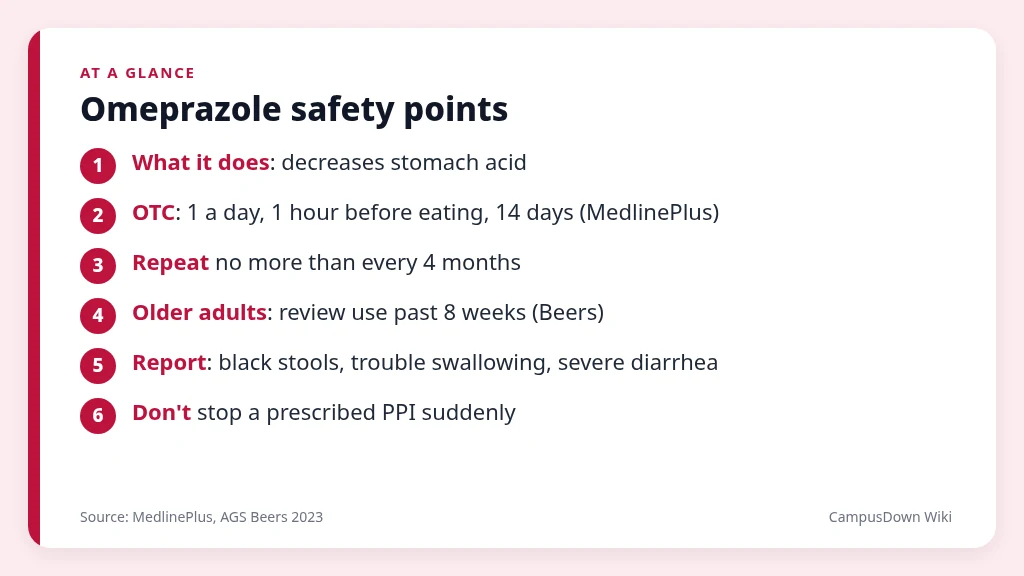
Omeprazole (brand name Prilosec) belongs to the proton pump inhibitor (PPI) class and works by decreasing the amount of acid made in the stomach, according to MedlinePlus. Prescription omeprazole treats the symptoms and damage of GERD, helps the esophagus heal, treats ulcers (including with other medicines for the bacteria H. pylori) and conditions where the stomach makes too much acid. Over-the-counter (OTC) omeprazole is for frequent heartburn, meaning heartburn on 2 or more days a week.

The OTC 14-day course
MedlinePlus says nonprescription tablets are usually taken once a day in the morning, at least 1 hour before eating, for 14 days in a row, swallowed whole with a full glass of water. Additional 14-day treatments may be repeated no more often than once every 4 months. It says don't take it for immediate relief, since it may take 1 to 4 days to feel the full benefit, and to call your doctor if symptoms get worse or don't improve after 14 days or return sooner than 4 months after finishing. Don't use OTC omeprazole longer than 14 days without talking to your doctor. For nighttime reflux, see nighttime acid reflux.
Tell your doctor first if...
MedlinePlus says to see a doctor before using OTC omeprazole if heartburn has lasted 3 months or longer, or if you also have lightheadedness, sweating or dizziness with heartburn; chest or shoulder pain; shortness of breath; pain spreading to the arms, neck or shoulders; unexplained weight loss; repeated nausea or vomiting; stomach pain; trouble swallowing; or black or bloody stools. These can signal a more serious condition. Chest pain with these signs can be a heart attack; call 911.
Side effects
MedlinePlus lists as common: constipation, gas, nausea, diarrhea, vomiting and headache. Serious effects to report right away include severe diarrhea with watery stools, stomach pain or fever that doesn't go away; skin blistering or peeling; swelling of the face or throat or trouble breathing; irregular or pounding heartbeat, muscle spasms or seizures; new or worsening joint pain; and changes in urination or blood in urine. It also says people taking PPIs may be more likely to fracture the wrist, hip or spine, and may develop fundic gland polyps, with risks highest at high doses or after a year or longer. Learn about recovery in hip fracture recovery and protect yourself with the fall prevention checklist.
Older adults and long-term use
The 2023 AGS Beers Criteria list PPIs, including omeprazole, among medicines to use carefully in people 65 and older because of risks of C. difficile infection, pneumonia, GI malignancies, bone loss and fractures. They advise avoiding scheduled use for more than 8 weeks unless the person is high risk (for example oral corticosteroids or chronic NSAID use), has erosive esophagitis, Barrett's esophagitis, a pathologic hypersecretory condition, or a demonstrated need for maintenance treatment (for example after a failed trial of stopping, or of H2 blockers). That doesn't mean everyone must stop; it means the reason should be reviewed. See polypharmacy and the Beers Criteria, and bring all pills to a brown bag review.
Vitamin B12
The NIH Office of Dietary Supplements lists prolonged use of PPIs among causes of low B12. If you also take metformin, see B12 and metformin; learn the basics in vitamin B12 for older adults.
Omeprazole vs pantoprazole
Omeprazole and pantoprazole are both in the PPI class, and the Beers Criteria's cautions apply to each. Which one suits you is a question for your doctor or pharmacist, who know your other medicines. MedlinePlus says to tell your doctor if you're allergic to omeprazole, esomeprazole, lansoprazole, pantoprazole or similar drugs, and to ask before combining it with iron supplements or St. John's wort, which it lists as interacting.
Don't stop suddenly
MedlinePlus says to continue prescription omeprazole even if you feel well and not to stop without talking to your doctor. The better question is: "Do I still need it, and could we step down?" If you also take aspirin or an NSAID, ask how that changes your stomach protection; see low-dose aspirin.
Get help now if
Call 911 for chest pain, black or bloody vomit, or trouble breathing. Call your doctor promptly for black stools, trouble swallowing or severe diarrhea.
Example scenario: the pill that outlasted its purpose
- Who
- Tiberius, 77, a retired county surveyor in Boise, Idaho, had taken omeprazole every morning for nearly three years after a bout of heartburn. His wife, Emmeline, 75, a retired piano teacher, helped him fill a weekly pill box.
- What happened
- When he broke his wrist in a slip on the porch steps, the orthopedic nurse asked how long he'd been on the heartburn pill, and he didn't know.
- How it felt
- Tiberius felt a little foolish and wondered how many of his pills he'd stopped questioning. Emmeline felt uneasy about the pile of bottles.
- What they did
- Emmeline took every bottle to the pharmacist for a review. The pharmacist and his doctor went through why he'd started it, what his symptoms were now, and whether he needed it daily; they made a plan together and set a date to recheck. He didn't stop on his own.
- How it turned out
- Tiberius said it felt good to know why each pill was in the box. Emmeline said the question "do you still need it?" was the most useful one anyone had asked.
This is an illustrative example, not a real patient or a review.
Tiberius's story is an illustrative example. Your clinician decides whether and how to change your medicine.
Most-asked questions about omeprazole
What is omeprazole used for?
Heartburn and GERD, ulcers and conditions with excess stomach acid, per MedlinePlus.
Why people ask: "omeprazole used for" is #6 for "omeprazole" (US autocomplete, November 2026).
Can I buy omeprazole over the counter?
Yes, for frequent heartburn; the OTC course is 14 days, repeated no more than every 4 months unless your doctor says otherwise.
Why people ask: "omeprazole over the counter" is #7 for "omeprazole" (US autocomplete, November 2026).
What are the side effects of omeprazole?
Common ones are constipation, gas, nausea, diarrhea and headache; rare serious effects include severe diarrhea and allergic reactions.
Why people ask: "omeprazole side effects" is #3 for "omeprazole" (US autocomplete, November 2026).
What are omeprazole side effects in the elderly?
The Beers Criteria warn about C. difficile infection, bone loss and fractures with long use. Ask for a review.
Why people ask: "omeprazole side effects in elderly" is #10 for "omeprazole side effects" (US autocomplete, November 2026).
What are the risks of long-term omeprazole use?
MedlinePlus says fracture and polyp risks are highest at high doses or after a year or longer.
Why people ask: "omeprazole long term use risks" is #5 for "omeprazole long term use" (US autocomplete, November 2026).
Is it bad to take omeprazole long term?
Some people need it long term; it should be reviewed regularly. Don't stop on your own.
Why people ask: "is it bad to take omeprazole long term" is #10 for "omeprazole long term use" (US autocomplete, November 2026).
Omeprazole vs pantoprazole: which is better?
Both are PPIs; your doctor or pharmacist can say which fits your medicines and conditions.
Why people ask: "omeprazole vs pantoprazole which is better" is #3 for "omeprazole vs pantoprazole" (US autocomplete, November 2026).
Related on CampusDown
You can learn more about the Beers Criteria and check it for yourself with a brown bag review.
Frequently asked questions
- How long can I take OTC omeprazole?
- 14 days, repeated no more than every 4 months unless your doctor directs otherwise.
- Should I take it with food?
- MedlinePlus says OTC tablets go in the morning at least 1 hour before eating.
- Can I crush the tablet?
- No; MedlinePlus says swallow delayed-release tablets whole.
- Will stopping cause rebound symptoms?
- Ask your doctor how to step down; don't stop a prescribed PPI suddenly.
Omeprazole is useful, and it deserves a purpose and an end date. Ask your doctor or pharmacist whether you still need it.
Browse more guides like this in the Medicines hub.
This article is for general education and does not replace advice from your own doctor, nurse or pharmacist.