
Could tingling feet, tiredness and fuzzy memory share one simple cause? In older adults, vitamin B12 deficiency is common, easy to test for and treatable. It's also easy to miss, because its symptoms look like ordinary aging.

This guide is based on the NIH Office of Dietary Supplements (ODS) consumer and health professional fact sheets on vitamin B12. It explains in detail who is at risk and how B12 is tested. Talk to your doctor before starting supplements, especially if you take other medicines.
Why B12 gets harder to absorb with age
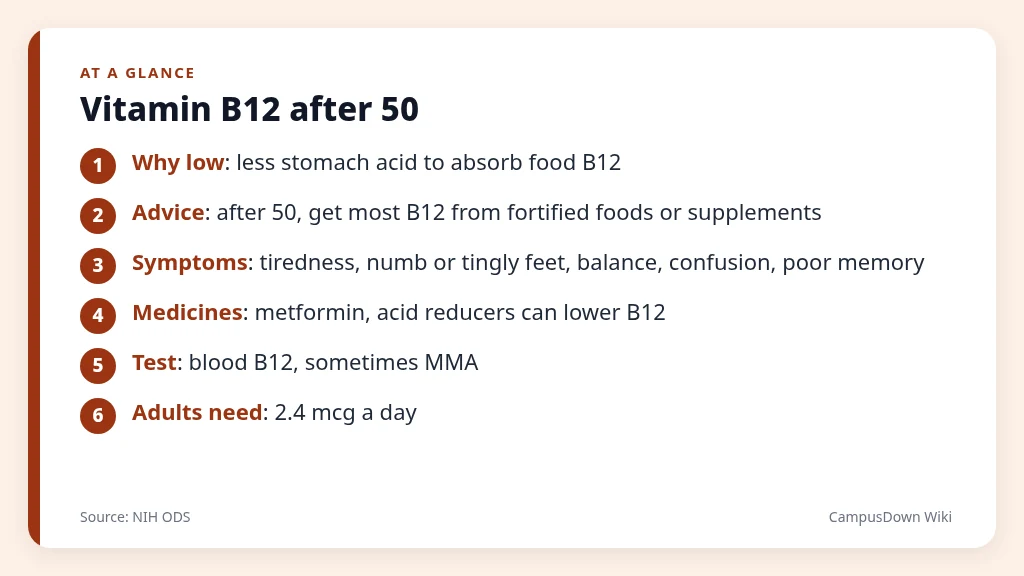
ODS explains that stomach acid separates B12 from food protein before it can be absorbed with the help of intrinsic factor. Many older adults don't make enough stomach acid, so they absorb less B12 from meat, fish, eggs and dairy.
That's why ODS advises that people over 50 get most of their B12 from fortified foods or supplements, which the body can usually absorb. Adults need 2.4 mcg a day.
ODS also lists higher risk for people with:
- Atrophic gastritis or pernicious anemia (an autoimmune condition that blocks intrinsic factor)
- Stomach or intestinal surgery, including weight-loss surgery
- Celiac disease or Crohn's disease
- Vegetarian or vegan diets

How common it is
ODS says B12 deficiency affects between 3% and 43% of older adults, depending on how it's defined. Because the body stores a lot of B12, symptoms can take several years to appear.
Symptoms
ODS lists:
- Tiredness or weakness from megaloblastic anemia
- Numb or tingly hands and feet; see peripheral neuropathy
- Balance problems
- Depression, confusion, poor memory or dementia
- Sore mouth or tongue
Weight and appetite changes have many causes; see unintended weight loss.
B12 and dementia: what the evidence says
Low B12 can cause confusion and memory problems, so doctors check it when memory changes. But ODS notes most studies show low blood B12 doesn't affect the risk of cognitive decline in older people, and more trials are needed on supplements. So B12 corrects a deficiency; it isn't a proven way to prevent dementia. Learn more in early signs of dementia.
Medicines that lower B12
ODS lists:
- Metformin, for diabetes and prediabetes; see B12 deficiency and metformin
- Acid reducers such as omeprazole (Prilosec), lansoprazole (Prevacid) and cimetidine (Tagamet); see omeprazole
Don't stop these medicines on your own; ask whether a B12 check makes sense.
Get help now if
New numbness, weakness, trouble walking or confusion should be checked by a doctor promptly. Untreated B12 deficiency can cause nerve damage, and confusion can have many other causes.
Testing
ODS's health professional sheet says doctors usually measure blood B12; most labs consider values below 200 or 250 pg/mL low. When B12 is borderline, a test for methylmalonic acid (MMA) can help confirm deficiency, though MMA also rises with kidney problems and age. Ask what your numbers mean, and check it for yourself on your lab report.
Treatment and sources
- Fortified foods, such as some breakfast cereals and nutritional yeasts
- Supplements, usually by mouth
- B12 shots, which doctors usually use for pernicious anemia; very high oral doses may also work
- A prescription nasal gel
ODS says B12 hasn't been shown to cause harm even at high doses, but supplements can interact with some medicines, so tell your doctor and pharmacist.
Example scenario: the tingling that wasn't age
- Who
- Percival, 79, a retired high school band director in Sioux Falls, South Dakota, had taken metformin for 14 years and omeprazole for reflux for 8. His daughter, Juniper, 48, noticed he was shuffling and forgetting names of his old students.
- What happened
- He blamed "getting old," but his feet felt numb in bed and he nearly fell on the porch steps twice.
- How it felt
- Juniper feared it was Alzheimer's, and Percival was scared to ask.
- What they did
- She brought his medicine list to his doctor and asked about B12, which she'd read about on the ODS site. Blood tests showed low B12, confirmed with MMA. The doctor started B12 shots, then switched to daily tablets, and reviewed whether he still needed omeprazole.
- How it turned out
- Over several months his energy and balance improved, and the tingling eased some, though not completely. His memory testing was normal for his age. Juniper said a cheap blood test answered the question she'd been too afraid to ask.
This is an illustrative example, not a real patient or a review.
Percival's story is an illustrative example. Ask your doctor before starting any supplement.
Most-asked questions about B12 in older adults
What are B12 deficiency symptoms in the elderly?
Tiredness, weakness, numb or tingly hands and feet, balance problems, depression, confusion, poor memory and a sore tongue.
Why people ask: "b12 deficiency elderly symptoms" is #2 for "b12 deficiency elderly" (US autocomplete, November 2026).
Can B12 deficiency cause dementia in the elderly?
Low B12 can cause confusion and memory problems. But ODS notes most studies show low B12 doesn't change the risk of cognitive decline, so a doctor should check other causes too.
Why people ask: "b12 deficiency elderly dementia" is #3 for "b12 deficiency elderly" (US, November 2026).
What are B12 deficiency symptoms in women?
The same as in men: fatigue, numbness or tingling, balance problems, mood and memory changes, and a sore tongue.
Why people ask: "b12 deficiency symptoms in women" is #5 for "b12 deficiency symptoms" (US, November 2026).
Are elderly women at higher risk of B12 deficiency?
ODS lists risk factors like low stomach acid, pernicious anemia, gut surgery, metformin and acid reducers, which apply to both women and men.
Why people ask: "b12 deficiency in elderly women" is #9 for "b12 deficiency elderly" (US, November 2026).
How is vitamin B12 deficiency in the elderly diagnosed?
With a blood B12 test, sometimes confirmed with methylmalonic acid, plus a look at symptoms and medicines.
Why people ask: "vitamin b12 deficiency elderly symptoms" is #10 for "b12 deficiency elderly" (US, November 2026).
Related on CampusDown
To take a closer look at a common medicine link, read B12 deficiency and metformin.
Frequently asked questions
- How much B12 do older adults need?
- ODS lists 2.4 mcg a day for adults, ideally mostly from fortified foods or supplements after 50.
- Are B12 shots better than pills?
- Doctors usually use shots for pernicious anemia, but ODS notes very high oral doses may also work. Ask your doctor.
- Can I take too much B12?
- ODS says B12 hasn't been shown to cause harm even at high doses, but check interactions with your doctor.
B12 deficiency is common after 60, often hidden, and easy to check. If you notice fatigue, numbness, balance or memory changes, or take metformin or acid reducers, ask your doctor about a B12 test.
Browse more guides like this in the Senior Health and Medicare hub.
This article is for general education and does not replace advice from your own doctor, nurse or pharmacist.