
Was it just a senior moment, or something more? When a parent asks the same question three times in an hour or gets lost driving to a store they've visited for years, the worry is hard to shake. Knowing the difference between normal aging and early dementia helps you act sooner, without panicking.

This guide is based on the National Institute on Aging (NIA) pages on memory problems and aging and on the signs of Alzheimer's disease. It explains in detail what NIA describes. Only a clinician can diagnose dementia.
Normal aging vs dementia
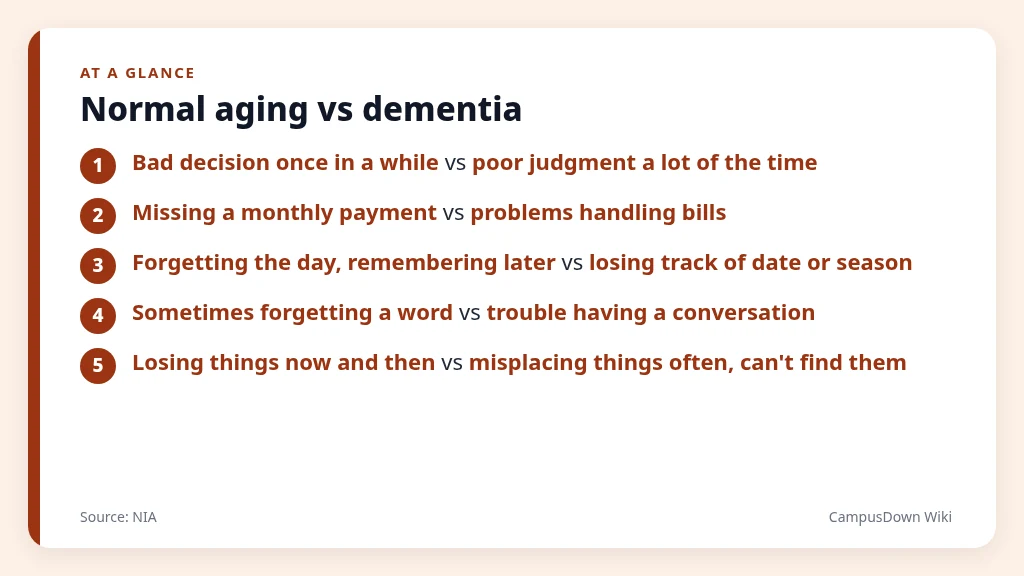
NIA says some changes are common with age, such as taking longer to learn something new, recalling information more slowly, or occasionally misplacing things or forgetting to pay a bill. But dementia is not a normal part of aging. Use the chart below to check it for yourself against what you have noticed.
| Normal aging | Possible dementia |
|---|---|
| Making a bad decision once in a while | Making poor judgments and decisions a lot of the time |
| Missing a monthly payment | Problems taking care of monthly bills |
| Forgetting which day it is and remembering later | Losing track of the date or time of year |
| Sometimes forgetting which word to use | Trouble having a conversation |
| Losing things from time to time | Misplacing things often and being unable to find them |
The key difference, NIA says, is that serious memory problems make it hard to do everyday things like driving, using the phone and finding the way home.

Signs it's time to talk with a doctor
NIA lists these signs:
- Asking the same questions over and over
- Getting lost in places you used to know well
- Trouble following recipes or directions
- More confusion about time, people and places
- Not taking care of yourself: eating poorly, not bathing or behaving unsafely
Early signs of Alzheimer's disease
NIA says memory problems are typically one of the first signs of Alzheimer's. Early, mild-stage problems can include:
- Memory loss that disrupts daily life
- Poor judgment and bad decisions; trouble handling money
- Losing track of dates or where they are
- Taking longer to finish normal tasks
- Word-finding trouble and problems with planning or solving problems
- Losing things or putting them in odd places
- Mood and personality changes, more anxiety or aggression
Memory loss isn't the only sign. NIA notes that people with dementia may also have problems with language, visual perception or attention, and symptoms vary by type, such as Alzheimer's, Lewy body, frontotemporal and vascular dementia. The underlying brain changes and treatments are covered in Alzheimer's pathology and Leqembi and Kisunla.
Mild cognitive impairment (MCI)
Some people have more memory or thinking problems than others their age but can still take care of themselves. This is called MCI. It may be an early sign of Alzheimer's, but not everyone with MCI develops Alzheimer's. Learn more in mild cognitive impairment.
Treatable causes of memory problems
NIA lists other factors that can affect memory, which may improve once treated:
- Medication side effects; see anticholinergic drugs and memory
- Thyroid, kidney or liver problems
- Depression and anxiety; see depression in older adults
- Sleep problems, alcohol or drug misuse
- Low vitamin B12; see vitamin B12 in older adults
- Head injury, or blood clots, tumors or infections in the brain
- Major stress such as retirement or losing a spouse
Hearing loss is also worth checking; see hearing loss and dementia.
Get help now if
Sudden confusion that starts over hours or days is different from slow memory changes. It can be a sign of delirium, infection or stroke. Get medical help right away, and call 911 for stroke signs.
What the doctor may do
NIA says a doctor can perform tests and assessments to find the source of memory problems and may refer to a neurologist. Bring a list of changes with examples and every medicine and supplement. Newer options such as Alzheimer's blood tests are used alongside a full evaluation. NIA suggests people with memory problems schedule a follow-up every 6 to 12 months.
Example scenario: the recipe she'd made for 40 years
- Who
- Esperanza, 72, a retired school librarian in San Antonio, had made her family's Christmas tamales for four decades. Her daughter, Clementine, 44, noticed her mother called three times one afternoon to ask the same question.
- What happened
- In December, Esperanza stood frozen at the counter, unable to remember the next step, and later couldn't find her car in the grocery store lot she'd used for years.
- How it felt
- Esperanza insisted she was "just tired" and snapped at Clementine, who was frightened and didn't want to insult her.
- What they did
- Clementine framed it as a general checkup, wrote down examples, and brought every pill bottle. The doctor did cognitive tests, ordered blood work and a medicine review, and referred Esperanza to a neurologist.
- How it turned out
- Her B12 was low and a sleep pill was stopped, which helped some, but testing still showed early Alzheimer's. Knowing early let the family plan together, and Esperanza taught her granddaughter the tamale steps while she still could.
This is an illustrative example, not a real patient or a review.
Esperanza's story is an illustrative example. Changes in memory deserve a professional evaluation.
Most-asked questions about early dementia signs
Are the early signs of dementia different in men?
NIA doesn't list separate signs for men. Watch for the same changes: repeated questions, getting lost, trouble with bills, and mood or personality changes.
Why people ask: "early signs of dementia in men" is #2 for "early signs of dementia" (US autocomplete, November 2026).
What are the early signs of dementia in women?
The same signs apply: memory loss that disrupts daily life, confusion about time and place, poor judgment and personality changes.
Why people ask: "early signs of dementia in women" is #3 for "early signs of dementia" (US, November 2026).
Is there a test for early signs of dementia?
A doctor can do cognitive tests, blood work and other assessments, and may refer to a neurologist. Online quizzes can't diagnose dementia.
Why people ask: "early signs of dementia test" is #4 for "early signs of dementia" (US, November 2026).
Is it dementia or Alzheimer's?
Dementia is the umbrella term; Alzheimer's is one type. Others include Lewy body, frontotemporal and vascular dementia.
Why people ask: "early signs of dementia or alzheimer's" is #6 for "early signs of dementia" (US, November 2026).
What are signs of dementia in women over 70?
Look for changes that affect daily life, like missing bills, getting lost or stopping self-care, rather than occasional forgetfulness.
Why people ask: "signs of dementia in women over 70" is #6 for "signs of dementia" (US, November 2026).
Related on CampusDown
To take a closer look at the condition, read dementia.
Frequently asked questions
- Is forgetting names normal with age?
- Sometimes forgetting a word or name is common. Ongoing trouble having conversations is a reason to see a doctor.
- Can memory loss be reversed?
- Sometimes, when the cause is treatable, such as medication side effects, thyroid problems or low B12. That's why getting checked matters.
- How do I get my parent to see a doctor?
- Try framing it as a routine checkup, go along, and share specific examples with the doctor privately if needed.
Occasional forgetfulness is normal, but changes that disrupt daily life aren't. Write down what you notice, look for treatable causes, and talk to the doctor early. Knowing sooner gives everyone more time to plan.
Browse more guides like this in the Senior Health and Medicare hub.
This article is for general education and does not replace advice from your own doctor, nurse or pharmacist.