
Could a simple blood draw tell you whether memory problems are caused by Alzheimer's? Not entirely, but it's getting closer. Since 2025, the FDA has cleared blood tests that look for signs of amyloid, the protein plaque linked to Alzheimer's, which once required a PET scan or a spinal tap.

This guide uses the FDA's May 2025 announcement on the first cleared test and Roche's announcements on its Elecsys tests. It explains in detail what's known. Talk to your doctor about whether testing fits your situation.
The FDA-cleared tests
| Test | Maker | Cleared | Intended use |
|---|---|---|---|
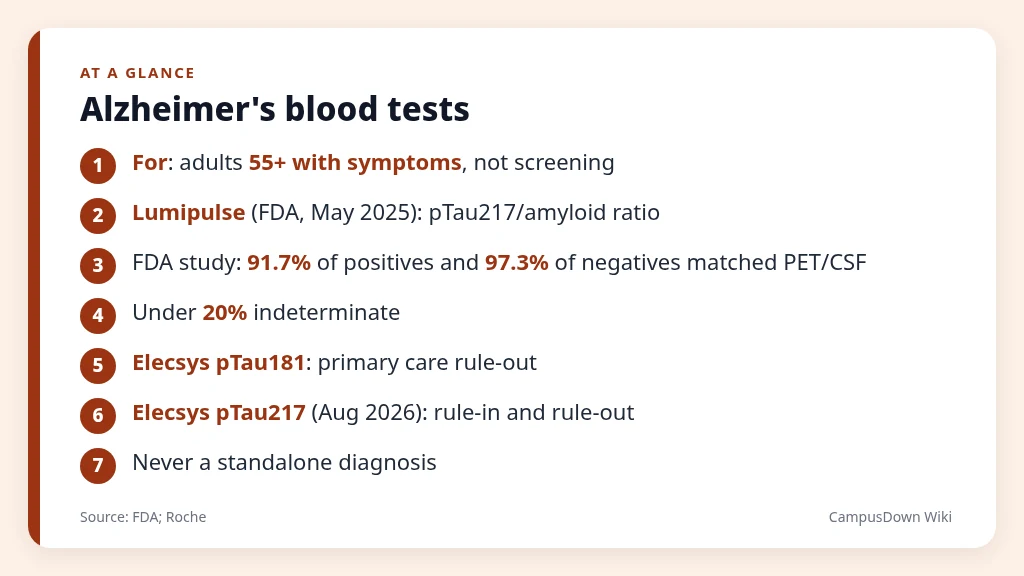
| Lumipulse G pTau217/Beta-Amyloid 1-42 Plasma Ratio | Fujirebio | May 16, 2025 | Aid in detecting amyloid plaques in adults 55+ with signs and symptoms |
| Elecsys pTau181 | Roche | 2025 | Primary care, adults 55+ with cognitive symptoms or complaints; helps rule out amyloid |
| Elecsys pTau217 | Roche (developed with Lilly) | August 2026 | Primary and specialty care, adults 55+ with symptoms; supports rule-in and rule-out with positive, intermediate and negative results |
All are meant for people who already have symptoms. FDA says the Lumipulse test is not intended as a screening or stand-alone diagnostic test.

How accurate is it?
FDA reviewed a study of 499 plasma samples from adults with cognitive impairment:
- 91.7% of people with a positive result had amyloid on PET or spinal fluid testing.
- 97.3% of people with a negative result had a negative PET or spinal fluid result.
- Less than 20% got an indeterminate result.
FDA notes the main risks are false positives, which could lead to an inappropriate diagnosis and unnecessary treatment, and false negatives, which could delay care.
What a result means
- Positive: amyloid is likely. Your specialist may confirm with PET or spinal fluid testing, especially before treatments like Leqembi or Kisunla.
- Negative: amyloid is unlikely, so doctors look harder at other causes of memory problems, such as medicines, sleep, mood, vitamin B12 levels or thyroid problems.
- Indeterminate or intermediate: more testing is usually needed.
Amyloid alone doesn't equal dementia. FDA notes plaques can show up on PET scans years before symptoms, and amyloid can occur in other diseases. Learn more about the science in Alzheimer's pathology and the amyloid hypothesis.
Get help now if
Be cautious about direct-to-consumer amyloid tests ordered without a clinician. FDA says these tests should be interpreted alongside other clinical evaluations. A result without context can cause needless fear or false reassurance.
Questions to ask your doctor
Before testing, it helps to check it for yourself with a few questions:
- Which test is this, and is it FDA-cleared for my situation?
- What will we do if it's positive, negative or indeterminate?
- Will insurance or Medicare cover it, and what will I pay?
- What other causes of my symptoms are we checking?
Example scenario: a result in context
- Who
- Philippa, 68, a retired court stenographer in Spokane, had been losing words mid-sentence and missing appointments. Her primary care doctor ordered a memory screen and an FDA-cleared blood test.
- What happened
- She'd read online that "one blood test tells you if you'll get Alzheimer's" and spent the week before her results barely sleeping.
- How it felt
- She felt terrified of becoming like her aunt and angry that a single number might decide her future. Her husband, Ellsworth, tried to stay calm but searched forums every night.
- What they did
- Her doctor explained the test was one piece of an evaluation. Her result was indeterminate, so she was referred to a neurologist, who did detailed memory testing and a PET scan.
- How it turned out
- The PET showed amyloid, and she was diagnosed with mild cognitive impairment due to Alzheimer's. It was hard news, but Philippa said knowing the steps ahead of time, and having a plan, felt better than the waiting.
This is an illustrative example, not a real patient or a review.
Philippa is an illustrative example. Your doctor will interpret any test for you.
Most-asked questions about Alzheimer's blood tests
How accurate is the Alzheimer's blood test?
In FDA's review of Lumipulse, 91.7% of positives and 97.3% of negatives matched PET or spinal fluid results, and under 20% were indeterminate.
Why people ask: "alzheimer's blood test accuracy" is #5 for "alzheimers blood test" (US autocomplete, November 2026).
What is the Alzheimer's blood test called?
FDA-cleared tests include the Lumipulse G pTau217/Beta-Amyloid 1-42 Plasma Ratio and Roche's Elecsys pTau181 and pTau217.
Why people ask: "alzheimer's blood test name" is #4 for "alzheimer's blood test" (US, November 2026).
Is there an FDA-approved Alzheimer's blood test?
Yes, FDA cleared Lumipulse in May 2025, and later cleared Roche tests. They aid diagnosis in people with symptoms and aren't screening tests.
Why people ask: "alzheimer's blood test fda approved" is #7 for "alzheimer's blood test" (US, November 2026).
How do I interpret Alzheimer's blood test results?
Positive means amyloid is likely, negative means unlikely, and indeterminate means more testing. Your doctor combines results with other evaluations.
Why people ask: "alzheimer's blood test results interpretation" is #8 for "alzheimer's blood test" (US, November 2026).
What is the Lumipulse blood test?
Fujirebio's test measures pTau217 and beta-amyloid 1-42 in blood and calculates a ratio linked to amyloid plaques in the brain.
Why people ask: "lumipulse blood test" is #1 for "lumipulse" (US, November 2026).
Related on CampusDown
To take a closer look at symptoms, read early signs of dementia, mild cognitive impairment and dementia.
Frequently asked questions
- Can I get an Alzheimer's blood test without symptoms?
- The FDA-cleared tests are intended for adults 55+ with signs or symptoms, not for screening people without symptoms.
- Does a positive test mean I have Alzheimer's?
- No. It suggests amyloid is likely. Diagnosis requires a full clinical evaluation, and sometimes PET or spinal fluid testing.
- Can a blood test replace a PET scan?
- FDA says it may reduce the need for PET scans, but some people will still need PET or spinal fluid testing.
Alzheimer's blood tests are a real step forward for people with symptoms, but they're one piece of a careful evaluation. Ask what the result will change, plan next steps together, and talk to your doctor before and after testing.
Browse more guides like this in the Senior Health and Medicare hub.
This article is for general education and does not replace advice from your own doctor, nurse or pharmacist.