
Is there finally a drug that changes the course of Alzheimer's? Leqembi and Kisunla are the first widely used treatments that remove amyloid plaques from the brain, and they can modestly slow decline in early disease. They also come with real commitments and risks, which families should understand before starting.

This guide uses the Leqembi and Kisunla FDA labels on DailyMed and Medicare.gov. It explains in detail what they say. Decisions about these drugs belong to you, your family and a dementia specialist.
Who they're for
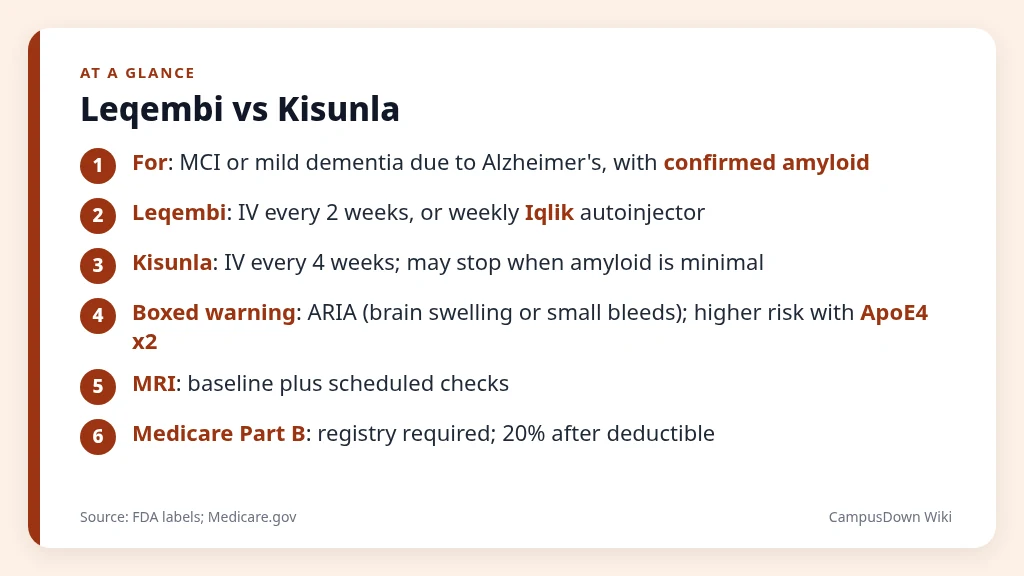
Both labels say treatment should be started only in people with mild cognitive impairment (MCI) or mild dementia due to Alzheimer's, the stage studied in trials. Before starting, doctors must confirm amyloid with a PET scan or spinal fluid test (blood tests can help guide who needs confirmation; see Alzheimer's blood tests) and get a recent baseline brain MRI.
Medicare.gov puts it plainly: these drugs may slow or delay symptoms of Alzheimer's, but they can't reverse the disease or make it go away.

How they're given
| Leqembi (lecanemab) | Kisunla (donanemab) | |
|---|---|---|
| Maker | Eisai | Eli Lilly |
| Starting | IV 10 mg/kg every 2 weeks (about 1 hour), or 500 mg weekly by Leqembi Iqlik autoinjector | IV every 4 weeks (about 30 minutes): 350 mg, 700 mg, 1,050 mg, then 1,400 mg |
| After 18 months / later | Continue, or maintenance: IV 10 mg/kg every 4 weeks or Iqlik 360 mg weekly | Consider stopping once amyloid is reduced to minimal levels on PET |
| MRI checks | Baseline, then after 1, 2, 3 and 6 months | Baseline, then before the 2nd, 3rd, 4th and 7th infusions |
The ARIA boxed warning
Both drugs carry a boxed warning for amyloid-related imaging abnormalities (ARIA): ARIA-E (swelling) and ARIA-H (small bleeds or iron deposits). The labels say ARIA is usually without symptoms, but serious and life-threatening events, including seizures, can occur, and ARIA can be fatal. Symptoms may include headache, confusion, visual changes, dizziness, nausea and trouble walking.
- In Leqembi's main trial, ARIA-E occurred in 13% of treated patients vs 2% on placebo.
- In Kisunla's main trial, ARIA-E occurred in 24% vs 2% on placebo, and symptomatic ARIA-E in 6%.
- ApoE ε4 homozygotes (two copies of the gene) have a higher risk of ARIA, including serious ARIA. Both labels say ApoE4 testing should be done before treatment, after discussing what results mean.
- Caution is advised with blood thinners because brain bleeds larger than 1 cm have occurred.
Get help now if
During treatment, call the care team right away for new headache, confusion, vision changes, dizziness, trouble walking, or a seizure. Make sure emergency doctors know you take an anti-amyloid drug; the labels say ARIA can mimic a stroke, which matters before any clot-busting treatment.
Other side effects
- Leqembi: infusion-related reactions, ARIA and headache are most common; injection-site reactions can happen with Iqlik.
- Kisunla: ARIA and headache are most common; infusion-related reactions occurred in about 9% in its main trial, mostly in the first 4 infusions.
Medicare coverage
Medicare Part B may cover Leqembi or Kisunla if you have MCI or mild dementia due to Alzheimer's with confirmed amyloid, and your provider collects data for a qualifying study or registry. After the Part B deductible, you pay 20% of the Medicare-approved amount. Ask whether your clinic participates, and check it for yourself on Medicare.gov.
Example scenario: weighing the commitment
- Who
- Zachariah, 72, a retired high school principal in Raleigh, was diagnosed with mild cognitive impairment due to Alzheimer's after a PET scan confirmed amyloid.
- What happened
- His neurologist explained both drugs, the MRI schedule, and ApoE4 testing. Zachariah wanted to start immediately; his wife, Wilhelmina, was frightened by the word "bleeding."
- How it felt
- He felt hopeful for the first time since his diagnosis. She felt torn between supporting him and fearing a side effect. Their son worried about the drive to infusions.
- What they did
- They asked for genetic counseling before ApoE4 testing, learned he had one copy, reviewed his blood thinner history, and confirmed the clinic enrolled patients in the Medicare registry. They chose the option whose schedule fit their lives.
- How it turned out
- Months later, Zachariah had completed his scheduled MRIs, with one mild ARIA finding without symptoms that his team monitored. He said the honest conversations up front made the hard parts easier.
This is an illustrative example, not a real patient or a review.
Zachariah is an illustrative example. Your specialist will tailor decisions to you.
Most-asked questions about Leqembi and Kisunla
What are Leqembi side effects?
Most common are infusion-related reactions, ARIA (brain swelling or small bleeds) and headache. Injection-site reactions can occur with Leqembi Iqlik.
Why people ask: "leqembi side effects" is #3 for "leqembi" (US autocomplete, November 2026).
What is Leqembi Iqlik?
An autoinjector for weekly under-the-skin Leqembi, used to start treatment (500 mg) or for maintenance (360 mg).
Why people ask: "leqembi iqlik" is #5 for "leqembi" (US, November 2026).
Leqembi vs Kisunla: which is better?
They haven't been compared head to head. They differ in schedule, ARIA rates in their trials and whether treatment can stop; the choice is individual.
Why people ask: "leqembi vs kisunla which is better" is #3 for "leqembi vs kisunla" (US, November 2026).
What is the Kisunla MRI schedule?
A recent baseline MRI, then MRIs before the 2nd, 3rd, 4th and 7th infusions, plus any time symptoms suggest ARIA.
Why people ask: "kisunla mri schedule" is #7 for "kisunla" (US, November 2026).
What does ARIA mean in Alzheimer's treatment?
Amyloid-related imaging abnormalities: brain swelling (ARIA-E) or small bleeds and iron deposits (ARIA-H) seen on MRI, usually without symptoms.
Why people ask: "aria meaning alzheimer's" is #7 for "aria alzheimer's" (US, November 2026).
Related on CampusDown
To take a closer look at the science, read Alzheimer's pathology and the amyloid hypothesis, mild cognitive impairment and early signs of dementia.
Frequently asked questions
- Can someone with moderate Alzheimer's start Leqembi or Kisunla?
- The labels say treatment should start at the MCI or mild dementia stage, the population studied.
- Do I need ApoE4 testing?
- Both labels say testing should be done before treatment to inform ARIA risk, after discussing implications. You can still be treated without testing.
- Do these drugs stop Alzheimer's?
- No. Medicare.gov notes they may slow or delay symptoms but can't reverse the disease.
Leqembi and Kisunla offer a modest chance to slow early Alzheimer's, in exchange for regular treatments, MRI checks and a real ARIA risk. Ask questions, involve your family, check registry coverage, and talk to your doctor about whether it fits your goals.
Browse more guides like this in the Senior Health and Medicare hub.
This article is for general education and does not replace advice from your own doctor, nurse or pharmacist.