
You've been given a prescription for Xanax, or a family member has, and the pharmacy handed over a long Medication Guide. What are you supposed to take from all that fine print?

This guide explains the main points in plain language. It draws on MedlinePlus's alprazolam drug information page, FDA's Drug Safety Communication on benzodiazepine boxed warnings and the Xanax prescribing label posted on FDA's Drugs@FDA site (2021 version, which FDA notes may not be the latest). It is general education and not a substitute for your prescriber or pharmacist. Do not start, stop or change this medicine on your own, and don't use this page to choose a dose. To learn more about each point, take a closer look at the sections below.
What alprazolam is
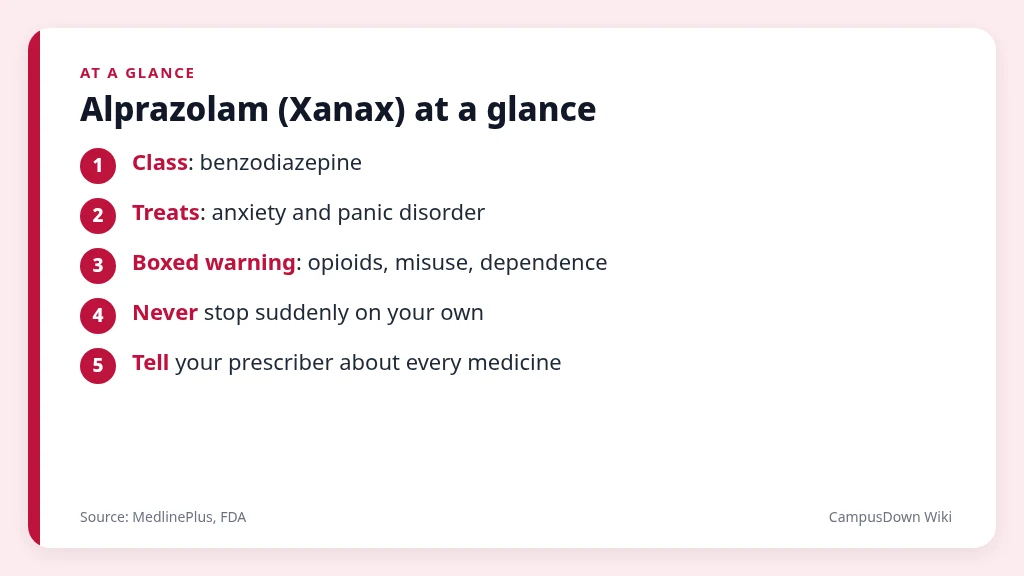
Alprazolam is the generic name; Xanax is a well-known brand name. MedlinePlus says it is used to treat anxiety disorders and panic disorder and that it is in a class of medicines called benzodiazepines, which work by decreasing abnormal excitement in the brain. It comes as a tablet, an extended-release tablet, a disintegrating tablet and an oral solution, according to MedlinePlus.
FDA describes benzodiazepines as a class approved for conditions such as generalized anxiety disorder, insomnia, seizures, social phobia and panic disorder, and says they work by binding to GABA receptors in the brain, which causes drowsiness or calming effects. For background on the conditions themselves, see panic disorder and generalized anxiety disorder.

The boxed warning, in plain words
A boxed warning is FDA's most prominent warning. The alprazolam label's boxed warning covers three topics:
- Use with opioids. Taking a benzodiazepine together with an opioid may cause profound sedation, slowed breathing, coma and death. The label says this combination is reserved for people who have no adequate alternatives.
2. Abuse, misuse and addiction. The label says benzodiazepines expose users to these risks, which can lead to overdose or death, and that misuse often involves other medicines, alcohol or illicit substances. 3. Dependence and withdrawal. The label says continued use may lead to significant physical dependence, that the risk rises with longer treatment and higher daily doses, and that stopping suddenly or cutting back too fast can cause withdrawal reactions that can be life-threatening. It says a gradual taper is used to stop or reduce the dose.
FDA's safety communication adds that physical dependence can occur when benzodiazepines are taken steadily for several days to weeks, even as prescribed, and that withdrawal reactions can include seizures. Dependence is not the same as a moral failing; it's a known effect of this drug class.
Get help now if
Do not stop alprazolam or take fewer doses on your own. MedlinePlus says your doctor will probably decrease the dose gradually. Call your doctor or get emergency treatment for seizures, shaking, muscle twitching, memory problems, seeing or hearing things others don't, thoughts of harming yourself or others, or losing touch with reality.
What to tell your prescriber and pharmacist
MedlinePlus says to tell your doctor and pharmacist about all prescription and nonprescription medicines, vitamins, supplements and herbal products. It specifically asks about cough and pain medicines because combining them with alprazolam can raise the risk of serious breathing problems, sedation or coma, and it lists some over-the-counter allergy medicines, cimetidine and other antacids and St. John's wort as products that may interact.
Also tell your doctor if you:
- have ever drunk large amounts of alcohol, use or have used street drugs or have overused prescription medicines
- have or have had depression or another mental illness
- have glaucoma, seizures, lung or breathing problems or kidney or liver disease
- are pregnant, plan to become pregnant or are breastfeeding
MedlinePlus also says the medicine may not be recommended for people 65 or older, and that other options may be safer or work better; the FDA label notes that the elderly may be more sensitive to benzodiazepines. A brown bag medicine review with a pharmacist is a practical way to catch interactions, and the guide to anticholinergic drugs and memory covers another group of medicines to ask about.
Side effects to know
MedlinePlus lists common side effects such as drowsiness, light-headedness, headache, tiredness, dizziness, irritability, dry mouth, nausea and constipation. It says to tell your doctor if they are severe or don't go away, and not to drive or operate machinery until you know how the medicine affects you.
Call your doctor right away or get emergency help, per MedlinePlus, for shortness of breath, seizures, rash, hives or swelling of the face or throat, yellowing of the skin or eyes, confusion, problems with speech and problems with coordination or balance. Slowed or difficult breathing, extreme sleepiness or unresponsiveness are emergencies. Serious side effects can be reported to FDA's MedWatch program.
Alcohol, missed doses and safe storage
- Alcohol and other sedating substances: FDA says abuse and misuse often involve alcohol and other substances, and the label links combined use with more frequent serious outcomes. Ask your prescriber what is safe for you.
- Missed dose: MedlinePlus says to take it as soon as you remember unless it's almost time for the next dose, and never to double up.
- Storage: keep it in the original container, tightly closed, at room temperature and out of reach of children, and not in the bathroom.
- Disposal: MedlinePlus says not to flush it; use a medicine take-back program.
- Overdose: call Poison Control at 1-800-222-1222, or 911 if someone has collapsed, had a seizure, has trouble breathing or can't be awakened.
Questions to bring to your appointment
- What is this medicine for in my case, and for how long is it meant to be used?
- Which of my other medicines, including cough, pain and allergy products, might interact?
- What is the plan for stopping, and who should I call if I have problems?
- Are there other treatments, such as therapy, that can be used alongside or instead? See what to do during a panic attack for non-medicine steps.
- If I feel chest tightness, how do I tell anxiety from something else? Read anxiety and chest pain and ask for advice that fits your health history.
Example scenario: the question she was afraid to ask
- Who
- Saoirse, 34, a dental hygienist in Boise, Idaho, had been prescribed alprazolam after a rough stretch of panic attacks.
- What happened
- After several months she wanted to stop, felt embarrassed about needing it, and had heard that quitting suddenly could be risky.
- How it felt
- She felt anxious about asking, worried she would sound like she was misusing it and unsure who to call.
- What they did
- She wrote her questions in her notes app, brought her list of medicines to her prescriber and asked how to stop safely. Her prescriber reviewed her history and set up a follow-up plan, and the pharmacist went over the Medication Guide with her.
- How it turned out
- Saoirse said she felt relieved that stopping was something to plan together rather than something to do alone.
This is an illustrative example, not a real patient or a review.
Saoirse's story is an illustrative example. Decisions about stopping or changing a medicine are made with your own prescriber.
Most-asked questions about alprazolam
What is Xanax used for?
MedlinePlus says alprazolam treats anxiety disorders and panic disorder.
Why people ask: "xanax for anxiety" is #9 for "xanax" (US autocomplete, November 2026).
What are the side effects of Xanax?
Drowsiness, light-headedness, headache, tiredness and dizziness are common; serious ones include breathing problems, seizures and confusion.
Why people ask: "xanax side effects" is #5 for "xanax" (US autocomplete, November 2026).
What are Xanax withdrawal symptoms?
FDA says withdrawal reactions can include seizures and can be life-threatening if the drug is stopped abruptly, so use a gradual taper with your prescriber.
Why people ask: "xanax withdrawal symptoms" is #8 for "xanax" (US autocomplete, November 2026).
Is Xanax the same as alprazolam?
Xanax is a brand name for alprazolam; ask your pharmacist about brand and generic products.
Why people ask: "xanax generic" is #2 for "xanax" (US autocomplete, November 2026).
What is the half-life of Xanax?
The FDA label reports a mean half-life of about 11 hours in healthy adults and 16.3 hours in healthy elderly subjects; ask your pharmacist what that means for you.
Why people ask: "xanax half life" is #10 for "xanax" (US autocomplete, November 2026).
Related on CampusDown
You can learn more about panic disorder and check it for yourself in the medicines hub. For the condition side in detail, read generalized anxiety disorder.
Frequently asked questions
- Is alprazolam addictive?
- FDA's boxed warning says benzodiazepines carry risks of abuse, misuse and addiction, and physical dependence can develop even when taken as prescribed.
- Can I stop Xanax suddenly if I feel better?
- No. FDA says abrupt discontinuation can cause life-threatening withdrawal reactions. Ask your prescriber for a gradual plan.
- Can I take Xanax with opioid pain medicine?
- The boxed warning says the combination can cause profound sedation, breathing problems, coma and death. Tell every prescriber and your pharmacist about all your medicines.
- Is alprazolam safe for older adults?
- MedlinePlus says it may not be recommended for people 65 or older and other options may be safer. Talk with a clinician about risks and benefits.
- What should I do with leftover pills?
- MedlinePlus says not to flush them; use a take-back program and keep the medicine away from children until then.
Alprazolam can help some people with panic and anxiety, and it comes with serious warnings. Ask questions, tell your care team about every medicine and never stop it on your own.
Browse more guides like this in the Medicines hub.
This article is for general education and does not replace advice from your own doctor, nurse or pharmacist.