
You finally lie down, and the burning starts: sour taste, a tight throat, maybe a cough. Why does reflux seem so much worse at night, and what can you do about it?

This guide uses NIDDK pages on acid reflux (GER and GERD) in adults and MedlinePlus on chest pain. It is general education, not a diagnosis. Talk with your doctor or pharmacist before starting or stopping any reflux medicine, and see a clinician for symptoms that persist. To learn more about the condition, see GERD, and take a closer look at the steps below.
What reflux feels like
NIDDK says gastroesophageal reflux (GER) and gastroesophageal reflux disease (GERD) commonly cause heartburn, a painful burning feeling in the middle of the chest, behind the breastbone, rising toward the throat, and regurgitation, when stomach contents come back up into the throat or mouth and you taste food or acid. Not everyone has heartburn or regurgitation. Other symptoms can include chest pain, nausea, trouble swallowing or pain with swallowing, and signs in the mouth, throat or lungs such as a chronic cough or hoarseness.

Why night-time matters
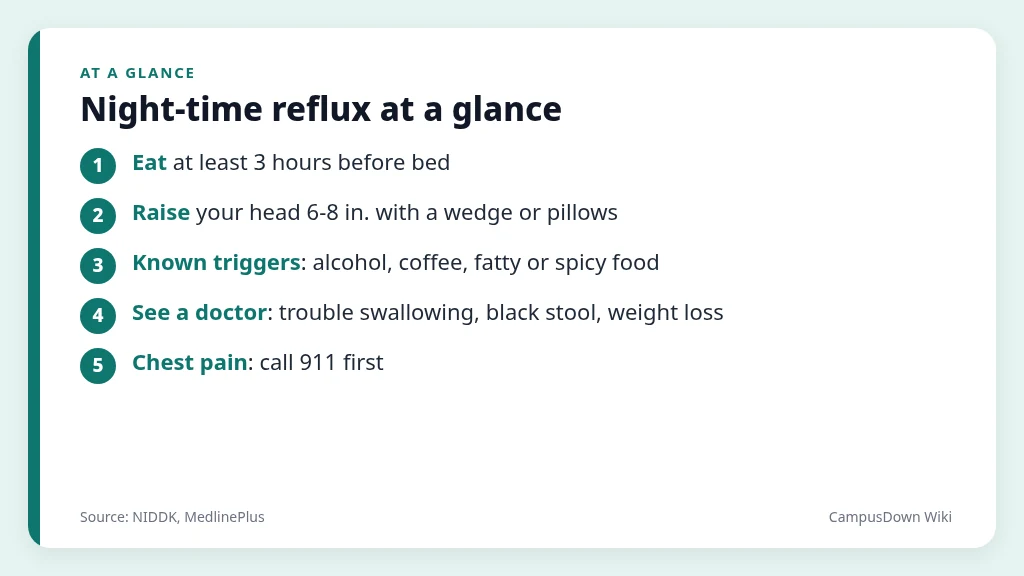
NIDDK's guidance for people who have symptoms at night or when lying down is to eat meals at least 3 hours before you lie down or go to bed, which may improve symptoms. NIDDK also lists raising the head of your bed as a treatment step. The practical point is that meal timing and sleeping position are things you can change, and both are worth discussing with your doctor.
Steps NIDDK lists
- Eat earlier. Leave at least 3 hours between your last meal and bed.
- Raise your head. NIDDK says doctors may suggest placing a foam wedge or extra pillows under your head and upper back so your body inclines, raising your head 6 to 8 inches off the bed. NIDDK specifies the head and upper back, so ask your doctor how to set it up.
- Stop smoking and avoid secondhand smoke, which NIDDK lists among factors that affect the lower esophageal sphincter.
- Lose weight if you're overweight. NIDDK says doctors may suggest it; being overweight or having obesity is a listed factor.
- Look at your triggers. See the next section.
Common trigger foods
NIDDK says some people find certain foods and drinks trigger symptoms or make them worse. Those commonly linked to GERD symptoms include acidic foods such as citrus fruits and tomatoes, alcoholic drinks, chocolate, coffee and other sources of caffeine, high-fat foods, mint and spicy foods. NIDDK suggests talking with your doctor about which foods seem to increase your symptoms; your doctor may recommend cutting back on particular ones to see whether symptoms improve.
Medicines that can make GERD worse
NIDDK says some medicines can cause GERD or worsen it, including benzodiazepines, calcium channel blockers, certain asthma medicines, nonsteroidal anti-inflammatory drugs (NSAIDs) and tricyclic antidepressants. Don't stop a prescribed medicine on your own; ask your doctor or pharmacist whether a change makes sense for you.
Treatment options
NIDDK describes three common medicine types:
- Antacids relieve mild heartburn and mild symptoms; you shouldn't use them every day or for severe symptoms without discussing it with your doctor.
- H2 blockers lower the amount of acid the stomach makes; see famotidine.
- Proton pump inhibitors (PPIs) also lower stomach acid, are better at treating GERD symptoms than H2 blockers and can heal the esophageal lining in most people with GERD. See omeprazole and pantoprazole.
NIDDK says PPIs are generally safe and effective, with uncommon side effects such as headache, diarrhea and upset stomach, and that research suggests taking them may increase the chance of a *Clostridioides difficile* (C. diff) infection; see C. diff. Experts are still studying long-term or high-dose use, so talk with your doctor about benefits and risks. Surgery and other procedures are options if symptoms don't improve.
When to see a doctor
NIDDK says to see a doctor if you think you have GERD or if symptoms don't improve with over-the-counter medicines or lifestyle changes. Also see a doctor for symptoms that could mean complications or something more serious:
- chest pain
- loss of appetite
- persistent vomiting
- trouble swallowing or pain with swallowing
- vomit that contains blood or looks like coffee grounds
- stool that contains blood or looks black and tarry
- unexplained weight loss
Get help now if
Heartburn and a heart attack can feel alike. MedlinePlus says to call 911 for sudden crushing, squeezing or pressure in the chest, pain spreading to the jaw, arm or back, or chest pain with nausea, dizziness, sweating, a racing heart or shortness of breath. If in doubt, call. See chest pain and anxiety for how doctors sort it out.
Example scenario: the late-night snack
- Who
- Mavis, 52, a school bus dispatcher in Des Moines, Iowa, had burning in her chest almost every night after late dinners and a glass of wine.
- What happened
- She propped herself on three pillows and took antacids most evenings, but her neck hurt and the burning still woke her.
- How it felt
- She felt tired, annoyed and a little worried that something serious was going on.
- What they did
- She booked an appointment, brought a list of her medicines and symptoms and asked about meal timing, a wedge pillow and whether her blood pressure pill could play a part. Her doctor reviewed her medicines, talked through her routine and set up follow-up.
- How it turned out
- Mavis said she felt relieved to have a plan instead of a nightly guessing game.
This is an illustrative example, not a real patient or a review.
Mavis's story is an illustrative example. Symptoms and treatment are decided with your own doctor.
Most-asked questions about acid reflux at night
Why do I only get acid reflux at night?
NIDDK says symptoms when lying down can improve with earlier meals and a raised head; ask your doctor if it keeps happening.
Why people ask: "acid reflux at night only" is #2 for "acid reflux at night" (US autocomplete, November 2026).
Is acid reflux at night common in pregnancy?
NIDDK lists being pregnant as a factor that can affect the lower esophageal sphincter; ask your obstetric provider before taking any medicine.
Why people ask: "acid reflux at night pregnancy" is #3 for "acid reflux at night" (US autocomplete, November 2026).
What causes acid reflux at night?
A weak or relaxing lower esophageal sphincter, certain medicines, a hiatal hernia, smoking and extra weight are among NIDDK's listed factors.
Why people ask: "acid reflux at night causes" is #4 for "acid reflux at night" (US autocomplete, November 2026).
What are the symptoms of acid reflux at night?
Heartburn, regurgitation, and sometimes chest pain, nausea, trouble swallowing, chronic cough or hoarseness.
Why people ask: "acid reflux at night symptoms" is #5 for "acid reflux at night" (US autocomplete, November 2026).
What should I do for acid reflux at night?
Try NIDDK's steps (earlier meals, raising your head, avoiding triggers), and see a doctor if symptoms persist or warning signs appear.
Why people ask: "acid reflux at night what to do" is #8 for "acid reflux at night" (US autocomplete, November 2026).
Related on CampusDown
You can learn more about obstructive sleep apnea if you also snore, and check it for yourself with the sleep changes with aging guide.
Frequently asked questions
- How long should I wait after eating before lying down?
- NIDDK says eating meals at least 3 hours before bed may improve night-time symptoms.
- How high should I raise my head?
- NIDDK says doctors may suggest raising your head 6 to 8 inches using a foam wedge or extra pillows under your head and upper back.
- Can I take antacids every night?
- NIDDK says not every day or for severe symptoms without discussing it with your doctor.
- Can reflux medicine have side effects?
- NIDDK lists headache, diarrhea and upset stomach for PPIs, and says research suggests PPIs may raise the chance of C. diff. Ask your doctor.
Night-time reflux responds to practical changes like earlier meals and a raised head, and it deserves a check-up if it keeps coming back. Know the warning signs, and call 911 for chest pain with the red-flag symptoms.
Browse more guides like this in the U.S. Health Topics hub.
This article is for general education and does not replace advice from your own doctor, nurse or pharmacist.