
You keep a bottle of famotidine in the bathroom for heartburn. It helps, so you take it most nights. How long is too long, and what is it actually doing in your stomach?

This guide explains famotidine in plain language, based on MedlinePlus's famotidine drug information and NIDDK's GERD treatment page. It does not give doses; follow your label and talk to your doctor or pharmacist. To learn more about nighttime symptoms, take a closer look at acid reflux at night.
What famotidine is
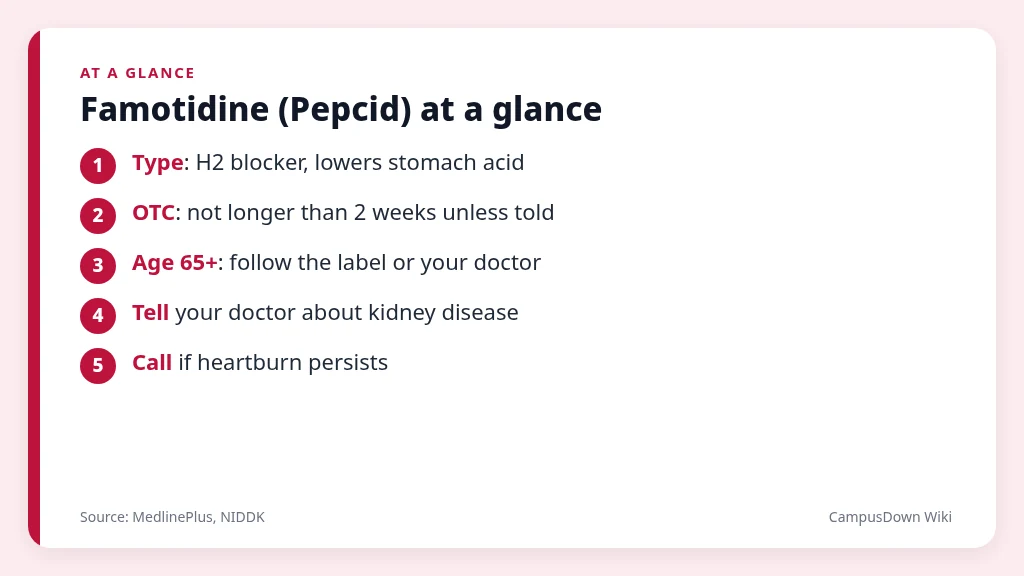
MedlinePlus says famotidine is in a class called H2 blockers, which work by decreasing the amount of acid made in the stomach. Pepcid is a brand name. Prescription famotidine is used to:
- treat ulcers in the stomach or intestine
- treat GERD, in which stomach acid flows back into the esophagus
- treat conditions where the stomach makes too much acid, such as Zollinger-Ellison syndrome
- treat and prevent heartburn
MedlinePlus says it comes as a tablet, a chewable tablet and a liquid suspension, and some strengths are sold over the counter.

How it compares with PPIs
NIDDK says H2 blockers lower the amount of acid your stomach makes and can help heal the esophagus, but not as well as proton pump inhibitors (PPIs). PPIs such as omeprazole and pantoprazole are better at treating GERD symptoms and can heal the esophageal lining in most people with GERD, according to NIDDK. Both types are available over the counter or by prescription. Which one makes sense depends on your symptoms, so ask your clinician rather than switching on your own.
How to take it
MedlinePlus says:
- Take exactly as directed, not more, not more often and not longer than prescribed.
- Prescription famotidine may be taken once daily at bedtime or two to four times a day.
- Swallow tablets with a full glass of water. Chew chewable tablets thoroughly, then swallow with a full glass of water.
- Shake the liquid well before each use.
- Over-the-counter limits: do not take more than two tablets or chewable tablets in 24 hours, and do not take OTC famotidine for longer than 2 weeks unless your doctor tells you to.
- If heartburn, acid indigestion or sour stomach lasts longer than 2 weeks, stop OTC famotidine and call your doctor.
If you miss a prescription dose, MedlinePlus says to take it as soon as you remember unless it's nearly time for the next one, and not to double up.
Who needs extra caution
Tell your doctor or pharmacist if you:
- have kidney disease, trouble swallowing or phenylketonuria (PKU), as MedlinePlus lists (see also chronic kidney disease)
- are 65 or older, since MedlinePlus says not to use it longer than the label or your doctor recommends
- are pregnant, plan to become pregnant or are breastfeeding
- take other medicines, especially other heartburn medicines. MedlinePlus says nonprescription heartburn products may interact and to not start them with famotidine without talking to a provider.
A brown bag review can help catch overlaps between acid reducers.
Side effects
MedlinePlus says to tell your doctor if these are severe or persistent: headache, dizziness, constipation and diarrhea. Allergic signs such as hives, rash, itching, swelling of the face, lips or tongue, hoarseness or trouble breathing or swallowing are uncommon but need prompt medical help.
Get help now if
Call 911 for trouble breathing, swelling of the face or throat or severe chest pain. Chest pain, a feeling of pressure, or pain with sweating or shortness of breath should not be assumed to be heartburn.
When heartburn needs more than a pill
Heartburn that comes back often, lasts beyond 2 weeks of OTC treatment or comes with new swallowing trouble should be reviewed by a clinician. NIDDK describes lifestyle changes, medicines and, in some cases, procedures for GERD, and a clinician can decide what suits you. Bring a list of what you take and when symptoms occur.
Questions to ask your pharmacist or doctor
- Is famotidine the right acid reducer for my symptoms?
- How long can I safely use it?
- Does my age or kidney function change how I should use it?
- Can I take it with my other medicines or other heartburn products?
- What symptoms mean I should be checked rather than keep treating myself?
- Would a PPI make sense, or should I stay with an H2 blocker?
Example scenario: nightly heartburn
- Who
- Vivian, 71, a retired postal clerk in Dayton, Ohio, took over-the-counter famotidine most evenings for months because it eased her heartburn.
- What happened
- She wasn't sure how long was too long, and she didn't want to bother her doctor over indigestion.
- How it felt
- She felt a little sheepish and a little worried.
- What they did
- She read the label, saw the two-week limit and called her pharmacist, who suggested she talk with her primary care clinician. At the visit they reviewed her symptoms, her kidney function and her medicines and planned follow-up.
- How it turned out
- Vivian said she was glad she asked instead of assuming it was fine.
This is an illustrative example, not a real patient or a review.
Vivian's story is an illustrative example. Your own plan comes from your clinician.
Most-asked questions about famotidine
What are the side effects of famotidine?
Headache, dizziness, constipation and diarrhea are listed by MedlinePlus; allergic signs need prompt help.
Why people ask: "famotidine side effects" is #4 for "famotidine" (US autocomplete, November 2026).
What is famotidine used for?
Ulcers, GERD, conditions with excess stomach acid and heartburn.
Why people ask: "famotidine uses" is #5 for "famotidine" (US autocomplete, November 2026).
What is the brand name for famotidine?
Pepcid, per MedlinePlus.
Why people ask: "famotidine brand name" is #6 for "famotidine" (US autocomplete, November 2026).
How does famotidine compare with omeprazole?
Famotidine is an H2 blocker; omeprazole is a PPI. NIDDK says PPIs heal the esophagus better than H2 blockers.
Why people ask: "famotidine vs omeprazole" is #7 for "famotidine" (US autocomplete, November 2026).
Is famotidine available over the counter?
Yes, some strengths are; OTC use has limits (no more than 2 weeks unless your doctor says).
Why people ask: "famotidine otc" is #9 for "famotidine" (US autocomplete, November 2026).
Related on CampusDown
You can learn more about medicines and check it for yourself in the nighttime reflux guide. For a stronger acid reducer in detail, see omeprazole.
Frequently asked questions
- How long can I take OTC famotidine?
- MedlinePlus says no longer than 2 weeks unless your doctor tells you to.
- Is it the same as omeprazole?
- No. Famotidine is an H2 blocker; omeprazole is a PPI, which NIDDK says heals the esophagus better.
- Can older adults use it?
- People 65 or older should follow the label or their doctor's directions on how long, per MedlinePlus.
- Does kidney disease matter?
- Yes. MedlinePlus says to tell your doctor if you have kidney disease.
- Can I take it with other heartburn medicines?
- Not without talking to a provider, per MedlinePlus.
Famotidine can help with heartburn, but it isn't meant for open-ended self-treatment. Follow the label limits and talk to a clinician if symptoms keep coming back.
Browse more guides like this in the Medicines hub.
This article is for general education and does not replace advice from your own doctor, nurse or pharmacist.