
You have taken the same tablet every morning for two years because of reflux. It works, so you've never asked how long you should keep taking it. Is that a question for your doctor?

Yes, it is. This guide covers pantoprazole in plain language, based on MedlinePlus's pantoprazole drug information (last revised September 2026) and NIDDK's GERD treatment page. It does not give doses; follow your own label and talk to your doctor or pharmacist. To learn more about a related acid reducer, take a closer look at famotidine.
What pantoprazole is
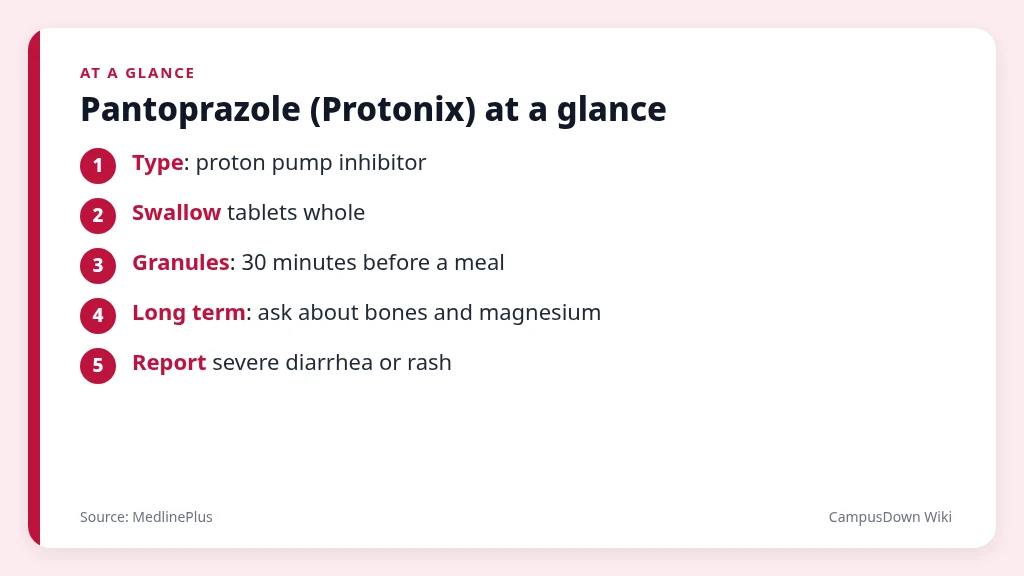
MedlinePlus says pantoprazole is in a class called proton-pump inhibitors (PPIs) that decrease the amount of acid made in the stomach. Protonix is a brand name. It is used to treat:
- gastroesophageal reflux disease (GERD), where stomach acid flows back into the esophagus
- conditions in which the stomach makes too much acid, such as Zollinger-Ellison syndrome
MedlinePlus adds that it may be used for stomach ulcers, and to talk to your doctor about the risks of using it for your condition. NIDDK says PPIs are better at treating GERD symptoms than H2 blockers and can heal the esophageal lining in most people with GERD.

How it's taken
MedlinePlus says pantoprazole comes as a delayed-release tablet and delayed-release granules, taken once or twice a day at about the same time each day.
- Tablets: swallow whole; do not split, chew or crush them. They can be taken with or without food.
- Granules: take 30 minutes before a meal, sprinkled on a teaspoon of applesauce or mixed into apple juice, and not mixed with water, other liquids or other foods. Swallow right away, within 10 minutes, without chewing the granules. Some people with a feeding tube can use granules in apple juice; ask your doctor how.
- Take it exactly as prescribed, and don't stop without talking to your doctor or take it for longer than recommended. If symptoms don't improve or get worse, call your doctor.
If you miss a dose, MedlinePlus says to take it when you remember unless it's almost time for the next one; don't double up.
Long-term use: the questions to ask
MedlinePlus says people who take PPIs may be more likely to fracture their wrists, hips or spine and may develop fundic gland polyps (a type of growth on the stomach lining), with the risks highest in people who take high doses or take them for a year or longer. It says people 65 or older should discuss risks and benefits and not take the medicine longer than recommended. It also asks you to tell your doctor about low magnesium, calcium or potassium, low vitamin B12, osteoporosis, hypoparathyroidism or autoimmune disease.
NIDDK notes that PPIs are generally safe and effective, and that some long-term use may be recommended for people who need it, so the answer is not "stop" but "review." For a lighter-acid option, see famotidine; for another PPI, see omeprazole. Don't stop or switch on your own.
Interactions to mention
MedlinePlus lists iron supplements among nonprescription products that may interact, and says other medicines may need dose changes or extra monitoring. Bring your full list, including supplements, to a brown bag review.
Side effects and warning signs
MedlinePlus lists milder effects to report if severe or persistent: headache, nausea, vomiting, diarrhea, gas, joint pain and dizziness, and in men difficulty with erections.
It lists these as reasons to call your doctor right away or get emergency help:
- blistering, peeling or bleeding skin; sores on the lips, nose, mouth or genitals; fever or flu-like symptoms
- rash, hives, swelling of the eyes, face, lips, mouth, throat or tongue, trouble breathing or swallowing, hoarseness
- an irregular, fast or pounding heartbeat, muscle spasms, shaking, excessive tiredness, lightheadedness or seizures
- severe diarrhea with watery stools, stomach pain or fever that doesn't go away; see C. diff after antibiotics for why this matters
- new or worsening joint pain, or a rash on the cheeks or arms that is sensitive to sunlight
- increased or decreased urination, blood in the urine, fatigue, nausea, fever, rash or joint pain
Get help now if
Call 911 for trouble breathing, throat swelling, seizures or chest pain. Don't assume chest pain is heartburn.
When heartburn needs more than a pill
Heartburn that keeps returning, wakes you at night or comes with trouble swallowing, weight loss, vomiting or black stools should be evaluated, not just treated at home. See acid reflux at night for night-time symptoms.
Questions to bring to your appointment
- Why am I on pantoprazole, and for how long?
- Is it time to review whether I still need it?
- Do I need blood tests for magnesium, calcium or B12?
- Should I take it with or without food, and at what time?
- Do any of my other medicines or supplements interact?
- What symptoms should I call about right away?
Example scenario: the two-year prescription
- Who
- Una, 63, a school bus driver in Boise, Idaho, had refilled pantoprazole every month for two years without a check-in.
- What happened
- She wasn't sure if she still needed it and worried that stopping would bring the reflux back.
- How it felt
- She felt unsure and a little guilty for not asking sooner.
- What they did
- She wrote down her symptoms and her medicine list and asked her doctor whether it was time for a review. The doctor went over her symptoms, asked about her bones and other medicines and made a follow-up plan, without telling her to stop on her own.
- How it turned out
- Una said she'd never realized refills could be reviewed.
This is an illustrative example, not a real patient or a review.
Una's story is an illustrative example. Your own plan comes from your clinician.
Most-asked questions about pantoprazole
What are the side effects of pantoprazole?
Headache, nausea, diarrhea, gas, joint pain and dizziness are listed; severe diarrhea, rash or heart rhythm symptoms need prompt attention.
Why people ask: "pantoprazole side effects" is #3 for "pantoprazole" (US autocomplete, November 2026).
What is pantoprazole sodium?
The salt form used in the medicine; pantoprazole is the active medicine, per MedlinePlus.
Why people ask: "pantoprazole sodium" is #4 for "pantoprazole" (US autocomplete, November 2026).
What is pantoprazole used for?
GERD and conditions with too much stomach acid; sometimes ulcers.
Why people ask: "pantoprazole used for" is #5 for "pantoprazole" (US autocomplete, November 2026).
What is the brand name for pantoprazole?
Protonix.
Why people ask: "pantoprazole brand name" is #9 for "pantoprazole" (US autocomplete, November 2026).
Can I get pantoprazole 40 mg over the counter?
Ask your pharmacist; the MedlinePlus page describes a prescription medicine, so talk with a prescriber first.
Why people ask: "pantoprazole 40 mg over the counter" is #10 for "pantoprazole 40 mg" (US autocomplete, November 2026).
Related on CampusDown
You can learn more about medicines and check it for yourself in the brown bag review guide. For another acid reducer in detail, see omeprazole.
Frequently asked questions
- Can I crush pantoprazole tablets?
- No. MedlinePlus says to swallow delayed-release tablets whole, not split, chew or crush.
- Should I take it with food?
- Tablets can be taken with or without food; granules go 30 minutes before a meal.
- Is long-term use safe?
- MedlinePlus says risks like fractures and polyps are highest with high doses or a year or longer; ask your doctor about reviewing it.
- Is it the same as famotidine?
- No. Pantoprazole is a PPI; famotidine is an H2 blocker. NIDDK says PPIs heal the esophagus better.
- When should I call my doctor?
- For severe watery diarrhea, rash, swelling, muscle spasms or an irregular heartbeat, per MedlinePlus.
Pantoprazole is a useful acid reducer, and the habit worth building is regular review: swallow tablets whole, know the warning signs and ask whether you still need it.
Browse more guides like this in the Medicines hub.
This article is for general education and does not replace advice from your own doctor, nurse or pharmacist.