
Have you ever caught your toe on the edge of a rug, grabbed the wall, and laughed it off? For an older adult, that same stumble can end in a broken hip. The good news is that most of the things that cause falls at home can be found and fixed in an afternoon.
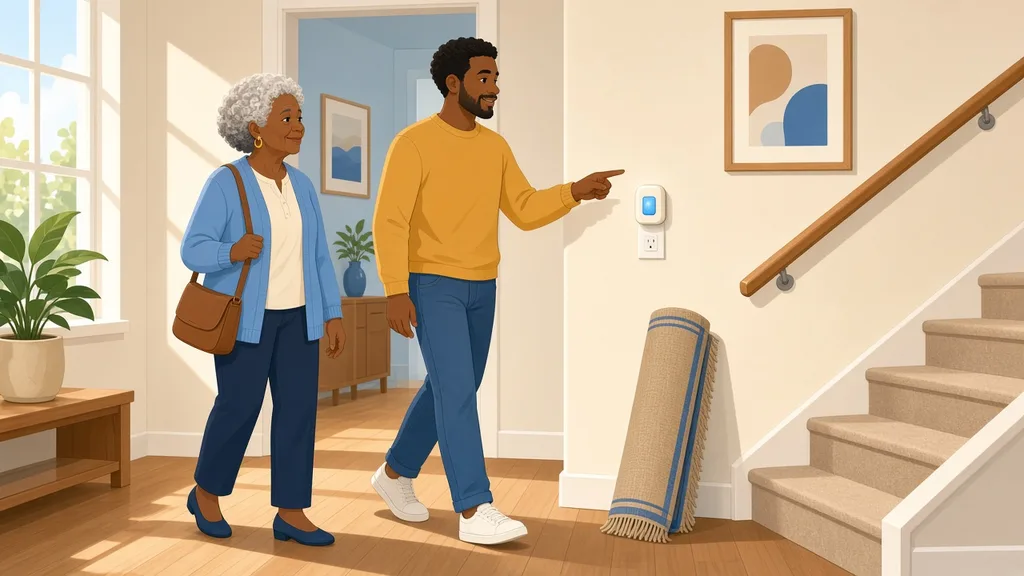
This checklist uses CDC fall data and its STEADI (Stopping Elderly Accidents, Deaths and Injuries) materials, the National Institute on Aging's room-by-room guidance, and the U.S. Preventive Services Task Force (USPSTF) 2024 recommendation, all checked in November 2026. It is worth reading in detail before you start. Use it for yourself or walk through a parent's home together.
Why it matters
The CDC reports that:
- More than one in four adults 65 and older falls each year, but less than half tell their doctor.
- Falling once doubles your chances of falling again.
- There are about 4.5 million emergency visits a year for older adult falls, and falls caused over 43,000 deaths among adults 65+ in 2024, the leading cause of injury death in that group.
- Falls cause most hip fractures; nearly 319,000 older adults are hospitalized for hip fractures each year.
- Falls are the most common cause of traumatic brain injury in older adults.
Most falls have more than one cause. The more risk factors you have, the higher the chance of a fall, so small fixes add up.

Step 1: a quick self-check
The CDC's Stay Independent brochure has 12 yes-or-no statements. The first two count 2 points each if true; the rest count 1 point:
- I have fallen in the past year. (2)
2. I use or have been advised to use a cane or walker. (2) 3. Sometimes I feel unsteady when I am walking. 4. I steady myself by holding onto furniture at home. 5. I am worried about falling. 6. I need to push with my hands to stand up from a chair. 7. I have some trouble stepping up onto a curb. 8. I often have to rush to the toilet. 9. I have lost some feeling in my feet. 10. I take medicine that sometimes makes me light-headed or more tired than usual. 11. I take medicine to help me sleep or improve my mood. 12. I often feel sad or depressed.
A score of 4 or more means you may be at risk for falling. Take the result to your doctor, who can take a closer look at the causes.
Step 2: the room-by-room walk-through
Take a closer look at each area, using the NIA's guidance.
Stairs and halls
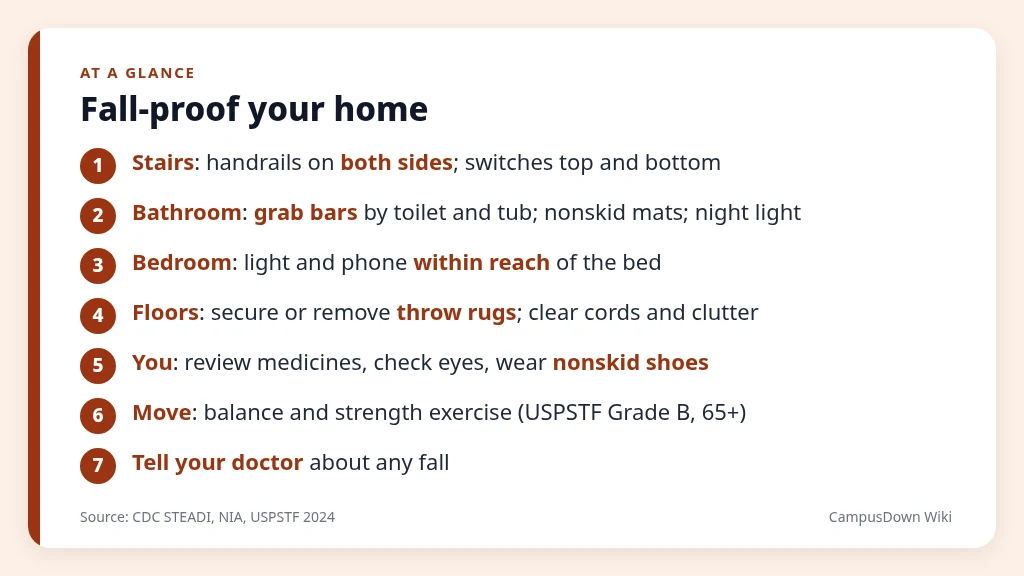
- Handrails on both sides, firmly attached. Hold them even when carrying something.
- Light switches at the top and bottom of stairs and at both ends of long halls. Motion-activated plug-in lights help.
- Nothing left on steps: no shoes, books or laundry.
Bathroom
- Grab bars near the toilet and both inside and outside the tub or shower. Our grab bar guide explains in detail why suction bars are not a substitute.
- Nonskid mats or strips on any surface that gets wet.
- A night light that turns on automatically.
Bedroom
- A lamp or switch and a phone within reach of the bed.
- A flashlight by the bed for power outages.
- Get up slowly. Standing too fast can drop blood pressure and make you wobbly; see orthostatic hypotension.
Kitchen and living areas
- Everyday items at waist level. Don't climb on chairs; use a reach stick, or a steady step stool with a handrail and a helper.
- Carpets fixed to the floor; no-slip strips on tile and wood. Avoid newly washed floors.
- Cords along walls, low tables moved out of walking paths, and chairs high enough to stand from easily.
- Know where pets are.
Outside
- Repair broken or uneven front steps. Clear leaves and branches.
- Consider a grab bar by the front door for balance while you unlock it.
- Turn on the porch light and treat icy walks with ice melt or sand.
Step 3: the things that aren't furniture
The CDC lists modifiable risk factors beyond the house:
- Leg weakness and balance problems. The USPSTF recommends exercise interventions to prevent falls in community-dwelling adults 65+ who are at increased risk (Grade B). You can learn more in our balance exercises guide.
- Medicines such as sedatives, tranquilizers and antidepressants, and even some over-the-counter drugs. Ask your doctor or pharmacist for a review; don't stop anything on your own.
- Vision. The NIA advises regular eye exams and giving yourself time to adjust to new glasses. Hearing matters too; see age-related hearing loss.
- Feet and shoes. Nonskid, rubber-soled, low-heeled shoes. No socks or smooth slippers on stairs.
- Low vitamin D. The CDC lists deficiency as a risk factor. The USPSTF, however, recommends against vitamin D supplements to prevent falls in community-dwelling adults 65+, so talk with your doctor about testing rather than self-treating.
Example scenario: the hallway at night
- Who
- Opal, 79, a retired seamstress in Memphis, lived alone in the house she had raised three kids in. She slipped one night on the way to the bathroom, caught herself on the dresser and bruised her arm.
- What happened
- She told no one. Her son Dwayne only noticed the bruise at Sunday dinner, and she brushed it off as "being clumsy."
- How it felt
- Underneath, Opal was frightened. She worried that admitting the fall would mean being pushed toward assisted living, and she felt embarrassed that her own house had become a hazard.
- What they did
- Dwayne asked her to do the Stay Independent checklist with him "just to see." She scored 5. Together they walked every room with the NIA list. He added plug-in night lights from bedroom to bathroom, rolled up two throw rugs, installed a second stair handrail and booked a handyman for grab bars. Opal brought the score to her doctor, who reviewed her sleep medicine and referred her to physical therapy for balance.
- How it turned out
- Three months later Opal had not fallen again. She said the night lights made the biggest difference, and that telling her son turned out to be the step that kept her at home.
This is an illustrative example, not a real patient or a review.
Opal and Dwayne are illustrative examples, not real patients. Your doctor can help decide which changes matter most for you.
Get help now if
If an older adult hits their head in a fall, the CDC advises seeing a doctor right away, especially if they take blood thinners. Learn more in blood thinners in older adults.
Most-asked questions about fall prevention checklists
Is there a CDC fall prevention checklist?
Yes. The CDC's STEADI program offers the 12-question Stay Independent brochure and a Check for Safety home checklist. A Stay Independent score of 4 or more means you may be at risk.
Why people ask: "fall prevention checklist cdc" is #6 for "fall prevention checklist" (US autocomplete, November 2026).
What should a home fall prevention checklist include?
Handrails on both sides of stairs, good lighting and night lights, grab bars by the toilet and tub, nonskid mats, secured rugs, clear walkways and a phone by the bed.
Why people ask: "fall prevention checklist for home" is #7 for "fall prevention checklist" (US, November 2026).
How do you prevent falls in the elderly at home?
Combine home fixes with exercise for strength and balance, a medicine review, eye checks and safe footwear. Most falls have more than one cause.
Why people ask: "fall prevention for elderly at home" is #2 for "fall prevention for elderly" (US, November 2026).
What fall prevention devices help older adults?
Grab bars, handrails, night lights, nonskid mats, reach sticks and, if prescribed, a cane or walker. Alert systems help you get help after a fall.
Why people ask: "fall prevention devices for elderly" is #9 for "fall prevention for elderly" (US, November 2026).
Related on CampusDown
If a fall has already happened, learn the safe way up in getting up after a fall, and how to keep worry from shrinking your world in fear of falling. Bone health matters too; see osteoporosis.
Frequently asked questions
- Should I tell my doctor about a fall if I wasn't hurt?
- Yes. The NIA says a fall can point to a new medical problem or a medicine or vision issue that can be fixed.
- Who can check my home for fall hazards?
- After a fall, your doctor may suggest an occupational therapist, physical therapist or nurse visit your home, the NIA says.
- Does Medicare pay for grab bars?
- Grab bars are generally not covered as medical equipment. Some state and local programs help with home modifications; ask your local agency on aging.
- Should I take vitamin D to prevent falls?
- The USPSTF recommends against vitamin D supplements to prevent falls in community-dwelling adults 65+. Ask your doctor whether you need testing.
A fall-safe home is built from small, boring fixes: a second handrail, a night light, a rug rolled up for good. Do the self-check, walk the rooms, and talk to your doctor or pharmacist about medicines and exercise. Every fix you make lowers the odds of the fall that changes everything.
Browse more guides like this in the Senior Health and Medicare hub.
This article is for general education and does not replace advice from your own doctor, nurse or pharmacist.