
Have you ever watched someone steady themselves on a towel bar as they step out of the tub? Towel bars aren't built for that, and when they rip out of the wall, the fall that follows often happens on hard tile. A properly installed grab bar is one of the cheapest fall-prevention fixes in the house.
This guide draws on the 2010 ADA Standards section 609 (U.S. Access Board), the National Institute on Aging (NIA) and Drive Medical's suction grab bar warnings, checked in November 2026. ADA rules apply to public buildings, not private homes, but they are the most widely used benchmark. An occupational therapist can tailor placement in detail to how you move.
Where grab bars go
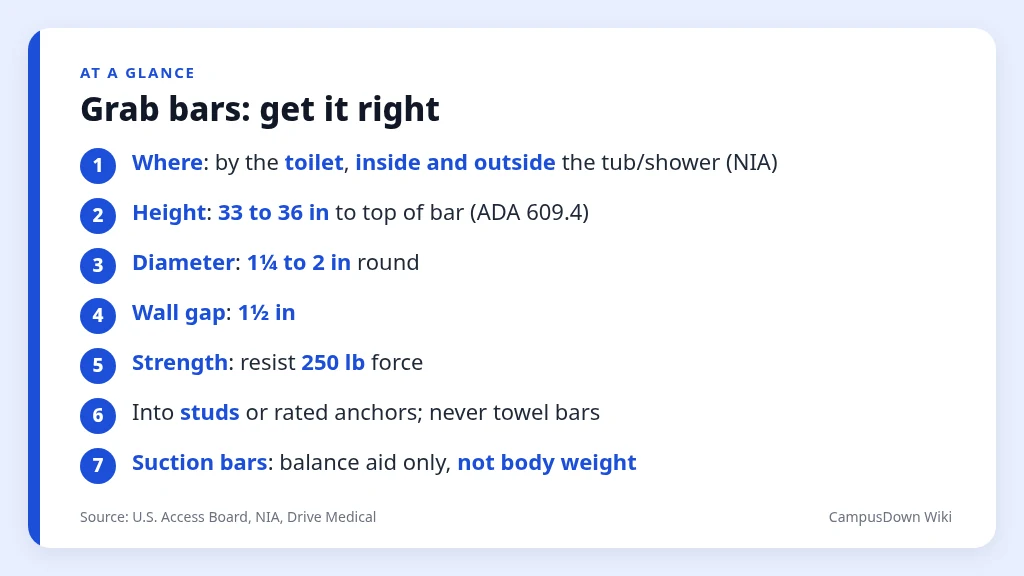
The NIA recommends grab bars:
- Near the toilet.
- Inside and outside the tub or shower.
In practice, think about each moment you shift weight: sitting and standing at the toilet, stepping over the tub edge, turning in the shower, and reaching for a towel.

ADA numbers worth knowing
| Spec | 2010 ADA Standard |
|---|---|
| Height (horizontal bars) | 33 to 36 inches above the floor, to the top of the gripping surface (609.4) |
| Round bar diameter | 1¼ inches minimum, 2 inches maximum (609.2.1) |
| Space from wall | 1½ inches (609.3) |
| Space to objects above | 12 inches minimum (609.3) |
| Strength | Resist a 250 lb vertical or horizontal force at any point (609.8) |
| Fittings | Bar must not rotate (609.6) |
| Toilet side wall bar | 42 inches long minimum, no more than 12 inches from the rear wall, extending at least 54 inches from it (604.5.1) |
| Toilet rear wall bar | 36 inches long minimum (604.5.2) |
Bathtubs and showers have additional placement rules in sections 607 and 608, so take the full standard to your contractor.
How to install it safely
- Find the studs. Screw into wall studs or solid blocking whenever possible. A stud finder helps, but tile can hide them.
- If no stud is where you need it, use anchors made and rated for grab bars, following the bar maker's instructions.
- Never use a towel bar or soap dish as a grab bar.
- Drill tile carefully with the right bit to avoid cracks, and seal around fittings in wet areas.
- Test the bar by pulling hard in several directions before anyone relies on it.
- If you're unsure, hire a licensed handyman or contractor. Some local agencies on aging help older adults with home modifications.
Suction grab bars: what they're for
Suction grab bars are popular because they need no drilling. Take a closer look at the warnings, though. Drive Medical's RTL13083 suction cup grab bar states:
- It is to be used as a balance assist only.
- It is not intended to support body weight, and body weight should not be applied to it.
- If you need a device to bear any body weight or to use for leverage, Drive recommends a traditional, permanently mounted grab bar.
- Check the suction attachment before each use.
Suction bars can help as a light touch point for balance, for example while traveling. For an older adult who pushes or pulls to stand, they are not a substitute.
Example scenario: the towel bar
- Who
- Edna, 85, a retired telephone operator in Spokane, had lived alone since her husband died. She used the towel bar to lower herself onto the toilet and pull herself out of the tub.
- What happened
- One morning the towel bar came away from the drywall in her hand. She sat down hard on the closed toilet lid, shaken but not hurt.
- How it felt
- She was mortified and didn't want to bother anyone. She also worried that grab bars would make her bathroom look "like a nursing home," and that admitting she needed them meant something bigger.
- What they did
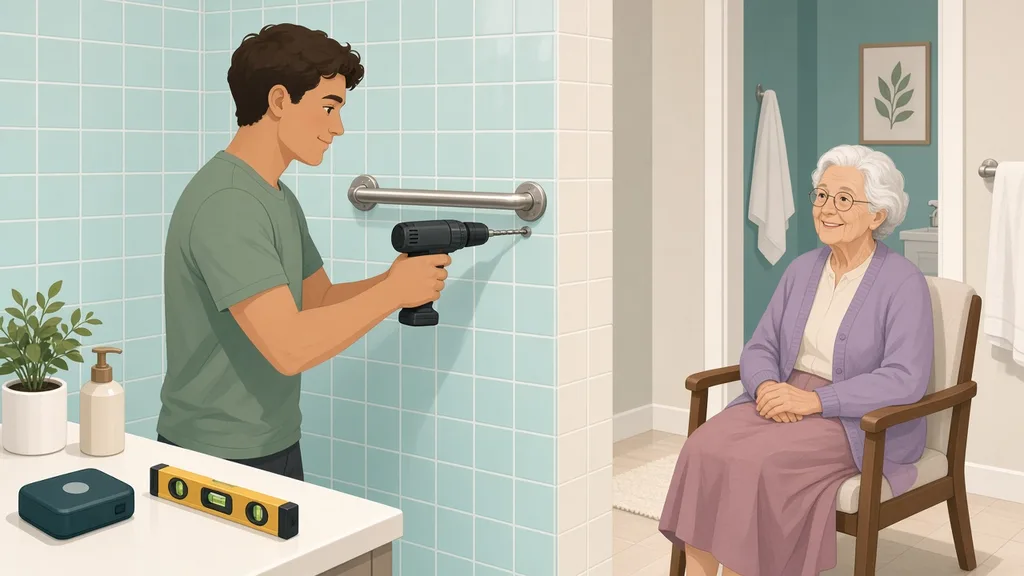
- Her great-grandson Tobias, home from trade school, offered to help. With her doctor's referral, an occupational therapist visited and marked where Edna actually shifted her weight. Tobias found the studs, installed a horizontal bar beside the toilet and two in the tub area at the marked heights, and tested each one with his full weight. The suction bar Edna had bought online went into her travel bag.
- How it turned out
- Edna now uses the bars every day and says they feel "like a hand that's always there." She also asked Tobias to replace the hallway night light, and she told her doctor about the towel bar incident at her next visit.
This is an illustrative example, not a real patient or a review.
Edna and Tobias are illustrative examples. A therapist or contractor should assess your bathroom.
Most-asked questions about grab bars
What is the ADA grab bar height?
33 to 36 inches above the floor, measured to the top of the gripping surface, for horizontal bars (ADA 609.4).
Why people ask: "grab bar height ada" is #4 for "grab bar height" (US autocomplete, November 2026).
How high should a grab bar be in the shower?
The ADA's general range is 33 to 36 inches; bathtubs have an extra lower bar rule in 607.4. An occupational therapist can fit the height to you.
Why people ask: "grab bar height in shower" is #1 for "grab bar height" (US, November 2026).
How high should a grab bar be next to a toilet?
ADA uses 33 to 36 inches, with the side bar at least 42 inches long.
Why people ask: "grab bar height for toilet" is #3 for "grab bar height" (US, November 2026).
Are suction grab bars safe for seniors?
Drive Medical says its suction bar is a balance assist only and not for body weight. Use a permanently mounted bar for support.
Why people ask: "suction grab bars for seniors" is #6 for "suction grab bar" (US, November 2026).
How do you install grab bars?
Mount into studs or solid blocking, or rated anchors; test before use; hire help if unsure.
Why people ask: "grab bar installation" is #9 for "grab bar" (US, November 2026).
Related on CampusDown
To learn more about bathroom and stair fixes, see our fall prevention checklist. If a fall happens, follow how to get up after a fall. If you use a walker, compare options in walker vs rollator. Strong bones lower the damage when falls do happen; see osteoporosis.
Frequently asked questions
- Does Medicare cover grab bars?
- Grab bars are generally not covered as durable medical equipment. Ask your local agency on aging about home modification programs.
- Can I install grab bars on fiberglass showers?
- Fiberglass needs solid backing or special anchors. Follow the bar maker's instructions or hire a contractor.
- Vertical or horizontal?
- The ADA sets horizontal bars at 33 to 36 inches; a vertical bar at a tub entry can help stepping in and out. An occupational therapist can advise in detail.
Grab bars work when they're in the right place and anchored to something solid. Use the ADA numbers as a guide, test every bar, and keep suction bars for light balance only. Talk to your doctor about an occupational therapy home visit.
Browse more guides like this in the Home Medical Devices hub.
This article is for general education and does not replace advice from your own doctor, nurse or pharmacist.