
Is the walker with the seat and the shiny wheels the "better" one? Many families assume so, and buy a rollator because it looks less clinical. But for someone who needs to lean their weight on a frame, the plain walker may be the safer choice.

This guide compares the main types, using AAOS OrthoInfo, the National Institute on Aging (NIA), Medicare.gov and a rollator owner's manual, all checked in November 2026. Take it to your physical therapist or doctor, who can see you walk and recommend in detail what fits.
The three main types
| Type | How it moves | Best for | Watch out for |
|---|---|---|---|
| Standard (pickup) walker | Four legs with rubber tips; you lift it each step | Most stability; taking weight off a leg after surgery or injury | Slower; needs arm strength to lift |
| Two-wheel (front-wheeled) walker | Wheels in front, tips or glides in back | Steady support with a smoother glide | Back tips wear; still not for fast walking |
| Four-wheel rollator | Four wheels, hand brakes, usually a seat | People with fair balance who tire on longer walks | Can roll away if you lean on it unlocked |
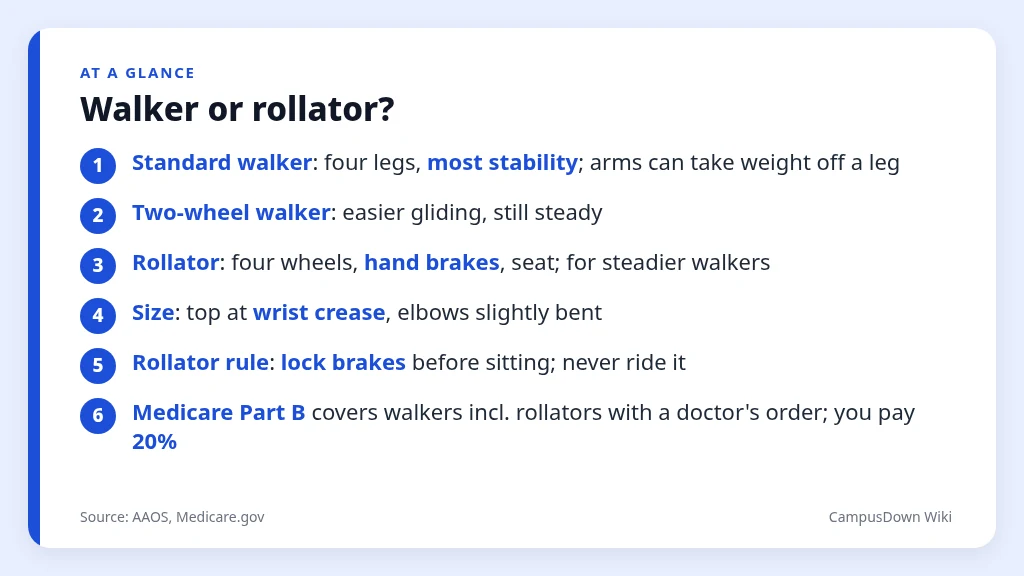
AAOS OrthoInfo says a pickup walker with four legs gives the most stability, and that after a total knee or hip replacement, a walker provides the most stability. A walker lets your arms support some of your body weight while you heal.
A rollator works differently. You push it ahead of you rather than leaning into it, and you control speed with the brakes. It suits people who can mostly carry their own weight but need help with balance and endurance.

Who should probably choose which
A standard or two-wheel walker may fit better if you:
- Need to keep weight off a leg, often after surgery or a fracture.
- Lean heavily on your hands or feel your legs could give way.
- Have trouble squeezing hand brakes, for example with arthritis or after a stroke.
A rollator may fit better if you:
- Walk fairly steadily but get tired or short of breath and need to rest.
- Walk longer distances outdoors, where small wheels catch on cracks.
- Have the hand strength and memory to use brakes every time.
How to size it
OrthoInfo gives the same rule for walkers that many clinicians use for rollators:
- Standing straight, the top of the walker reaches the crease in your wrist.
- Your elbows are slightly bent when you hold the grips.
- Keep your back straight; don't hunch over the frame.
- Check the rubber tips often and replace them when worn.
The NIA adds that if you borrow a walker or cane, ask your health care provider to make sure it is the right size and safe to use, and that walker wheels should roll smoothly.
Rollator safety rules
It helps to take a closer look at a real manual. The Drive Nitro rollator manual is a useful example of standard warnings:
- Lock the brakes before sitting, on an even, solid surface. Sit straight and don't lean back.
- Never move the rollator while someone is seated. It is a walking aid, not a transport chair.
- Don't use the seat on an incline or uneven ground.
- Test the brakes regularly; worn wheels weaken braking.
- Don't overload the bag.
For a model-specific look, see our Drive Nitro rollator guide.
What Medicare pays
Medicare.gov says Part B covers walkers, including rollators, if you are eligible, as durable medical equipment your doctor orders for use in your home. After the Part B deductible, you generally pay 20% of the Medicare-approved amount, if the supplier accepts assignment. Use a Medicare-enrolled supplier; suppliers that don't accept assignment can charge more. Medicare.gov also says any Medicare-approved supplier can repair a walker you own.
If you're in a Medicare Advantage plan, rules and suppliers may differ; call the plan. After a hospital stay, a rehab team will usually fit you before discharge; see Medicare skilled nursing rehab.
Example scenario: the wrong walker
- Who
- Gustavo, 72, a retired bus mechanic in San Antonio, came home from a hip fracture repair with a standard walker. Within weeks he bought a sporty red rollator online because his granddaughter said the old one "looked like a hospital."
- What happened
- On his second day with it, he leaned his weight forward to stand from the couch without locking the brakes. The rollator shot ahead and he dropped back onto the cushions.
- How it felt
- He was shaken and annoyed with himself. He had liked feeling less like a patient, and now he worried he'd never get past the gray walker.
- What they did
- At his next therapy visit, he told his physical therapist. She watched him walk with both, set the rollator handles to his wrist crease, and had him keep the standard walker indoors for six more weeks while they worked on leg strength. She drilled one habit: brakes down before every sit and stand.
- How it turned out
- By spring, Gustavo used the rollator for walks to the park, resting on its seat halfway, and the standard walker went to the closet. He said the lesson was simple: the right walker depends on your legs that month, not on how it looks.
This is an illustrative example, not a real patient or a review.
Gustavo is an illustrative example. Your therapist or doctor should choose and fit your device.
Most-asked questions about walkers and rollators
Is a walker or rollator better for seniors?
It depends on balance and strength. A standard walker gives the most stability; a rollator suits steadier walkers who need rest and smoother rolling. A physical therapist can help you decide.
Why people ask: "walker vs rollator for seniors" is #2 for "walker vs rollator" (US autocomplete, November 2026).
What is the difference between a rolling walker and a rollator?
A "rolling walker" usually has two front wheels and back tips; a rollator has four wheels, hand brakes and usually a seat.
Why people ask: "rolling walker vs rollator" is #5 for "walker vs rollator" (US, November 2026).
Standard walker vs rollator: which is more stable?
AAOS says a four-legged pickup walker gives the most stability. A rollator rolls more easily but can roll away if you lean on it unlocked.
Why people ask: "standard walker vs rollator" is #8 for "walker vs rollator" (US, November 2026).
Are rollator walkers with a seat safe to sit on?
Yes, when brakes are locked on flat, solid ground. Never let anyone push you while you're seated.
Why people ask: "rollator walker with seat" is #2 for "rollator walker" (US, November 2026).
Related on CampusDown
If you need lighter support, learn how to size a cane in cane height and use. Check your home for yourself with our fall prevention checklist, and take a closer look at strength work in balance exercises and sarcopenia.
Frequently asked questions
- Can I use a rollator to push someone?
- No. Manufacturer instructions say not to move a rollator while seated. Use a transport chair or wheelchair.
- Can I take a walker on stairs?
- No. OrthoInfo says never climb stairs or use an escalator with your walker. Ask a therapist about a safe plan for stairs.
- Does Medicare cover a rollator?
- Yes, Part B covers walkers including rollators for eligible people with a doctor's order for home use; you pay 20% after the deductible.
The best walker is the one that matches your legs, balance and hands today. Get fitted, learn the brake habits, and revisit the choice with your therapist as you get stronger. Talk to your doctor before switching devices.
Browse more guides like this in the Home Medical Devices hub.
This article is for general education and does not replace advice from your own doctor, nurse or pharmacist.