
"Medicare gives you 100 days of rehab." Have you heard that at a hospital bedside? It is one of the most common misunderstandings in senior care. Medicare can cover up to 100 days in a skilled nursing facility per benefit period, but only while specific conditions are met, and days 21 through 100 come with a daily charge.

This guide walks through the rules on Medicare.gov's skilled nursing facility page, the costs for 2026 and 2027, and what to do if the facility says coverage is ending. If a parent is about to leave the hospital, take a closer look at the eligibility checklist first.
Who qualifies
Medicare.gov says you must meet all of these conditions:
- You have Part A and have days left in your benefit period.
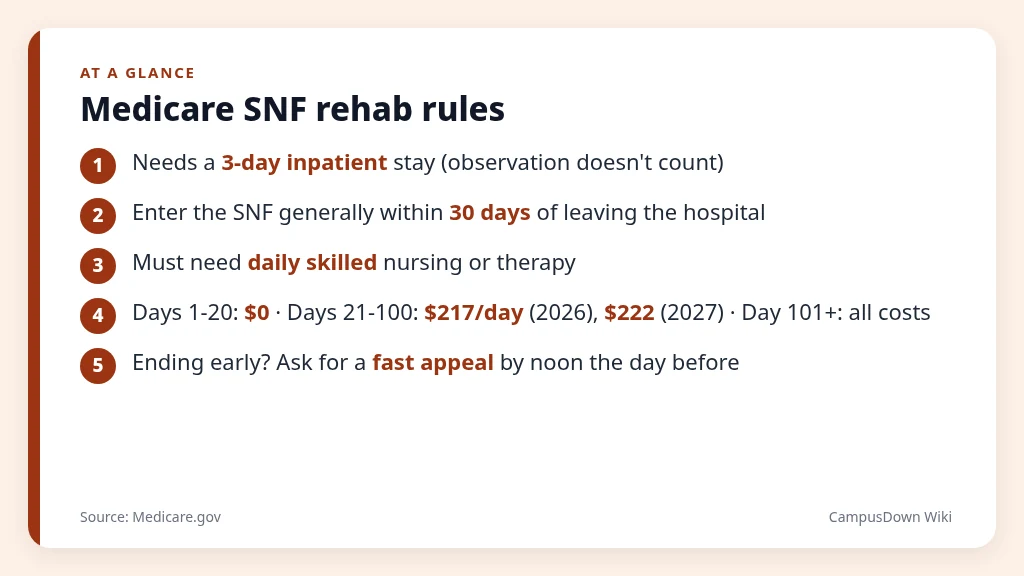
- You had a qualifying inpatient hospital stay: at least 3 days in a row as an inpatient, counting the admission day but not the discharge day. Time in the emergency room or under observation does not count; see observation vs inpatient.
- You enter the SNF within a short time, generally 30 days, after leaving the hospital.
- Your doctor decides you need daily skilled care, such as IV medicines or physical therapy, given by or under the supervision of skilled nursing or therapy staff.
- You get the care in a Medicare-certified SNF, for a condition treated during the hospital stay or one that started during SNF care.
Medicare.gov also notes the care can be to improve or maintain your condition, or to prevent or delay it from getting worse. You do not have to be "improving" to qualify. Medicare Advantage plans may waive the 3-day requirement; ask your plan.

What it covers and costs
Covered services include a semi-private room, meals, skilled nursing, physical, occupational and speech therapy if needed, medical social services, medications, supplies, and some ambulance transport. For each benefit period:
- Days 1-20: $0 per day after the Part A deductible ($1,736 in 2026; $1,776 in 2027). If you already paid the deductible for the hospital stay in the same benefit period, you do not pay it again.
- Days 21-100: $217 per day in 2026, $222 in 2027.
- Day 101 and beyond: you pay all costs.
Many Medigap plans, including Plan G and Plan N, pay the SNF coinsurance; see Plan G vs Plan N. Advantage plans may charge copays even in the first 20 days.
A benefit period begins the day you are admitted as an inpatient and ends when you have gone 60 days in a row without inpatient hospital or SNF care. A new benefit period can bring a new set of up to 100 SNF days, after a new qualifying stay.
Knowing the rules matters most when a facility starts talking about discharge. The story below shows how that conversation can go.
Example scenario: day 19
- Who
- Leonard, 79, a retired high school band director, broke his hip, had surgery, spent four days as an inpatient, and went to a SNF for rehab.
- What happened
- On day 17 the facility handed his daughter Carla a notice saying Medicare coverage would end in two days because he had "plateaued," even though he still could not walk to the bathroom safely.
- How it felt
- Carla felt panic and guilt; she worked full time and could not lift him. Leonard was scared and quietly angry, feeling written off.
- What they did
- Carla read the Notice of Medicare Non-Coverage, called the Quality Improvement Organization number on it before noon the day before the end date, and asked the therapists to document what skilled care he still needed.
- How it turned out
- The reviewer decided his skilled therapy should continue. Leonard stayed two more weeks, learned safe transfers, and went home with home health therapy. Carla now keeps a folder of every notice from his care.
This is an illustrative example, not a real patient or a review.
Leonard's story is an illustration, not a real case; appeal outcomes depend on the medical record.
When coverage ends: notices and fast appeals
Medicare.gov says that in settings like a SNF you should get a Notice of Medicare Non-Coverage at least 2 days before covered services end. To request a fast appeal from the independent reviewer (the BFCC-QIO), follow the notice's instructions no later than noon the day before the end date. Read the full process in detail in fast appeals when Medicare coverage ends.
Get help now if
Medicare Part A does not cover long-term custodial care, such as help with bathing and dressing when that is the only care needed. Plan ahead for what happens after skilled care ends.
Most-asked questions about the 100-day benefit
Does Medicare cover 100 days of skilled nursing?
Up to 100 days per benefit period, only while you meet the rules, and with $217 per day (2026) or $222 per day (2027) coinsurance for days 21 to 100.
Why people ask: "does medicare cover 100 days of skilled nursing" is #2 for "medicare 100 days skilled nursing" (US autocomplete, November 2026).
When do Medicare's 100 SNF days reset?
A new benefit period starts after you have gone 60 days in a row without inpatient hospital or SNF care. A new qualifying stay can then open up to 100 new days.
Why people ask: "medicare skilled nursing 100 days reset" is #3 for "medicare 100 days skilled nursing" (US, November 2026).
What do I pay for days 21 to 100?
$217 per day in 2026 and $222 per day in 2027, unless supplemental coverage pays it.
Why people ask: "medicare skilled nursing days 21 100" is #4 for "medicare 100 days skilled nursing" (US, November 2026).
What happens after 100 days?
You pay all costs for that benefit period. Options may include private pay, long-term care insurance, Medicaid or veterans' benefits.
Why people ask: "medicare skilled nursing after 100 days" is #5 for "medicare 100 days skilled nursing" (US, November 2026).
Before choosing a facility, check it for yourself on Medicare's Care Compare: look at star ratings, staffing and inspection results.
Related on CampusDown
Plan the next step with hospital discharge planning and learn what recovery involves in hip fracture recovery.
Frequently asked questions
- Does a nursing home stay always count as SNF care?
- No. Only daily skilled care in a Medicare-certified SNF after a qualifying stay counts; long-term custodial care is not covered by Part A.
- Can I choose the SNF?
- Yes, if a bed is available at a Medicare-certified facility; a hospital with its own SNF may offer a bed there.
- What if I go back to the hospital from the SNF?
- Ask your doctor and the facility; a new hospital stay may affect your benefit period and costs.
- Do Advantage plans follow the same rules?
- Plans must cover what Original Medicare covers, but they may waive the 3-day rule, require prior authorization, and charge different copays.
The 100-day benefit is real, but it is conditional and it can end early. Learn more about your loved one's daily skilled needs, and keep every notice in one folder.
Browse more guides like this in the Senior Health and Medicare hub.
This article is for general education and does not replace advice from your own doctor, nurse or pharmacist.