
Your heart skips, pauses, then thumps hard in your chest. Did it actually stop? No, but it feels that way. This sensation is usually a premature contraction, one of the most common reasons people notice their heartbeat.
This guide is based on the American Heart Association (AHA) and MedlinePlus. We explain in detail what they say about premature ventricular contractions, known as PVCs. Talk with your doctor about palpitations, and call 911 for chest pain or fainting.
What a PVC is
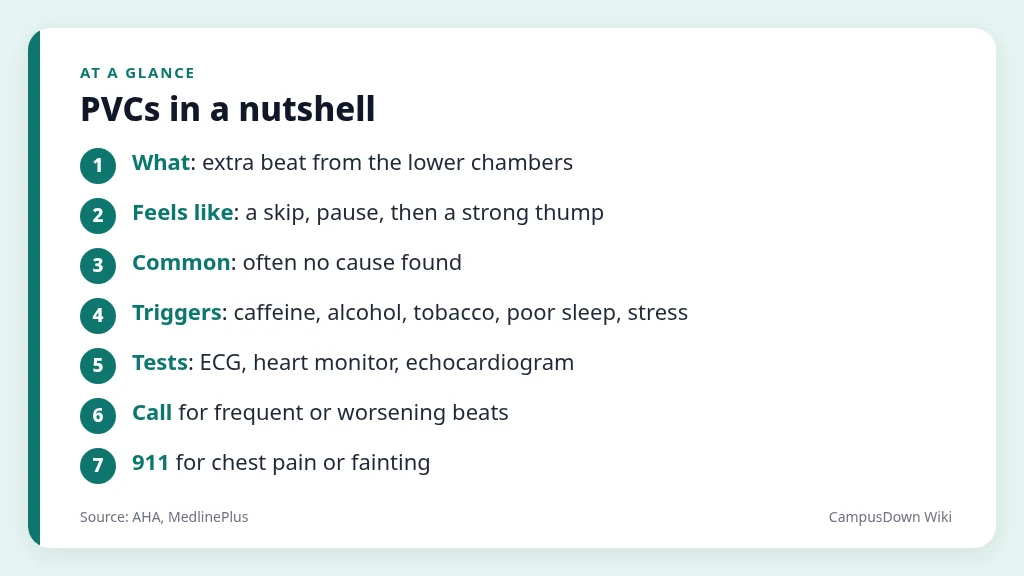
The AHA says that in reality your heart may not be skipping a beat; instead you may have had a premature contraction. It can start in the upper chambers (PACs) or the lower chambers (PVCs). With this extra beat, a pause usually causes your next normal heartbeat to be more forceful, which is the thump people feel. MedlinePlus calls these ectopic heartbeats, changes in an otherwise normal heartbeat that lead to extra or skipped beats, and says they're common, often without a clear cause.

What it feels like
The AHA says most people have no symptoms at all, but common ones include heartbeats with a lot of force, a skipped beat, pounding heartbeats (palpitations) and shortness of breath; some people feel anxious. MedlinePlus lists feeling like your heart stopped or skipped a beat and occasional forceful beats. Anxiety can also cause chest sensations; see anxiety and chest pain.
Causes and triggers
The AHA says premature contractions can happen to anyone but are more often found in older adults. Common causes include:
- Reduced blood flow to the heart, injury or structural problems of the heart
- Electrolyte problems, such as low potassium
- Not enough sleep, too much caffeine, stress, tobacco, alcohol, recreational drugs
- Some prescription medicines (stimulants)
MedlinePlus adds that ectopic beats may be caused or worsened by smoking, stimulant medicines and some street drugs. Review your medicines with a pharmacist; see brown bag medication review.
How doctors check
The AHA says that infrequently, premature contractions can be caused by disease or injury to the heart, and your professional may order an electrocardiogram (ECG), a heart monitor or an echocardiogram. MedlinePlus says a monitor can record your rhythm for 24 to 48 hours (Holter monitor) or an event monitor that records when you feel a skipped beat, and that often no further testing is needed when the ECG is normal and symptoms aren't severe. Learn what an ECG shows in ECG rhythm basics.
Treatment
MedlinePlus says that for the most part, ectopic heartbeats don't need to be treated; treatment is for severe symptoms or very frequent extra beats, and for any underlying cause. The AHA says a plan may include healthy lifestyle changes (less caffeine and alcohol, no tobacco, regular exercise, hydration and enough rest), sometimes medicines such as beta blockers, and in very rare cases catheter ablation. MedlinePlus also says that in some cases ectopic beats may mean a greater risk of serious abnormal rhythms, which is why frequent ones should be looked into. Don't start or stop heart medicines on your own.
PVCs, PACs and AFib
Premature beats are separate beats; AFib is an ongoing irregular rhythm that can raise stroke risk. A watch can't tell you which you have. Learn how wearables handle it in the Samsung Galaxy Watch ECG guide (it notes early beats can make a result "inconclusive"), the Apple Watch ECG guide and the KardiaMobile 6L guide. For AFib symptoms, see AFib symptoms in women.
Get help now if
Call 911 for chest pain or pressure, shortness of breath, fainting or near-fainting, or sudden confusion with palpitations. Call your doctor if you keep feeling pounding or racing, or if it's getting worse.
Example scenario: the thump at bedtime
- Who
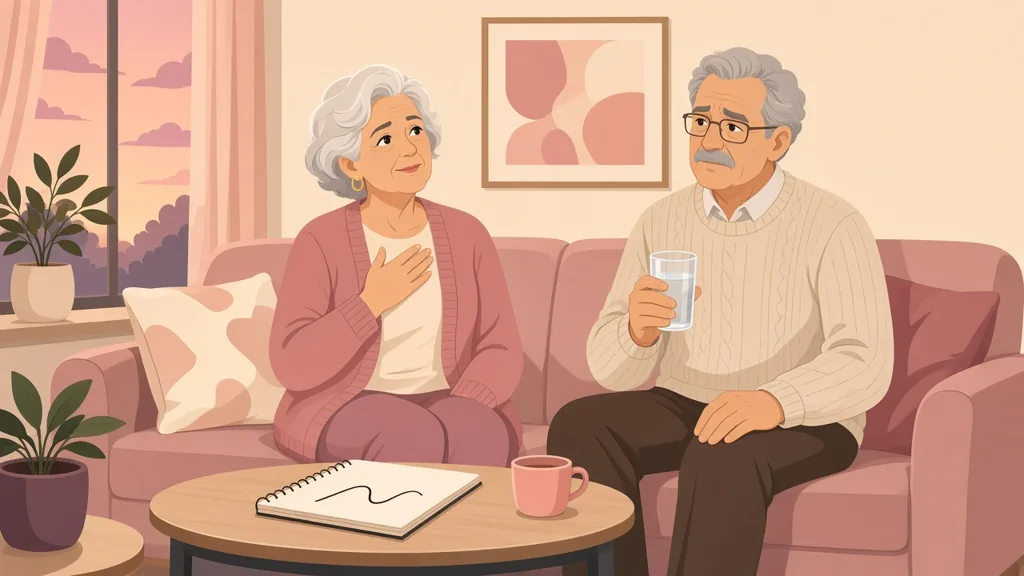
- Alaric, 68, a retired high school chemistry teacher in Missoula, Montana, noticed a hard thump in his chest most nights as he lay down. His wife, Lenore, 66, a retired court reporter, saw him pressing a hand to his chest and went quiet.
- What happened
- He'd just started drinking two extra cups of coffee in the afternoons and sleeping poorly since a new job as a volunteer driver.
- How it felt
- Alaric felt frightened but didn't want to make a fuss. Lenore felt afraid and told him to call the doctor.
- What they did
- He called, and his doctor took his history, examined him and ordered an ECG and a monitor to wear for a couple of days. The doctor explained what the results meant for him and talked with him about caffeine, alcohol and sleep. He cut back on coffee and kept a note of when the beats came.
- How it turned out
- Alaric said understanding what it was made the sensation less scary. Lenore said she was glad they'd called rather than waited.
This is an illustrative example, not a real patient or a review.
Alaric's story is an illustrative example. Only a clinician can say what your extra beats mean.
Most-asked questions about PVCs
What is a PVC in the heart?
An extra beat from the lower chambers, often felt as a skipped beat followed by a strong thump.
Why people ask: "pvc heart" is #1 for "pvc heart" (US autocomplete, November 2026).
What does PVC mean in the heart?
A premature ventricular contraction: a premature beat that starts in the ventricles, per the AHA.
Why people ask: "pvc heart meaning" is #3 for "pvc heart" (US autocomplete, November 2026).
Is a PVC a heart condition?
Occasional PVCs are common and often benign; frequent ones should be checked for an underlying cause.
Why people ask: "pvc heart condition" is #4 for "pvc heart" (US autocomplete, November 2026).
How are PVCs treated?
Usually lifestyle changes and treating causes; medicines like beta blockers or, rarely, ablation for severe cases. Your doctor decides.
Why people ask: "pvc heart treatment" is #5 for "pvc heart" (US autocomplete, November 2026).
What does a PVC look like on an ECG?
An ECG is the usual first test, and a clinician reads it. MedlinePlus says no further testing is often needed if the ECG is normal and symptoms aren't severe.
Why people ask: "pvc heart ecg" is #6 for "pvc heart" (US autocomplete, November 2026).
What causes PVCs in the heart?
Low potassium, reduced blood flow, caffeine, alcohol, tobacco, stress, poor sleep, stimulants and heart disease or injury.
Why people ask: "pvc heart causes" is #7 for "pvc heart" (US autocomplete, November 2026).
What are PVC heart symptoms?
Skipped beats, forceful beats, palpitations and sometimes shortness of breath or anxiety; many people have none.
Why people ask: "pvc heart symptoms" is #10 for "pvc heart" (US autocomplete, November 2026).
Related on CampusDown
You can learn more about ECG rhythm basics and take a closer look at AFib symptoms in women.
Frequently asked questions
- Are PVCs dangerous?
- Occasional ones are common; frequent ones need evaluation. Ask your doctor.
- Can caffeine cause PVCs?
- The AHA lists excessive caffeine among common causes.
- Do I need a monitor?
- Your doctor decides; it can record your rhythm for a day or two.
- Can my watch tell me if it's a PVC?
- No; a watch may call it inconclusive. Check it for yourself with your doctor.
Most occasional skipped beats are harmless, and frequent ones deserve a check. Note when they happen and tell your doctor.
Browse more guides like this in the U.S. Health Topics hub.
This article is for general education and does not replace advice from your own doctor, nurse or pharmacist.