
Has your cardiologist ever said, "If you feel it again, try to catch it on an EKG"? That is hard to do when symptoms last ten minutes and the clinic is 40 minutes away. Personal EKG devices like the KardiaMobile 6L exist for exactly that moment.

This guide uses AliveCor's own product pages for the KardiaMobile 6L and 6L Max, checked in November 2026. It covers what the six leads mean, what each model detects, how to get a clean recording, and the limits AliveCor states. If you are choosing between Kardia and a smartwatch, take a closer look at the comparison section.
What the KardiaMobile 6L is
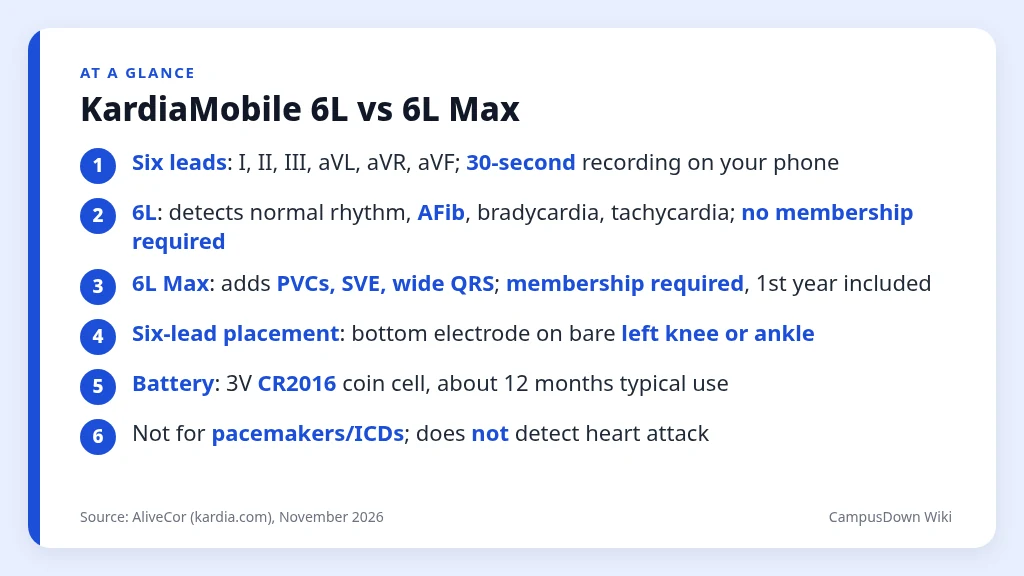
The KardiaMobile 6L is a small device about 9.0 x 3.0 x 0.72 cm and 24 grams that connects to the Kardia app on your phone by Bluetooth Low Energy. AliveCor calls it the world's first FDA-cleared six-lead personal EKG. It records six leads: I, II, III, aVL, aVR and aVF. A hospital ECG uses 12 leads; a smartwatch records something similar to a single lead. More leads give doctors more views of the heart's electrical activity, which can help when they review a rhythm strip. Our ECG rhythms basics explains what those views show.

6L vs 6L Max
KardiaMobile 6L (AliveCor listed it at $129, on a Black Friday sale for $96, when we checked on November 28, 2026; HSA/FSA eligible):
- detects normal sinus rhythm, atrial fibrillation, bradycardia and tachycardia
- no membership required: unlimited EKGs, instant results, sharing with your doctor
- optional KardiaCare membership adds more detections and cardiologist reviews
KardiaMobile 6L Max (listed at $149, HSA/FSA eligible):
- adds detections for sinus rhythm with PVCs, sinus rhythm with supraventricular ectopy (SVE) and sinus rhythm with wide QRS
- requires a KardiaCare membership; the first year is included, you enter payment details at sign-up, and AliveCor says it renews after one year unless canceled
- the included membership has four cardiologist EKG reviews per year, with turnaround under 24 hours; extra reviews were listed at $39 each
Prices and promotions change, so check them for yourself before buying.
How to record
For a single-lead EKG you rest both thumbs on the top electrodes. For a six-lead EKG, AliveCor says to place the bottom electrode on your left knee or ankle, on bare skin, not over clothing. Its tips for a clear signal:
- stay still and do not press too hard
- lightly moisten fingers and the knee or ankle with a damp towel
- use the device only within the Kardia app
Each recording takes 30 seconds.
Example scenario: catching the flutter
- Who
- Ingrid, 68, a retired dental hygienist in Minnesota, had felt short spells of a fluttering heartbeat for a year, always gone by the time she reached urgent care.
- What happened
- Two Holter monitors had come back without an episode. Her cardiologist suggested a personal EKG, and her son gave her a KardiaMobile 6L for her birthday.
- How it felt
- She felt silly at first, sitting on the couch with her pant leg rolled up. She was also afraid of what it might show, and a little afraid it would show nothing again and people would think she was imagining it.
- What they did
- The next time the flutter started, she recorded a six-lead EKG against her left knee. The app read tachycardia. She emailed the PDF to her cardiology office through the patient portal and called the nurse line.
- How it turned out
- Her cardiologist reviewed the tracing, ordered further testing, and found a rhythm problem that could be treated. Ingrid says the hardest part was believing herself; the 30-second strip helped her doctor believe her too.
This is an illustrative example, not a real patient or a review.
Ingrid is an illustrative example, not a real patient or a product review. Only a clinician can diagnose a rhythm problem.
Battery and practical details
AliveCor's specifications list a 3V CR2016 coin cell battery (included), 200 hours of operating time, and about 12 months of typical use, and describe the battery as replaceable. Bluetooth range is listed as 1 meter, so keep your phone close. Check the Kardia app's device compatibility list before buying.
What it cannot do
Get help now if
AliveCor states the KardiaMobile 6L and 6L Max are not tested or recommended for people with pacemakers or ICDs, do not check for a heart attack, and do not replace regular checkups. If you have chest pain, pressure, fainting, severe shortness of breath or stroke signs, call 911 instead of recording an EKG. Do not change any medicine based on an app result.
Kardia vs Apple Watch
- Leads: Kardia 6L records six; Apple Watch's ECG app records one, similar to Lead I.
- Background alerts: Apple Watch can send irregular rhythm notifications; Kardia records only when you use it.
- Cost: Kardia is a one-time device purchase (6L) or device plus membership (6L Max); a watch costs more but does other things.
- Who it suits: people who already know they need occasional rhythm checks and want more detail for their doctor.
See our Apple Watch ECG guide and Samsung Galaxy Watch ECG for the watch side.
Most-asked questions about KardiaMobile 6L
KardiaMobile 6L vs 6L Max: what is the difference?
Both record six leads. The 6L detects normal rhythm, AFib, bradycardia and tachycardia with no membership needed. The 6L Max adds PVC, SVE and wide QRS detections and requires KardiaCare, with the first year included.
Why people ask: "kardiamobile 6l vs 6l max" is the #3 Google suggestion for "kardiamobile 6l," and "kardia 6l vs 6l max" is #4 for "kardia 6l" (US autocomplete, November 2026).
What battery does the KardiaMobile 6L use?
AliveCor lists a 3V CR2016 coin cell battery, included, with about 12 months of typical use.
Why people ask: "kardiamobile 6l battery" is #7 and "kardiamobile 6l battery size" is #9 for "kardiamobile 6l," and "kardia 6l battery" is #2 for "kardia 6l" (US, November 2026).
How much does the KardiaMobile 6L cost?
AliveCor listed the 6L at $129 and the 6L Max at $149 when we checked in November 2026, both HSA/FSA eligible, with seasonal sales. Prices change.
Why people ask: "kardiamobile 6l price" is #8 for "kardiamobile 6l" (US, November 2026).
Is KardiaMobile 6L accurate?
AliveCor describes it as FDA-cleared and medical-grade, but any automated reading can be wrong or unclassified. Share recordings with your doctor, who can confirm with a standard ECG.
Why people ask: "kardiamobile 6l review" is #4 for "kardiamobile 6l," and "kardia 6l max reviews" is #6 for "kardia 6l" (US, November 2026).
You can learn more about your own rhythm by bringing a few recordings, with notes on what you felt, to your next cardiology visit.
Related on CampusDown
For background, read about PVCs and skipped heartbeats, AFib symptoms in women and atrial fibrillation.
Frequently asked questions
- Does KardiaMobile 6L work without a subscription?
- Yes. AliveCor says the 6L does not require a KardiaCare membership; the 6L Max does.
- Can I use it on my left ankle instead of my knee?
- AliveCor says either the left knee or the left ankle, on bare skin.
- Can my doctor see the results?
- You can share recordings; KardiaCare can also email results automatically.
- Is it safe with a pacemaker?
- AliveCor says it is not tested or recommended for pacemakers or ICDs.
A six-lead pocket EKG can turn "it happened again" into a tracing your doctor can read in detail. Talk to your doctor about whether it fits your situation, and call 911 for any emergency symptoms.
Browse more guides like this in the Home Medical Devices hub.
This article is for general education and does not replace advice from your own doctor, nurse or pharmacist.