
Your watch says "Inconclusive," and your pulse seems fine. Should you worry? A wearable ECG can be useful and also easy to misread. Here's what Samsung's own instructions say, so you can use it wisely.
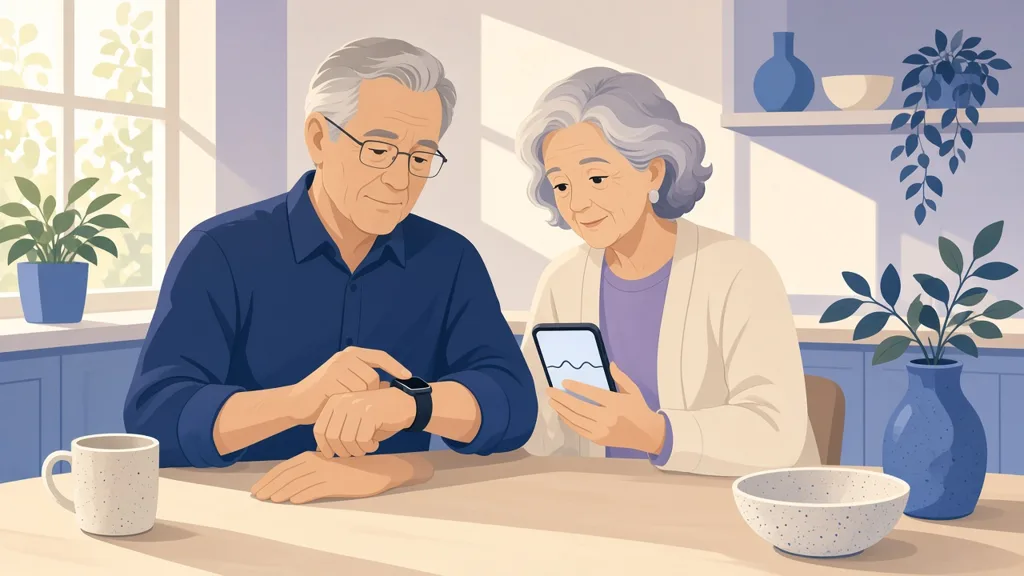
This guide is based on Samsung's US instructions for use (IFU) for the ECG App with Irregular Heart Rhythm Notification, which describes the product's FDA-cleared use, and Samsung's support page for the Samsung Health Monitor app. We take a closer look at what it measures. A watch can't diagnose anything; talk with your doctor about symptoms and results.
What it is
Samsung's IFU says the ECG App is an over-the-counter, software-only mobile medical application on a compatible Galaxy Watch and phone, for informational use only in adults 22 and older. It records a single-lead ECG to look for atrial fibrillation (AFib), and an Irregular Heart Rhythm Notification (IHRN) feature analyzes pulse data in the background and suggests you record an ECG. Learn about AFib in AFib symptoms in women and the treatment context in AFib blood thinners for seniors.

Which watch and phone
Samsung's support page says the Samsung Health Monitor app works only with some Samsung phones (Android 12.0 or higher) and Samsung Galaxy Watch Active2 or newer, and isn't available on other Android models or iOS devices, or on Samsung fitness watches. That answers a common question: it doesn't work with a non-Samsung phone. Check Samsung's compatibility page for your exact model.
How to record
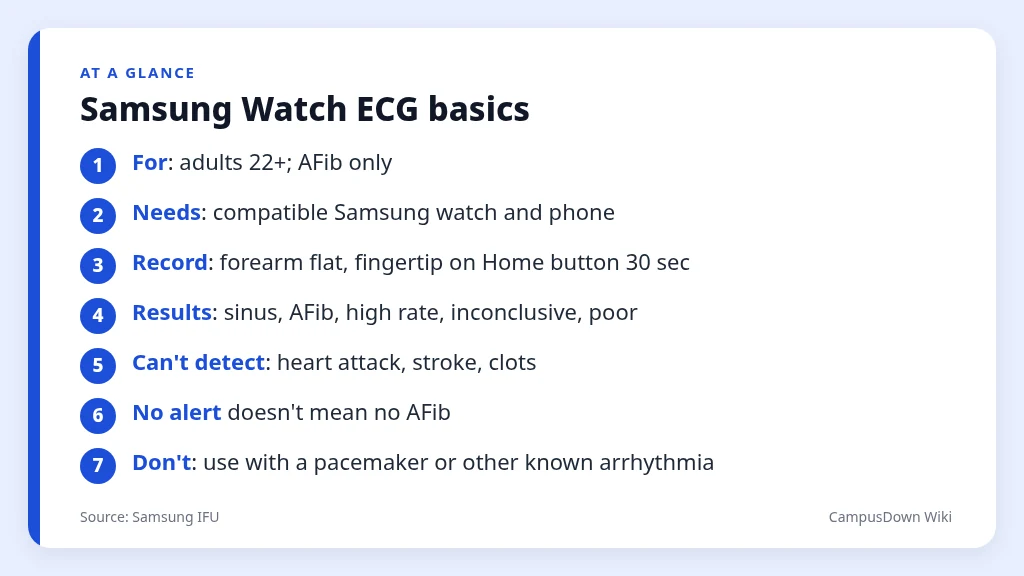
The IFU says: open Samsung Health Monitor on the watch, tap OK, follow the prompts, rest your forearm comfortably on a flat surface, lightly rest a fingertip on the Home button for 30 seconds, and stay still and don't talk. Pressing the Home button during recording stops it. Reports are saved in the phone app so you can share them with a clinician.
The six results
- Sinus rhythm: a regular rhythm. Samsung says this is based only on that recording and doesn't mean your heart beats uniformly all the time.
2. Atrial fibrillation: if you aren't under care for AFib or have symptoms, talk to a healthcare provider. 3. High heart rate: normal rhythm but 100-150 beats per minute; talk to a provider if it keeps happening and isn't usual for you. 4. AFib with high heart rate: Samsung says to contact a provider as soon as possible. 5. Inconclusive: a good-quality recording that can't be classified. 6. Poor recording: too much movement or poor skin contact; try again.
Why you may see "inconclusive"
Samsung lists these reasons: extra or early heartbeats (ectopic beats), which it says are common and usually harmless; a heart rate below 50 or above 150; or an irregular rhythm other than AFib. Its troubleshooting advice is to stay still for 5-10 minutes and try again, and to contact your doctor if you repeatedly get inconclusive. Early beats are often called PVCs; see skipped heartbeats (PVCs). A low heart rate can be normal in well-trained athletes or caused by medicines or conditions; a high one can be normal with exercise or stress, or follow dehydration, fever or infection.
How accurate is it?
The IFU reports two studies:
- ECG app (version 1.3): 1,013 adults; it correctly classified 435 of 453 AFib recordings (sensitivity 96.0%) and 682 of 691 sinus rhythm recordings (specificity 98.7%), among recordings with a heart rate of 50 to 150 BPM.
- IHRN feature: 810 adults who wore the watch with a reference ECG patch for up to 10 days; it correctly notified 102 of 150 participants with an AFib episode of 1 hour or longer (sensitivity 68.0%) and correctly didn't notify 652 of 660 without (specificity 98.8%).
The takeaway in Samsung's own words: the absence of a notification doesn't mean no disease is present. Numbers from a study don't tell you how it will perform on your wrist.
What it can't do
Samsung's IFU says the ECG App cannot look for signs of a heart attack and never looks for other rhythm problems or conditions such as high or low blood pressure, heart failure, high cholesterol, blood clots or stroke. It says don't use it with an implanted pacemaker, defibrillator or other implanted device, or if you have a known arrhythmia other than AFib, and don't change your medicines based on it. For heart attack signs, read heart attack symptoms in women. For comparison, see the Apple Watch ECG and the KardiaMobile 6L, and learn what rhythms look like in ECG rhythm basics.
Get help now if
Samsung says call emergency services immediately for shortness of breath, chest pain or pressure, or fainting. Don't wait to record an ECG.
Example scenario: the "inconclusive" streak
- Who
- Stellan, 71, a retired high school band director in Rochester, Minnesota, bought a Samsung watch for his walks. His wife, Cecilia, 69, a retired school nurse, noticed he'd started checking it every few minutes after it said "inconclusive" three days in a row.
- What happened
- He felt fine on the trail, but the word nagged at him and he stopped sleeping well.
- How it felt
- Stellan felt anxious about a result he couldn't interpret. Cecilia worried he was spiraling.
- What they did
- Cecilia read the instructions with him, and they tried again after resting five minutes. When it kept happening, they saved the reports and made an appointment. His doctor reviewed them, examined him, and explained what could cause the readings. They talked about ectopic beats and what test might be next. He checked the watch less often afterward.
- How it turned out
- Stellan said it helped to know "inconclusive" wasn't a verdict. Cecilia said bringing the reports made the visit easier.
This is an illustrative example, not a real patient or a review.
Stellan's story is an illustrative example. Your doctor decides what tests you need.
Most-asked questions about the Samsung Watch ECG
Does a Samsung watch have ECG?
Compatible Galaxy Watches do, through the Samsung Health Monitor app on a compatible Samsung phone.
Why people ask: "does samsung watch have ecg" is #10 for "samsung watch ecg" (US autocomplete, November 2026).
What is the Samsung Watch ECG app?
The Samsung Health Monitor ECG app records a 30-second single-lead ECG and looks for AFib, for adults 22 and older.
Why people ask: "samsung watch ecg app" is #2 for "samsung watch ecg" (US autocomplete, November 2026).
How accurate is the Samsung Watch ECG?
In Samsung's study, sensitivity for AFib was 96.0% and specificity 98.7% for the ECG app; the background notification had 68.0% sensitivity.
Why people ask: "samsung watch ecg accuracy" is #3 for "samsung watch ecg" (US autocomplete, November 2026).
Why does my Samsung Watch ECG say inconclusive?
Early beats, a heart rate below 50 or above 150, or another rhythm can cause it. Rest and retry; ask your doctor if it repeats.
Why people ask: "samsung watch ecg inconclusive" is #6 for "samsung watch ecg" (US autocomplete, November 2026).
Why is my Samsung Watch ECG not working?
Check compatibility, free watch storage (Samsung says the notification feature needs at least 10 MB), and skin contact with your wrist and finger; Samsung's support page lists troubleshooting steps.
Why people ask: "samsung watch ecg not working" is #5 for "samsung watch ecg" (US autocomplete, November 2026).
Can I use the Samsung Watch ECG with a non-Samsung phone?
Samsung says no: it isn't available on other Android models or iOS.
Why people ask: "samsung watch ecg on non samsung phone" is #8 for "samsung watch ecg" (US autocomplete, November 2026).
Can a Samsung Watch detect atrial fibrillation?
It can flag AFib on an ECG recording and notify of possible AFib episodes, but it doesn't diagnose. See your doctor.
Why people ask: "samsung watch ecg atrial fibrillation" is #9 for "samsung watch ecg" (US autocomplete, November 2026).
Related on CampusDown
You can learn more about the Apple Watch ECG and check it for yourself in ECG rhythm basics.
Frequently asked questions
- Can the watch detect a heart attack?
- No, per Samsung's instructions.
- Can I use it with a pacemaker?
- Samsung says don't.
- Does sinus rhythm mean I'm fine?
- Not necessarily; it reflects only that recording. Talk to your doctor if you have symptoms.
- Should I change medicines based on a result?
- No; Samsung says not to without your doctor.
A watch ECG is a prompt to talk to your doctor, not a diagnosis. Know what it can't see, and call 911 for chest pain or fainting.
Browse more guides like this in the Home Medical Devices hub.
This article is for general education and does not replace advice from your own doctor, nurse or pharmacist.