
Is your mom up at 4:30 every morning, napping in her chair by 2 p.m., and telling you "that's just what happens when you get old"? Some of that is normal aging. Some of it may not be, and the difference matters for her health, her mood and her safety.
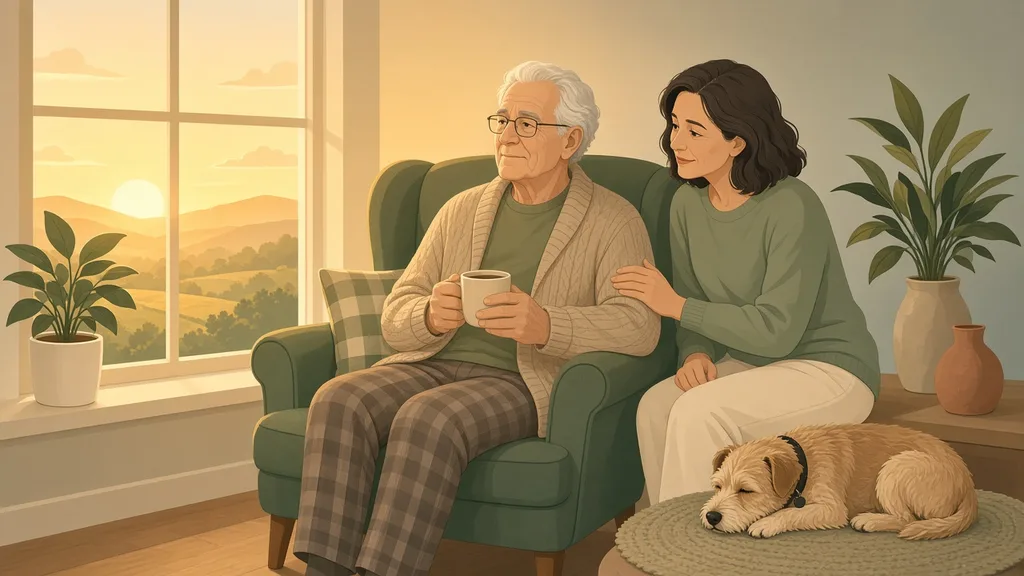
This guide uses the National Institute on Aging (NIA) and the National Heart, Lung, and Blood Institute (NHLBI), checked in November 2026, to explain how sleep changes after 60, what is not normal, and when to talk to a doctor. It is written for older adults and the family members who worry about them.
How much sleep do older adults need?
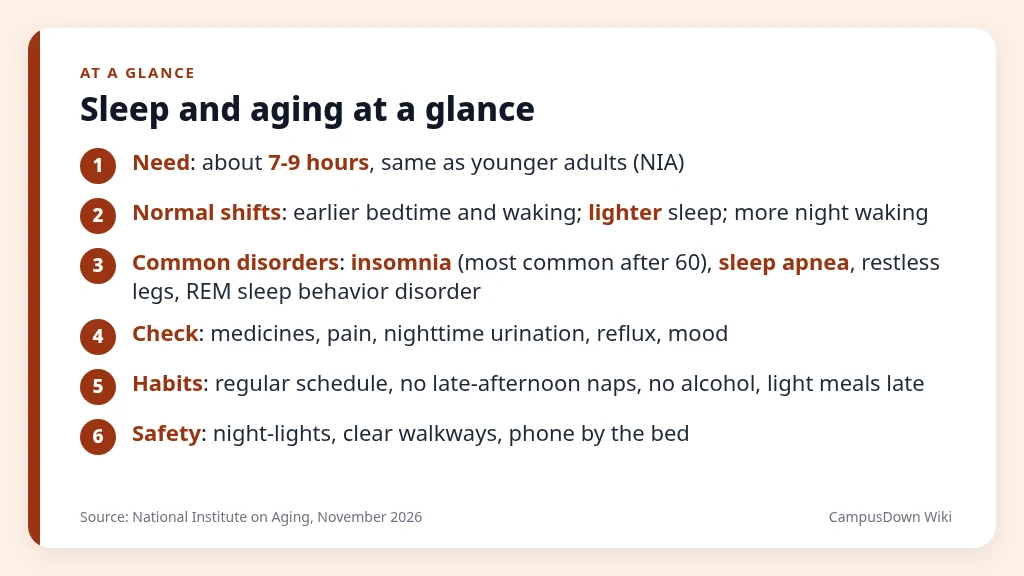
The NIA says older adults need about the same amount of sleep as all adults: seven to nine hours each night. Needing less sleep is not a normal part of aging. What changes is when and how people sleep.

What normally changes with age
According to the NIA:
- Earlier bedtime, earlier waking. Older people tend to go to sleep earlier and get up earlier than they did when younger.
- Lighter, shorter sleep. The time spent in each type of sleep decreases. Sleep tends to be shorter and lighter.
- More night waking. You may wake up more often during the night.
- More outside influences. Older adults are more likely to take medicines and have conditions that affect sleep.
The NIA explains that sleep runs on your circadian rhythm (your body clock) and on sleep pressure that builds while you are awake. Melatonin, a hormone released when it gets dark, helps signal sleep. See our melatonin page before trying it as a supplement.
Key point
Waking at 5 a.m. after going to bed at 9 p.m. can be a normal shift. Feeling sleepy all day, falling asleep during conversations, or never feeling rested is not something to accept as normal aging.
Sleep problems that become more common
The NIA lists several sleep disorders that become more common with age:
- Insomnia: the most common sleep problem in adults 60 and older. Trouble falling or staying asleep at least three nights a week; chronic insomnia lasts more than three months. Cognitive behavioral therapy can help. See insomnia and CBT-I.
- Sleep apnea: repeated pauses in breathing as throat muscles relax and block the airway. Snoring can be a sign, but not everyone who snores has it. The NIA warns that untreated sleep apnea can lead to serious health problems, including heart attack. Read about obstructive sleep apnea and treatments like CPAP.
- Restless legs syndrome: tingling or crawling feelings in the legs, worse at night and better with movement.
- Periodic limb movement disorder: jerking or kicking of the legs every 20 to 40 seconds during sleep.
- REM sleep behavior disorder: acting out dreams, which can cause injuries. The NIA recommends a safe sleep space and medical treatment.
Your doctor may suggest an overnight sleep test (polysomnogram) to sort out the cause.
Other things that break up sleep
- Nighttime urination: getting up to use the bathroom is a common reason for waking, and a fall risk in the dark. See nocturia and fall risk.
- Heartburn at night: lying down can bring on reflux. See acid reflux at night.
- Pain, breathing problems, depression and anxiety.
- Medicines: some cause wakefulness, others cause daytime drowsiness. NHLBI notes some cold and allergy medicines can disrupt sleep.
Bring every pill, including over-the-counter sleep aids and supplements, to a doctor or pharmacist visit. Over-the-counter "PM" products often contain diphenhydramine, an antihistamine that deserves extra caution in older adults.
Dementia and sleep
The NIA says Alzheimer's disease and related dementias can cause sleeping too much or not enough, frequent waking and wandering at night, and that poor sleep can make dementia symptoms worse. Late-day agitation, sometimes called sundowning, is also common. Caregivers' sleep suffers too, so ask the care team about support.
Example scenario: the dad who slept all afternoon
- Who
- Ambrose, 79, a retired high school shop teacher in Spokane, lives alone with his terrier. His daughter Celeste visits on weekends.
- What happened
- Celeste noticed her father dozing off mid-sentence, napping three times a day, and waking before 4 a.m. He had started using an over-the-counter "PM" pain reliever most nights and had fallen once on the way to the bathroom.
- How it felt
- Ambrose insisted he was "just old," but he admitted he felt foggy and lonely since his wife died. Celeste felt guilty for not visiting more, and scared after the fall.
- What they did
- She went with him to his primary care visit with a bag of every pill he took. The doctor stopped the nightly PM product, treated his frequent nighttime urination, and ordered a home sleep apnea test after Celeste described his loud snoring and pauses. They also set up night-lights and moved a rug.
- How it turned out
- The test showed moderate sleep apnea, and he started CPAP. He still wakes early, but the afternoon naps shrank to one short one, and he joined a morning walking group. Celeste says the most useful thing she did was bring the pill bag.
This is an illustrative example, not a real patient or a review.
Ambrose and Celeste are an illustrative example, not real patients. Only a doctor can sort out the causes of sleep changes.
Habits the NIA recommends
- Keep a regular schedule, going to bed and getting up at the same times every day, even on weekends.
- Have a relaxing bedtime routine, such as reading, soothing music or a warm bath.
- Keep the bedroom comfortable, not too hot or cold.
- Exercise regularly, but not within three hours of bedtime.
- Avoid napping in the late afternoon or evening.
- Avoid caffeine late in the day (coffee, tea, chocolate, soda).
- Avoid alcohol, even small amounts.
- Keep screens out of the bedroom.
- Avoid large meals within two to three hours of bedtime and large amounts of liquid late in the day.
Keeping a sleep diary for a couple of weeks, noting bedtimes, night waking, caffeine, alcohol and exercise, helps your doctor see patterns.
Nighttime safety
The NIA suggests smoke alarms on every floor, locked outside doors and windows, a phone with emergency numbers by the bed, an easy-to-reach lamp, night-lights in the hallway and bathroom, and removing rugs and cords you could trip on at night.
Get help now if
Sleep medicines may help in the short term, the NIA says, but they carry risks, including dependence and not feeling clearheaded during the day. Do not start, stop or combine sleep aids without talking to a doctor or pharmacist. Call a doctor promptly about new confusion, falls or severe daytime sleepiness.
Most-asked questions about sleep and aging
How much sleep do seniors need?
About seven to nine hours a night, the same as other adults, according to the National Institute on Aging.
Why people ask: "how much sleep do seniors need" is the #1 Google suggestion for "how much sleep do seniors" (US autocomplete, November 2026).
Why do elderly people sleep so much?
Lighter, broken night sleep can lead to more daytime dozing, and medicines, illness, depression, sleep apnea and dementia can all cause sleepiness. Ongoing heavy sleepiness is worth a doctor visit.
Why people ask: "why do elderly people sleep so much" is the #1 suggestion for "why do elderly" (US, November 2026).
How do sleep patterns change in older adults?
The NIA says older adults tend to go to bed and wake earlier, spend less time in each sleep stage, sleep more lightly and wake more often.
Why people ask: "older adults sleep patterns" is #2 for "older adults sleep" (US, November 2026).
How does dementia affect sleep?
The NIA says dementia can cause sleeping too much or too little, frequent waking and nighttime wandering, and that poor sleep can worsen symptoms.
Why people ask: "sleep problems in elderly with dementia" is #8 for "sleep problems elderly" (US, November 2026).
If you want to learn more about a parent's sleep, take a closer look for two weeks with a simple sleep diary before the next appointment.
Related on CampusDown
Read about insomnia, find help in CBT-I, and if pills are piling up, see polypharmacy and the Beers Criteria.
Frequently asked questions
- Is it normal to wake up at 4 or 5 a.m. after 60?
- Earlier waking is a common change with age, especially with an earlier bedtime. Daytime exhaustion is not normal.
- Are naps bad for older adults?
- The NIA advises avoiding naps in the late afternoon or evening, which can make night sleep harder.
- Should seniors take melatonin?
- Ask a doctor or pharmacist first. Supplements are not reviewed by the FDA for safety and effectiveness before sale.
- When should a sleep problem be checked?
- When it lasts weeks, causes daytime sleepiness, or comes with loud snoring, breathing pauses, leg discomfort or acting out dreams.
Sleep changes with age, but exhaustion, constant napping and frequent falls at night are signals, not just birthdays. Talk to your doctor, bring the medicine bag, and check it for yourself with a sleep diary.
Browse more guides like this in the Senior Health and Medicare hub.
This article is for general education and does not replace advice from your own doctor, nurse or pharmacist.