
It's labeled "PM," it's on the shelf beside the headache pills, and your mother has taken it every night for years to sleep. Is it harmless? Not for many older adults. Diphenhydramine, best known as Benadryl, is among the medicines that experts advise older adults to avoid in most cases.

This guide is based on MedlinePlus drug information and the 2023 American Geriatrics Society (AGS) Beers Criteria, which list potentially inappropriate medicines for people 65 and older. We explain in detail what they say. Ask your doctor or pharmacist before you start, change or stop anything, including nonprescription products.
What diphenhydramine is
MedlinePlus says diphenhydramine is an antihistamine that works by blocking histamine, a substance in the body that causes allergic symptoms. It's used for allergy and cold symptoms, to prevent and treat motion sickness and, in adults, insomnia. It's also an ingredient in many combination products, "PM" pain relievers and nighttime cold remedies, so read labels. Brand names include Benadryl.

What MedlinePlus says about older adults
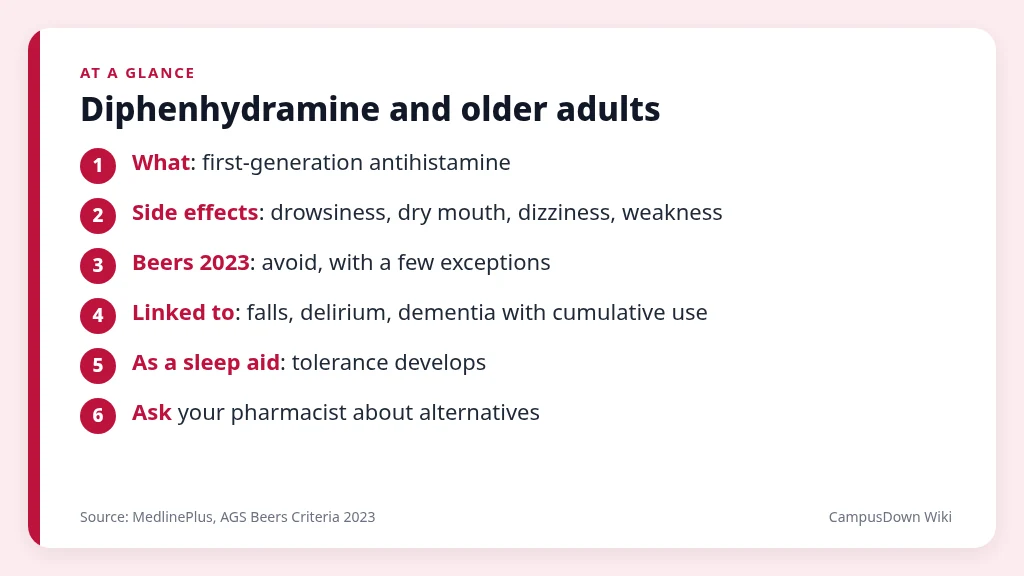
MedlinePlus says generally, diphenhydramine should not be used in older adults, except to manage serious allergic reactions, because it isn't as safe or effective as other medicines for the condition. If you're 65 or older, talk to your doctor about the risks and benefits. It also says the medicine may make you drowsy, so don't drive or operate machinery until you know how it affects you, and that alcohol adds to the drowsiness.
What the Beers Criteria say
The 2023 AGS Beers Criteria list oral diphenhydramine among first-generation antihistamines to avoid in older adults. The rationale: it's highly anticholinergic, its clearance is reduced with advanced age, and tolerance develops when used as a sleep aid, with risk of confusion, dry mouth, constipation and other anticholinergic effects. It states that cumulative exposure to anticholinergic drugs is associated with an increased risk of falls, delirium and dementia, and suggests considering the total anticholinergic burden during regular medication reviews. It also notes that diphenhydramine may be appropriate in situations such as acute treatment of severe allergic reactions. Learn more in anticholinergic drugs and memory and polypharmacy and the Beers Criteria.
Side effects
MedlinePlus lists dry mouth, nose and throat, drowsiness, dizziness and muscle weakness, and says to call your doctor right away for vision problems or difficulty or painful urination. It also says to tell your doctor if you have glaucoma, lung disease such as emphysema or chronic bronchitis, or difficulty urinating due to an enlarged prostate. Dry mouth is a common medicine effect; see dry mouth from medications. If you get up at night to urinate, a sedating pill can make the trip riskier; see waking at night to urinate and the fall prevention checklist.
Benadryl for sleep
The Beers Criteria say tolerance develops when diphenhydramine is used as a hypnotic, so the sleepy effect can fade while side effects remain. If poor sleep is the reason you take it, ask about proven non-drug approaches such as CBT for insomnia; see CBT-I for insomnia and sleep changes with aging. Don't stop a long-used sleep medicine abruptly without asking, since your clinician may suggest a plan.
Hidden sources
Check the active ingredients on nighttime pain, cold and cough products. Words like "PM," "nighttime" and "sleep" often signal diphenhydramine or a related sedating antihistamine. Ask your pharmacist to check your whole list in a brown bag review.
Children
MedlinePlus says don't use diphenhydramine in children between 2 and 5 unless directed by a doctor, use caution at 6 to 11, don't give adult products to children, and don't use it to make a child sleepy. Use the measuring device that comes with liquids.
Get help now if
Call 911 for swelling of the face or throat, trouble breathing, or severe allergic reaction. Call your doctor for vision changes, trouble urinating, new confusion or a fall.
Example scenario: the nightly "PM"
- Who
- Hamilton, 79, a retired postal clerk in Albuquerque, New Mexico, took a nighttime sleep tablet from the drugstore every evening for six years. His wife, Evangelina, 77, a retired cafeteria cook, noticed he was groggy until late morning and had started missing words.
- What happened
- One night he stumbled in the hallway on the way to the bathroom, and his dry mouth woke him twice.
- How it felt
- Hamilton felt embarrassed and worried that he was "slipping." Evangelina worried about dementia.
- What they did
- Evangelina brought the box to the pharmacist, who explained the age-related cautions, and together with his doctor they made a plan. They looked at his evening routine and his sleep schedule, and he started a structured sleep program. He didn't stop on his own.
- How it turned out
- Hamilton said his mind felt clearer by the month. Evangelina said the pharmacist's explanation made her feel less alone.
This is an illustrative example, not a real patient or a review.
Hamilton's story is an illustrative example. A clinician should guide any change to your medicines.
Most-asked questions about diphenhydramine
What are the side effects of Benadryl?
Drowsiness, dry mouth, dizziness and muscle weakness, plus vision problems or trouble urinating that need a call to your doctor.
Why people ask: "benadryl side effects" is #1 for "benadryl side effects" (US autocomplete, November 2026).
What are Benadryl side effects in the elderly?
MedlinePlus and the Beers Criteria warn that older adults are more at risk of confusion, falls and anticholinergic effects.
Why people ask: "benadryl side effects in elderly" is #3 for "benadryl side effects" (US autocomplete, November 2026).
Is Benadryl safe for the elderly?
MedlinePlus says generally not, except for serious allergic reactions; ask your doctor.
Why people ask: "benadryl elderly" is #1 for "benadryl elderly" (US autocomplete, November 2026).
Can Benadryl cause dementia in the elderly?
The Beers Criteria say cumulative anticholinergic exposure is associated with an increased risk of falls, delirium and dementia. Ask your doctor about your total exposure.
Why people ask: "benadryl elderly dementia" is #3 for "benadryl elderly" (US autocomplete, November 2026).
Can I take Benadryl for sleep?
MedlinePlus lists insomnia as a use in adults, but the Beers Criteria note tolerance develops and advise older adults to avoid it.
Why people ask: "benadryl for sleep" is #1 for "benadryl for sleep" (US autocomplete, November 2026).
Is Benadryl for sleep safe in the elderly?
Generally not recommended; ask for non-drug options and a medicine review.
Why people ask: "benadryl for sleep in elderly" is #7 for "benadryl for sleep" (US autocomplete, November 2026).
What are the side effects of Benadryl for sleep?
Next-day grogginess, dry mouth, dizziness and weakness are listed side effects; older adults risk confusion and falls.
Why people ask: "benadryl for sleep side effects" is #8 for "benadryl for sleep" (US autocomplete, November 2026).
Related on CampusDown
You can learn more about anticholinergic drugs and take a closer look at CBT-I.
Frequently asked questions
- What's an anticholinergic?
- A medicine that blocks acetylcholine; effects include dry mouth, constipation, confusion and blurred vision.
- Is it ever appropriate?
- The Beers Criteria say it may be appropriate for acute treatment of severe allergic reactions.
- Can I stop it suddenly?
- Ask your clinician; check it for yourself with your pharmacist.
- Are nighttime cold medicines the same?
- Many contain diphenhydramine; read the active ingredients.
Diphenhydramine has real uses, but for older adults it's usually the wrong choice for sleep. Ask your pharmacist to check your list.
Browse more guides like this in the Medicines hub.
This article is for general education and does not replace advice from your own doctor, nurse or pharmacist.