
Your patient's apical pulse is 54, she says her food looks "yellow-ish" and she hasn't felt like eating. Do you give the 9 a.m. digoxin?

Digoxin is one of the most tested and most careful medicines in cardiac nursing. This guide uses OpenStax's Pharmacology (17.6 Unclassified Antidysrhythmics) and Medical-Surgical Nursing (10.3 Electrolyte Imbalance), plus MedlinePlus's digoxin drug information. It is a study aid, not orders; your instructor, facility policy and the provider decide care. If you want to learn more about the potassium side of this story, take a closer look at high potassium (hyperkalemia).
What digoxin does
OpenStax calls digoxin an older antidysrhythmic first approved in 1954 and used for rate control of atrial fibrillation or atrial flutter. It suppresses conduction through the AV node, slowing conduction and the ventricular heart rate, by enhancing vagal (parasympathetic) stimulation of the heart. It is also approved for heart failure with reduced ejection fraction. MedlinePlus says it is used to treat heart failure and abnormal heart rhythms, helps the heart work better and helps control heart rate, and lists the brand names Cardoxin, Digitek, Lanoxicaps and Lanoxin. For background on the conditions, see atrial fibrillation and heart failure.

Why levels and kidneys matter
OpenStax says digoxin comes in oral and IV forms and is eliminated by the kidneys, so it can accumulate in individuals with decreased kidney function; nurses must monitor renal function. It gives the reference range for serum levels as 0.5 to 2.0 ng/mL, and notes that levels of 1.2 ng/mL or higher may be associated with higher mortality (citing Lopes et al., 2018). Different labs and facilities have their own targets; follow your policy. See eGFR and kidney function.
MedlinePlus says to always take the same brand, because different brands contain different amounts of active drug and the dose would need to change, and that older adults should usually receive low doses because higher doses may cause serious side effects. Its drug page was last revised in 2017, so check current labeling and your pharmacist.
Pulse check before dosing
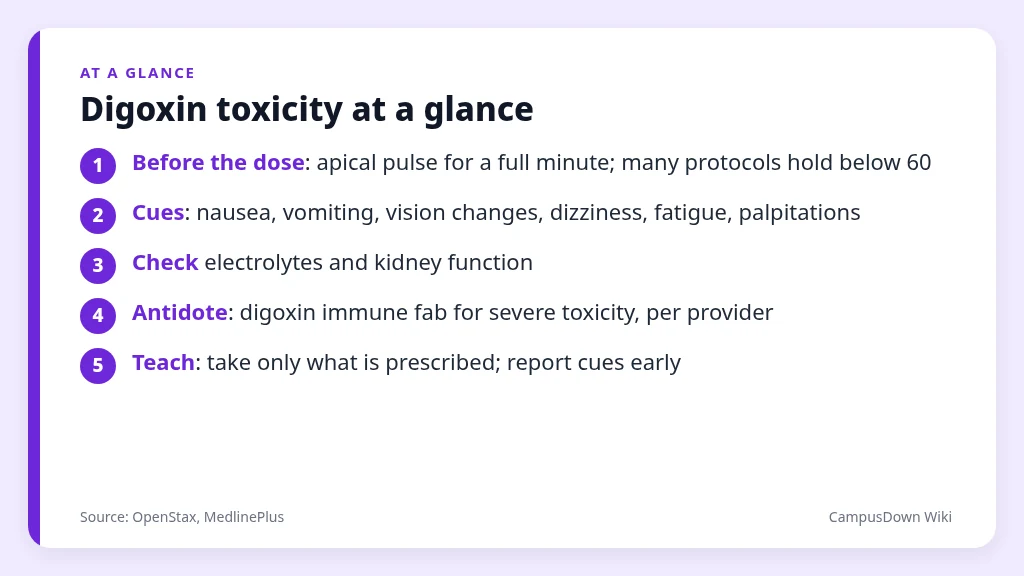
OpenStax says many health care providers monitor the apical heart rate before administering digoxin and withhold it if the apical rate is less than 60 beats per minute. Nursing skills texts commonly teach counting the apical pulse for a full minute; OpenStax does not spell this out, so check your facility policy for the exact method, the hold rule and what to report. OpenStax adds in its nursing implications:
- Get a complete medication list and check for interactions.
- Measure heart rate and blood pressure before giving it.
- Monitor for adverse effects, including electrolyte imbalances and kidney function changes.
- Notify the provider if the client has baseline bradycardia and no pacemaker.
- Use continuous cardiac monitoring when the drug class calls for it.
- Teach the client about the drug and when to call.
OpenStax says digoxin should not be used in clients with baseline bradycardia or certain heart blocks, because it can cause bradycardia as part of its therapeutic effect.
Signs of toxicity
OpenStax says digoxin therapy has a propensity for toxicity, characterized by gastrointestinal upset, vision changes, dizziness, fatigue, and cardiovascular symptoms such as palpitations from premature ventricular contractions (PVCs). MedlinePlus lists dizziness or lightheadedness, drowsiness, blurred or yellow vision, rash and irregular heartbeat as side effects, and says to call a doctor for upset stomach, vomiting, diarrhea, loss of appetite, swelling of the feet or hands, unusual weight gain and difficulty breathing.
Put together, a slow pulse, nausea or loss of appetite, a vision change, new fatigue or a new rhythm change in a patient on digoxin is a cue to hold, check and call; the decision belongs to the provider. For rhythm basics, see ECG rhythm basics.
Get help now if
Signs of toxicity with a slow or irregular pulse, fainting, chest pain, severe weakness or confusion need immediate escalation per your facility's protocol. Call for help.
Treatment (provider-directed)
OpenStax says that for clients with toxicity and particularly high serum levels (greater than 6 to 10 ng/mL), an antidote called digoxin immune fab (Digibind) can be given to bind the digoxin and help excrete it. The rest of care is decided by the provider; your facility's protocol applies.
Potassium, magnesium and calcium
OpenStax's electrolyte chapter says potassium imbalances can cause lethal cardiac dysrhythmias, so patients with hypokalemia are placed on continuous telemetry for early ECG changes, and that IV potassium must never be given by IV push but slowly via a pump. MedlinePlus says that a person taking digoxin may be advised to follow a low-sodium diet and take a potassium supplement, and lists antacids, calcium supplements and some acid reducers (esomeprazole, lansoprazole, omeprazole) among products that can interact. These sources don't give a complete rule for how each electrolyte shifts digoxin effect, so follow your pharmacology text and facility policy. See normal potassium range for nursing and calcium and magnesium for nursing.
Client teaching
OpenStax says digoxin teaching should include to avoid taking more than prescribed or more often than prescribed and to report any signs or symptoms of toxicity. MedlinePlus adds:
- Don't stop it without talking to your doctor.
- Tell the doctor and pharmacist about all medicines, supplements and herbals (St. John's wort, neomycin and activated charcoal are among those listed).
- Tell the doctor about thyroid problems, arrhythmias, cancer or kidney disease.
- Alcohol can add to drowsiness; don't drive until you know how it affects you.
- If you miss a dose, take it when you remember unless it is almost time for the next one, and don't double up.
Questions for your instructor or preceptor
- What does our policy say about the pulse rate that means "hold" and who do we call?
- Which labs do we check before and during therapy?
- How do we double-check a digoxin dose and the brand?
- What do we teach older adults and their families about early cues?
- Where do we chart the apical pulse, the hold decision and the notification?
Example scenario: the yellow-ish menu
- Who
- Mathilda, 26, a new graduate nurse on a cardiac floor in Pittsburgh, Pennsylvania, took her patient's apical pulse for a full minute before a morning digoxin dose and found it slower than usual.
- What happened
- The patient had mentioned that her breakfast looked "yellow-ish" and she had no appetite, and Mathilda wasn't sure if it mattered.
- How it felt
- She felt nervous about holding a dose on her own.
- What they did
- She did not give the dose, rechecked the pulse, told the charge nurse and called the provider using the SBAR format, mentioning the pulse, the appetite change and the vision comment. The provider reviewed the labs and gave new orders. Mathilda documented everything and added kidney function and electrolytes to her shift checklist.
- How it turned out
- Mathilda said asking out loud was less scary than guessing.
This is an illustrative example, not a real patient or a review.
Mathilda's story is an illustrative example. Follow your facility's policy and the provider's orders, and escalate promptly for a slow or irregular pulse with symptoms.
Most-asked questions about digoxin toxicity
What are the symptoms of digoxin toxicity?
GI upset, vision changes, dizziness, fatigue and palpitations from premature ventricular contractions, per OpenStax.
Why people ask: "digoxin toxicity symptoms" is #2 for "digoxin toxicity" (US autocomplete, November 2026).
What ECG changes occur in digoxin toxicity?
OpenStax mentions palpitations from PVCs and bradycardia as part of the drug's effect; it doesn't list specific ECG patterns, so use your cardiology text and facility protocol.
Why people ask: "digoxin toxicity ecg" is #3 for "digoxin toxicity" (US autocomplete, November 2026).
What level of digoxin is toxic?
OpenStax gives a reference range of 0.5 to 2.0 ng/mL and says very high levels (greater than 6 to 10 ng/mL) with toxicity may be treated with digoxin immune fab; clinical decisions depend on the whole picture.
Why people ask: "digoxin toxicity levels" is #4 for "digoxin toxicity" (US autocomplete, November 2026).
What is the antidote for digoxin toxicity?
Digoxin immune fab, which binds digoxin and helps remove it, per OpenStax.
Why people ask: "digoxin toxicity antidote" is #5 for "digoxin toxicity" (US autocomplete, November 2026).
How is digoxin toxicity treated?
Provider-directed; OpenStax names digoxin immune fab for severe toxicity with very high levels, and nurses hold the dose and report cues per policy.
Why people ask: "digoxin toxicity treatment" is #6 for "digoxin toxicity" (US autocomplete, November 2026).
What are the signs of digoxin toxicity?
Nausea, vomiting, loss of appetite, blurred or yellow vision, dizziness, fatigue, a slow or irregular pulse; MedlinePlus also lists swelling and unusual weight gain as reasons to call.
Why people ask: "digoxin toxicity signs" is #7 for "digoxin toxicity" (US autocomplete, November 2026).
How does potassium relate to digoxin toxicity?
OpenStax says potassium imbalances can cause lethal dysrhythmias and MedlinePlus mentions a potassium supplement for some patients; the exact interplay is for your pharmacology text and the provider.
Why people ask: "digoxin toxicity and potassium" is #8 for "digoxin toxicity" (US autocomplete, November 2026).
Does low potassium raise the risk of digoxin toxicity?
These sources don't state it directly; electrolyte balance is monitored in therapy, so ask your instructor or pharmacist and follow facility policy.
Why people ask: "digoxin toxicity hypokalemia" is #10 for "digoxin toxicity" (US autocomplete, November 2026).
What are the nursing interventions for digoxin toxicity?
Check the apical pulse before dosing, hold and report per policy, monitor electrolytes and kidney function, use cardiac monitoring as ordered and teach.
Why people ask: "digoxin toxicity nursing interventions" is #1 for "digoxin toxicity nursing" (US autocomplete, November 2026).
What are the nursing considerations for digoxin?
Medication list review, heart rate and blood pressure before the dose, bradycardia or heart block cautions, kidney function, electrolytes and teaching.
Why people ask: "digoxin toxicity nursing considerations" is #4 for "digoxin toxicity nursing" (US autocomplete, November 2026).
Related on CampusDown
You can learn more about the nursing student hub and check it for yourself in the lab values cheat sheet. For how nurses frame these decisions in detail, see the nursing process, and for a medicines-by-class overview see pharmacology drug suffixes.
Frequently asked questions
- What apical pulse means "hold"?
- OpenStax says many providers withhold digoxin if the apical rate is less than 60; follow your facility's policy.
- What is the reference range for digoxin?
- OpenStax gives 0.5 to 2.0 ng/mL, with higher mortality possible at 1.2 or above in one study.
- What is the antidote?
- Digoxin immune fab (Digibind) for severe toxicity.
- Why watch kidney function?
- Digoxin is eliminated by the kidneys and can accumulate with decreased kidney function.
- Can patients switch brands?
- MedlinePlus says to always take the same brand because brands differ in active drug amounts.
Digoxin slows the heart rate and helps in heart failure, but toxicity is possible. Check the apical pulse before dosing, hold and report per policy, watch for GI upset, vision changes, fatigue and palpitations, monitor kidney function and electrolytes, know the antidote, and teach clients not to take more than prescribed.
Browse more guides like this in the Nursing Student and NCLEX hub.
This article is for general education and does not replace advice from your own doctor, nurse or pharmacist.