
You have 200 drug names to learn and the exam is in three weeks. How do you stop them blurring together? One trick is to read the end of the word, because the ending often tells you the family.

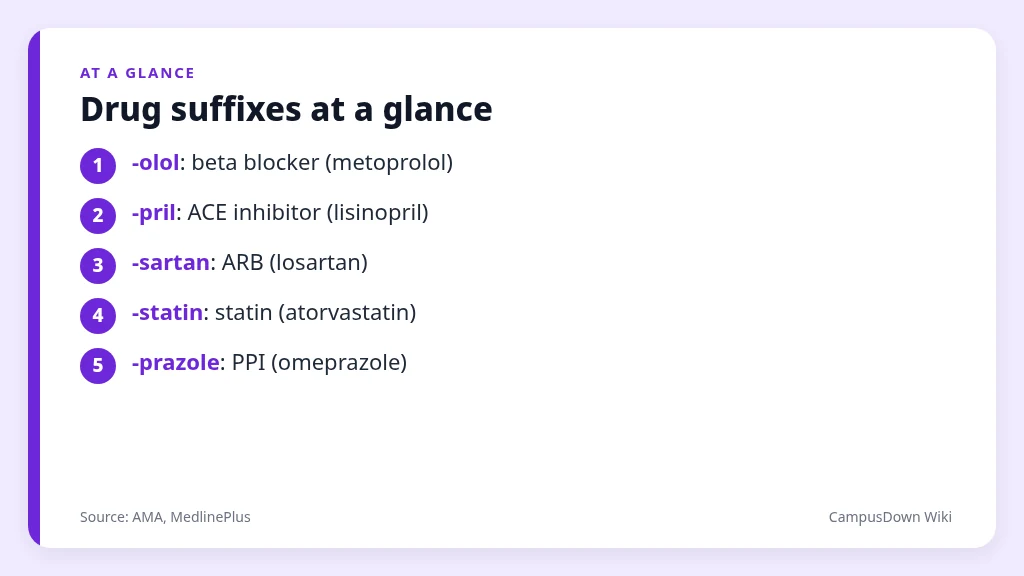
This guide is for nursing students. It uses the AMA's summary of how USAN generic names are built and MedlinePlus drug information for the class of each example drug. Follow your instructor's materials and your facility's policy, and confirm every drug in a current drug reference or with a pharmacist. To learn more about safe administration, see the rights of medication administration, and take a closer look at the table below.
How generic names are built
The AMA explains that the United States Adopted Names (USAN) Council assigns the nonproprietary names for active drug ingredients. A name has a stem or substem, usually at the end, that signals a chemical structure, an indication or an action at a specific receptor, plus a one- or two-syllable prefix that makes each drug in the class distinct. The AMA gives imatinib as an example: "-tinib" marks a tyrosine kinase inhibitor. It also says the Council avoids prefixes that would create names too similar to other drugs, because patient safety and reducing medication errors are the most important concern.
So the ending is a clue to the family, and the beginning tells family members apart.

Common endings with examples
The class for each example below comes from its MedlinePlus drug information page. The ending is the part of the generic name to look for.
| Ending | Example drug | Class (MedlinePlus) |
|---|---|---|
| -olol | metoprolol | Beta blockers |
| -pril | lisinopril | ACE (angiotensin-converting enzyme) inhibitors |
| -sartan | losartan | Angiotensin II receptor antagonists (ARBs) |
| -statin | atorvastatin | HMG-CoA reductase inhibitors (statins) |
| -prazole | omeprazole | Proton-pump inhibitors |
| -tidine | famotidine | H2 blockers |
| -xaban | apixaban | Factor Xa inhibitors |
| -cillin | amoxicillin | Penicillin-like antibiotics |
| -cycline | doxycycline | Tetracycline antibiotics |
| -zolam | alprazolam | Benzodiazepines |
For a closer look at individual drugs, see lisinopril, losartan, atorvastatin, omeprazole, famotidine, amoxicillin and alprazolam.
Why the class matters at the bedside
Knowing the class lets you predict what to assess and teach. For instance, MedlinePlus describes metoprolol's class as beta blockers and lisinopril's as ACE inhibitors, and both are used for conditions such as high blood pressure, so a nurse thinks about blood pressure and heart rate checks. MedlinePlus describes losartan as blocking the action of substances that tighten blood vessels. When you meet a drug you haven't studied, the stem gives you a first guess to confirm, not an answer.
A stem is a guide, not a safety check
- Confirm the drug. Use a current drug reference, the order and your facility's process. Don't give or teach a drug on the strength of its ending.
- Read the whole name. The AMA says prefixes are chosen to reduce confusion between names, but never rely on the ending or the first letters alone; check the full name, strength and form.
- Know the high-alert list. Some drug classes carry extra risk when errors occur; see high-alert medications and the ISMP list.
- Ask. If anything is unclear, ask your instructor, preceptor, nurse or pharmacist.
Study tips
- Start small. Learn five or six endings you see most often, then add more.
- Sort, then quiz. Put each drug on a card, sort cards into class piles, then close the book and say the class aloud.
- Pair the ending with one example you've seen in practice. A real patient's medicine list is easier to remember than a table.
- Pair class with nursing actions. Add one assessment and one teaching point per class from your textbook.
- Plan your review. See a 6-week NCLEX study plan and the ATI TEAS exam for pacing ideas.
Get help now if
Don't use a study table to make decisions about a real patient's medicine. If you're unsure about an order, a drug name or a dose, stop and ask your instructor, nurse or pharmacist before you act.
Example scenario: the flashcard fix
- Who
- Hadley, 22, a second-year nursing student in Columbus, Ohio, kept mixing up blood pressure drugs on quizzes.
- What happened
- She had been memorizing names one by one from a long list the night before each test.
- How it felt
- She felt frustrated and worried she wasn't cut out for pharmacology.
- What they did
- A classmate suggested sorting cards by ending first, and her instructor reminded her to check every class in the textbook rather than trust the ending alone. She learned the endings in small groups, then matched each to a patient teaching point.
- How it turned out
- Hadley said the list stopped feeling like noise, and she felt calmer walking into her next exam.
This is an illustrative example, not a real patient or a review.
Hadley's story is an illustrative example. Study methods vary; follow your program's materials.
Most-asked questions about drug suffixes
Is there a drug suffixes cheat sheet?
Many exist; this guide gives a short table, and you should check it against your textbook or a drug reference.
Why people ask: "drug suffixes cheat sheet" is #2 for "drug suffixes" (US autocomplete, November 2026).
What do drug suffixes mean?
Per the AMA, a stem signals chemical structure, indication or action at a receptor.
Why people ask: "drug suffixes and meaning" is #4 for "drug suffixes" (US autocomplete, November 2026).
Is there a quiz for drug suffixes?
Make your own: cover the class column and say each class aloud, then check it.
Why people ask: "drug suffixes quiz" is #6 for "drug suffixes" (US autocomplete, November 2026).
What is a good list of drug suffixes?
Start with the ten endings in the table above, then add from your course materials.
Why people ask: "drug suffixes list" is #7 for "drug suffixes" (US autocomplete, November 2026).
Where can I find a pharmacology suffixes cheat sheet?
Your course or a current drug reference is the best source.
Why people ask: "pharmacology suffixes cheat sheet" is #6 for "pharmacology suffixes" (US autocomplete, November 2026).
Related on CampusDown
You can learn more about the nursing process and check it for yourself with the asthma medications for nursing students guide.
Frequently asked questions
- Are new stems created often?
- No. The AMA says a new stem is rare and is assigned only when a drug is truly novel and doesn't fit an existing group.
- Can I rely on the ending to identify a drug's class?
- Use it as a first guess, then confirm in a current drug reference.
- What is the difference between a stem and a prefix?
- The AMA describes the stem as the usual ending that signals structure or action and the prefix as the one- or two-syllable start that distinguishes the drug within its class.
- Are brand names part of this?
- No. Stems apply to generic (nonproprietary) names; brand names are chosen by manufacturers.
Endings help you sort drugs into families, and that makes studying faster. Treat the ending as a clue, confirm every drug in a current reference, and ask when you're unsure.
Browse more guides like this in the Nursing Student and NCLEX hub.
This article is for general education and does not replace advice from your own doctor, nurse or pharmacist.
References
- American Medical Association: How generic drugs get their names
- MedlinePlus Drug Information: Metoprolol
- MedlinePlus Drug Information: Lisinopril
- MedlinePlus Drug Information: Losartan
- MedlinePlus Drug Information: Atorvastatin
- MedlinePlus Drug Information: Omeprazole
- ISMP: List of High-Alert Medications in Acute Care Settings (2024)