
Your patient has two inhalers. One she uses every day, one only when she's wheezing. She says she isn't sure which is which. How do you sort it out?

Asthma medicines come down to one question: does this drug open airways now, or calm inflammation over time? This guide follows OpenStax's Medical-Surgical Nursing (11.4 Asthma), Pharmacology for Nurses (25.1 and 25.2) and Clinical Nursing Skills (14.4 Inhaled Medications), plus MedlinePlus's asthma article. It is a study aid, not orders; doses, drug choices and plans come from the prescriber and your instructor. To learn more about warning signs, take a closer look at asthma attack signs.
Rescue vs controller
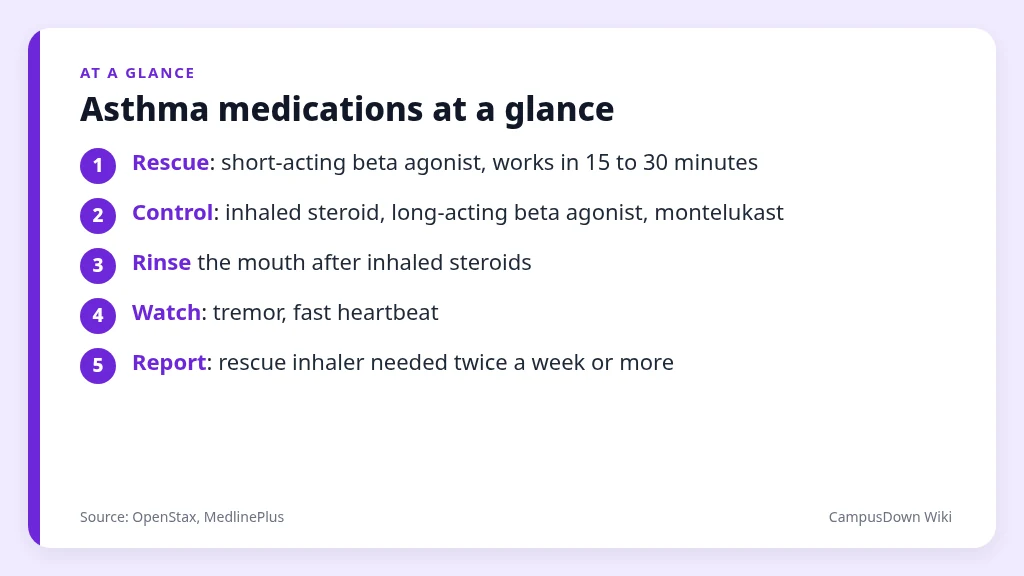
- Rescue (quick-relief): MedlinePlus says these are used for coughing, wheezing, trouble breathing or other symptoms during an attack, and just before physical activity to help prevent symptoms.
- Controller (long-term): MedlinePlus says these are used every day to prevent symptoms in people with moderate to severe asthma, and they must be taken even when you feel fine to work as well as possible.
MedlinePlus adds a key teaching point: tell the provider if quick-relief medicines are needed twice a week or more, since asthma may not be under control.

The classes in OpenStax
| Class | Examples | Role |
|---|---|---|
| Short-acting beta agonist (SABA) | Albuterol, levalbuterol | Rescue; onset 15 to 30 minutes; inhaled or nebulized |
| Long-acting beta agonist (LABA) | Salmeterol, formoterol | Long-term control |
| Inhaled corticosteroid | Budesonide, fluticasone propionate | Reduce chronic inflammation |
| Leukotriene inhibitor | Montelukast | Oral; prevents symptoms |
| Long-acting muscarinic antagonist (LAMA) | Tiotropium | Used in moderate cases |
| Mast cell stabilizer | Cromolyn | Allergic responses and exercise-induced symptoms; rarely used |
| Methylxanthine | Theophylline | Sometimes used for bronchoconstriction |
OpenStax adds that some inhalers combine a corticosteroid with a LABA, and that in severe flares oral or IV corticosteroids are often needed. Its pharmacology chapter stresses that salmeterol is maintenance therapy and should not be used for immediate relief of an asthma attack. For the suffix patterns that help with recall, see drug suffixes.
Side effects to know
- Albuterol: common effects are tremor, nervousness, headache and tachycardia, and patients with severe heart disease should use it only as their provider directs. When giving nebulized treatments, monitor heart rate throughout.
- Inhaled corticosteroids: oral thrush is the main teaching point. OpenStax says to have patients rinse the mouth with water and spit it out (or brush teeth) after use, and not swallow the rinse.
- Oral corticosteroids: OpenStax says to monitor blood pressure, sleep, potassium, weight and glucose (in patients with diabetes), and teach patients to report signs of infection. See the lab values cheat sheet for potassium.
Inhaler technique
OpenStax's inhaled medication chapter teaches:
- Metered-dose inhalers (MDI) can be used with a spacer, a clear tube that slows delivery so the patient inhales the medicine more slowly and with control; clean the spacer frequently. See AeroChamber spacers.
- Dry powder inhalers need a quick, forceful breath, don't need a spacer, and can be affected by humidity.
- Nebulizers turn liquid medicine into a mist and don't need coordinated breathing; see nebulizer vs inhaler.
Ask the patient to show you their technique (teach-back) and correct gently.
Assessment (what the nurse looks at)
OpenStax says nurses gather both patient-reported and objective data: shortness of breath, wheezing, chest tightness, cough, mucus, activity limits and nighttime waking, along with respiratory rate, heart rate, work of breathing and lung sounds. In severe exacerbations, breathing and heart rate increase and patients may sit upright, leaning forward (tripod position). Use the lung sounds guide to listen for wheezes. OpenStax also points to peak flow meters to track lung function; MedlinePlus says readings of 50% to 80% of a person's best are a sign of a moderate attack and below 50% a severe attack.
Get help now if
Severe shortness of breath at rest, trouble speaking, blue lips or face, drowsiness or confusion, or a peak flow below 50% of the personal best need emergency help. Call 911 or your facility's rapid response; don't wait.
Teaching points
- Know which inhaler is which, and when to use each
- Use controller medicines daily, even when well
- Track triggers and use the asthma action plan the provider gave; OpenStax says it shows how to monitor symptoms, adjust medicines and when to seek urgent help
- Rinse the mouth after inhaled steroids
- Keep the spacer clean
- Call the provider if rescue use rises
Study tips
- Make a two-column card: opens airways now vs calms inflammation over time.
- Pair each class with one side effect and one teaching point.
- Practice the teach-back script aloud.
- Memorize the exception: salmeterol is not a rescue drug.
Questions for your instructor
- Which asthma action plan format does our unit use?
- How often do we check peak flow?
- What do we monitor with nebulized albuterol?
- Which patients need extra teaching on spacers?
- What triggers a call to the provider?
Example scenario: the two inhalers
- Who
- Ottilie, 24, a nursing student in Spokane, Washington, met a patient who used her rescue inhaler daily and her controller only now and then.
- What happened
- The patient said she preferred the one that "worked right away."
- How it felt
- Ottilie worried about lecturing her.
- What they did
- She asked the patient to show how she used both, explained the difference in plain words, and shared the patient's habit with her nurse, who informed the provider. Ottilie wrote a one-line teach-back in her notes.
- How it turned out
- Ottilie said asking the patient to show her first made the talk feel like teamwork.
This is an illustrative example, not a real patient or a review.
Ottilie's story is an illustrative example. Real teaching follows your instructor and the provider's plan.
Most-asked questions about asthma medications in nursing
What are the nursing considerations for asthma medication?
Assess breathing, give as ordered, watch for tremor and fast heart rate, teach technique and mouth rinsing, and report rising rescue use.
Why people ask: "asthma medication nursing considerations" is #2 for "asthma medications nursing" (US autocomplete, November 2026).
What is the nursing treatment for asthma?
Support breathing, give rescue and control medicines as ordered, monitor and teach.
Why people ask: "asthma treatment nursing" is #3 for "asthma medications nursing" (US autocomplete, November 2026).
What is asthma in nursing terms?
A chronic airway disease with inflammation and narrowing that causes wheezing, cough and shortness of breath, per MedlinePlus.
Why people ask: "what is asthma nursing" is #4 for "asthma medications nursing" (US autocomplete, November 2026).
What does asthma management involve for nurses?
Trigger awareness, action plans, medicine teaching and monitoring symptom frequency, per OpenStax.
Why people ask: "asthma management nursing" is #2 for "asthma treatment nursing" (US autocomplete, November 2026).
How do nurses treat an asthma attack?
Call for help for severe signs; rescue bronchodilators are given as ordered, with oxygen and other care directed by the provider.
Why people ask: "asthma attack treatment nursing" is #5 for "asthma treatment nursing" (US autocomplete, November 2026).
What belongs in an asthma nursing care plan?
Assessment of breathing and symptom frequency, medication and technique teaching, trigger control and action plan review.
Why people ask: "asthma nursing care plan" is #6 for "asthma treatment nursing" (US autocomplete, November 2026).
Related on CampusDown
You can learn more about the nursing student hub and check it for yourself in the asthma attack signs guide. For delivery devices in detail, see spacers.
Frequently asked questions
- Which asthma medicine is the rescue drug?
- A short-acting beta agonist such as albuterol.
- Is salmeterol a rescue inhaler?
- No; OpenStax says it is maintenance and not for immediate relief.
- Why rinse the mouth after an inhaled steroid?
- To lower the risk of oral thrush.
- What do I report to the provider?
- Using rescue medicine twice a week or more, worsening symptoms or side effects.
- What is a peak flow reading below 50% of the best?
- A sign of a severe attack, per MedlinePlus; seek emergency help.
Asthma medicines make sense once you sort them into rescue and control. Teach technique, watch for side effects and report rising rescue use.
Browse more guides like this in the Nursing Student and NCLEX hub.
This article is for general education and does not replace advice from your own doctor, nurse or pharmacist.