
You've used your rescue inhaler, but you still can't take a full breath and talking feels like work. How do you know this is an emergency?

Asthma attacks can build slowly or arrive in minutes, and knowing the line between "use my plan" and "get help now" matters. This guide uses MedlinePlus's asthma article (reviewed January 2025) and OpenStax's Medical-Surgical Nursing asthma chapter. It is general information, not a plan for you; follow the asthma action plan from your clinician. If you want to learn more about the medicines, take a closer look at asthma medications.
What an asthma attack is
MedlinePlus says asthma is caused by swelling (inflammation) in the airways, and an attack occurs when the lining of the air passages swells and the muscles around the airways tighten, narrowing the airway so less air can pass. Attacks can last minutes to days, may start suddenly or develop slowly over hours or days, and can become dangerous if airflow is severely blocked.

Common signs
MedlinePlus lists symptoms of asthma:
- Cough, with or without phlegm
- Wheezing, a whistling sound when you breathe
- Shortness of breath, which may worsen with exercise
- Pain or tightness in the chest
- Pulling in of the skin between the ribs when breathing (retractions)
- Difficulty sleeping
- An abnormal breathing pattern, with breathing out taking more than twice as long as breathing in
OpenStax adds that the cough is often worse at night and that symptoms commonly follow a trigger, such as exercise, allergens, cold air or a respiratory infection. In severe exacerbations, breathing and heart rate rise and people may sit upright and lean forward (tripod position) to breathe more easily. For related sounds, see lung sounds.
Emergency signs
MedlinePlus lists emergency symptoms that need prompt medical help:
- Bluish color to the lips and face
- Drowsiness or confusion during an attack
- Extreme difficulty breathing
- Rapid pulse
- Severe anxiety due to shortness of breath
- Sweating
- Difficulty speaking
- Breathing that temporarily stops
Get help now if
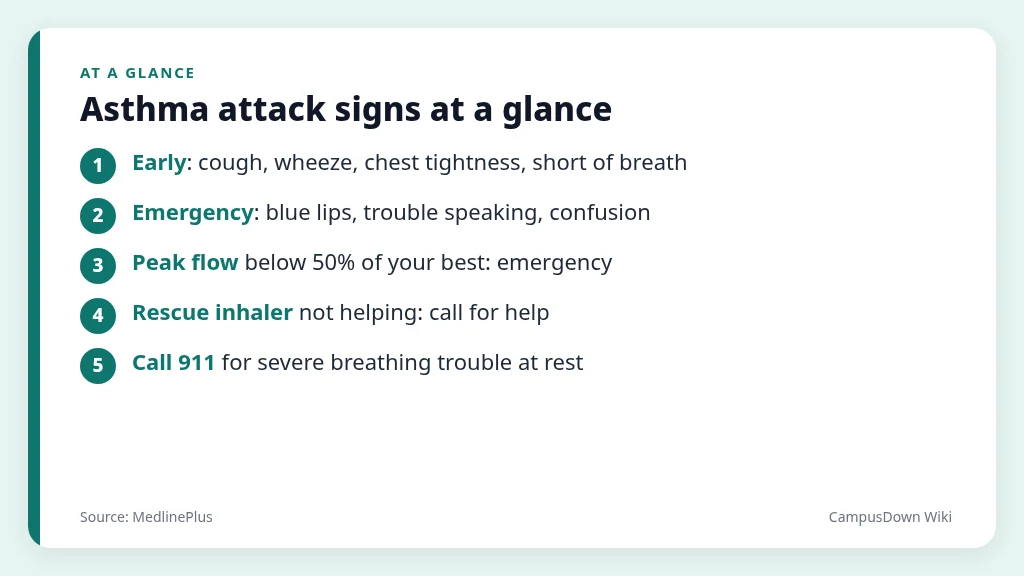
Go to the emergency room or call 911 if you have drowsiness or confusion, severe shortness of breath at rest, blue lips or face, trouble speaking, or a peak flow below 50% of your personal best. Don't drive yourself.
When the rescue inhaler isn't enough
MedlinePlus says to contact your provider right away if an asthma attack requires more medicine than recommended, symptoms get worse or do not improve with treatment, you have shortness of breath while talking, or your peak flow is 50% to 80% of your personal best. It also says a severe asthma attack requires a visit to your provider and may require a hospital stay with oxygen, breathing assistance and medicines given through a vein or by nebulizer. Using quick-relief medicine twice a week or more is a sign asthma may not be under control, so tell your provider. See spacers and nebulizer vs inhaler for how medicines are delivered.
Peak flow zones
A peak flow meter measures how fast you can blow air out. MedlinePlus says readings of 50% to 80% of your best are a sign of a moderate attack and below 50% are a sign of a severe attack, and that peak flow can show an attack is coming, sometimes before symptoms appear. Your clinician will help you find your personal best.
Adults, children and "no inhaler"
- Adults: the signs above apply. MedlinePlus doesn't separate adults from children in its list; use your own action plan.
- Children and toddlers: use the child's own action plan and call the child's doctor; the emergency signs above (blue lips, trouble speaking or breathing, drowsiness) mean call 911.
- No inhaler on hand: MedlinePlus says a severe attack needs medical care. If you can't relieve breathing trouble with your usual plan, or you don't have your medicine, call 911.
Is it asthma or panic?
Severe anxiety can accompany shortness of breath, and MedlinePlus lists it among emergency signs of an asthma attack. Wheezing and chest tightness need medical evaluation; don't assume it's only anxiety. See anxiety chest pain vs heart pain and panic attack for comparison. Allergic reactions can also cause breathing trouble; see alpha-gal syndrome for one delayed allergy that can include breathing symptoms.
Reducing the chance of an attack
MedlinePlus advises knowing your triggers, using controller medicine as prescribed, knowing how to take your peak flow reading and following your action plan. OpenStax adds avoiding triggers such as secondhand smoke and keeping up with recommended vaccines.
Questions for your clinician
- What is my personal best peak flow, and what are my zones?
- Which medicine do I use at each sign?
- When should I call you, and when should I call 911?
- How do I know my controller is working?
- Can you watch my inhaler technique?
Example scenario: the cold night air
- Who
- Imogen, 33, a delivery driver in Duluth, Minnesota, felt her chest tighten after loading a truck in cold air and used her rescue inhaler twice.
- What happened
- She still could barely finish a sentence.
- How it felt
- She felt embarrassed to call and tried to wait it out.
- What they did
- Her coworker saw her struggling and called 911; the responders helped her and took her to the hospital. Afterward she and her clinician reviewed her action plan and she carried a copy.
- How it turned out
- Imogen said she now treats trouble speaking as the signal to call, not wait.
This is an illustrative example, not a real patient or a review.
Imogen's story is an illustrative example. In a real emergency, call 911.
Most-asked questions about asthma attack symptoms
What are asthma attack symptoms in adults?
Cough, wheezing, chest tightness and shortness of breath, with emergency signs such as blue lips, trouble speaking and confusion.
Why people ask: "asthma attack symptoms in adults" is #2 for "asthma attack symptoms" (US autocomplete, November 2026).
What are asthma attack symptoms in a child?
MedlinePlus's list doesn't separate children; use the child's action plan and call 911 for blue lips, trouble breathing or speaking, or drowsiness.
Why people ask: "asthma attack symptoms child" is #3 for "asthma attack symptoms" (US autocomplete, November 2026).
What if I have asthma attack symptoms and no inhaler?
A severe attack needs medical care; call 911 if breathing trouble is severe.
Why people ask: "asthma attack symptoms no inhaler" is #5 for "asthma attack symptoms" (US autocomplete, November 2026).
What is the treatment for asthma attack symptoms?
Quick-relief medicines per your action plan, with emergency care for severe attacks, including oxygen, breathing support and IV or nebulized medicines.
Why people ask: "asthma attack symptoms treatment" is #6 for "asthma attack symptoms" (US autocomplete, November 2026).
How do you know if you're about to have an asthma attack?
Peak flow can show an attack is coming, sometimes before symptoms, and early cough, wheeze or chest tightness are warnings.
Why people ask: "how do you know if your about to have an asthma attack" is #2 for "asthma attack symptoms in adults" (US autocomplete, November 2026).
What are asthma flare up symptoms in adults?
The same symptoms: cough, wheeze, chest tightness and shortness of breath.
Why people ask: "asthma flare up symptoms adults" is #3 for "asthma attack symptoms in adults" (US autocomplete, November 2026).
Related on CampusDown
You can learn more about the health topics hub and check it for yourself in the asthma medications guide. For the inhaler tools in detail, see spacers.
Frequently asked questions
- When should I call 911?
- For blue lips, severe trouble breathing at rest, trouble speaking, drowsiness or confusion, or a peak flow below 50% of your best.
- What if my rescue inhaler isn't helping?
- Contact your provider right away, and call 911 if symptoms are severe.
- How often is too often for a rescue inhaler?
- Twice a week or more is a sign asthma may not be controlled, per MedlinePlus.
- Can asthma attacks last days?
- Yes; MedlinePlus says attacks can last minutes to days.
- Is wheezing always asthma?
- No; wheezing needs medical evaluation to find the cause.
An asthma attack is an emergency when speaking, color or alertness change. Know your peak flow zones, follow your action plan and call 911 when the rescue inhaler isn't enough.
Browse more guides like this in the U.S. Health Topics hub.
This article is for general education and does not replace advice from your own doctor, nurse or pharmacist.