
Which is stronger, a nebulizer or an inhaler? It's one of the most common questions when someone is newly diagnosed with COPD or asthma, and it hides a wrong assumption: the device isn't stronger or weaker, it's a delivery method. The question is whether the medicine reaches your lungs when you use it.
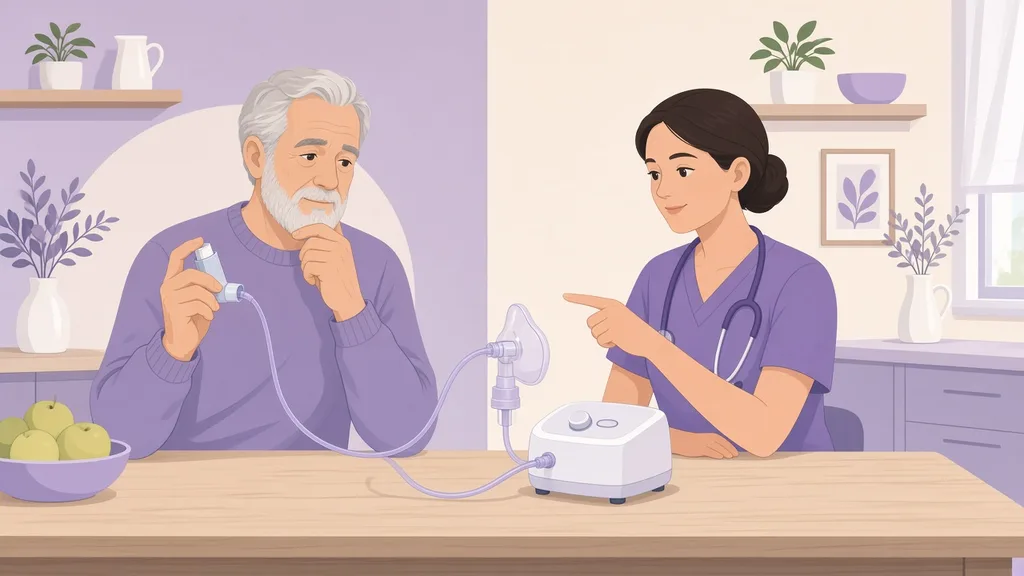
This guide uses American Thoracic Society (ATS) patient education, MedlinePlus and the CMS DME MAC Local Coverage Determination L33370 "Nebulizers". It explains in detail how the options differ. Don't switch devices or change a medicine on your own. Talk with your doctor, respiratory therapist or pharmacist.
How each device works
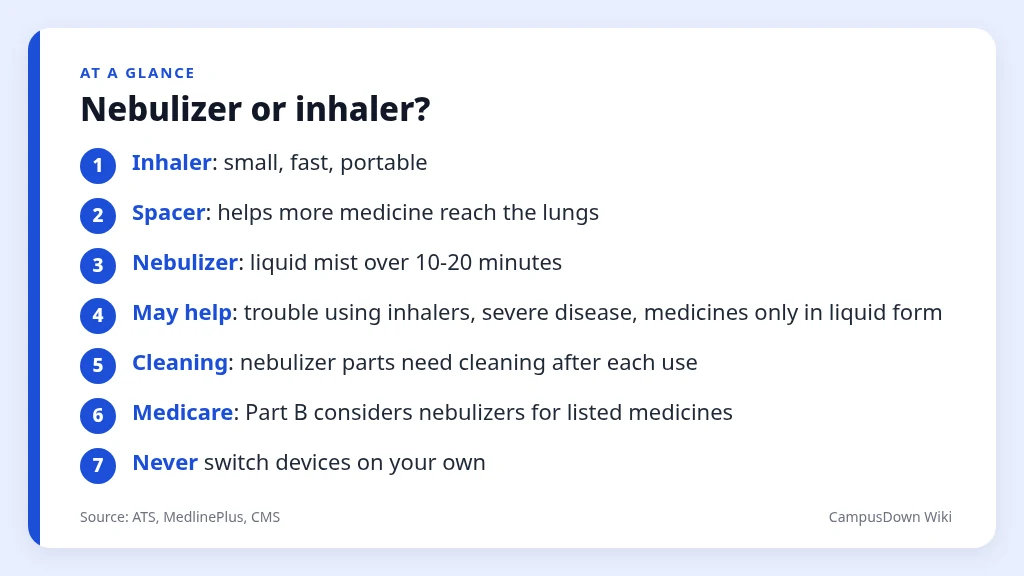
- Nebulizer: ATS says a nebulizer uses an air compressor and a cup that holds liquid medicine. Air passes through a tube to the cup and turns the medicine into a mist that you breathe through a mouthpiece or facemask.
- Metered-dose inhaler (MDI): MedlinePlus describes a canister, mouthpiece and cap. Each press releases a puff of medicine. A spacer connects to the mouthpiece to catch the puff so you can breathe it in.
- Dry powder inhaler: MedlinePlus notes you don't need a spacer with these. They work by a quick, deep breath.

The real issue: technique
MedlinePlus says many people don't use an MDI in the best way, and that when it's used the wrong way, less medicine gets to your lungs and most remains in the back of your mouth. A spacer helps get more medicine into your airways. See our AeroChamber spacer guide for step-by-step use.
Who may do better with a nebulizer
ATS lists people who may benefit from a nebulizer:
- Older people with arthritis that makes an inhaler hard to use.
- People who have trouble using an inhaler device.
- People who benefit from the moisture of a nebulizer.
- People with severe disease who may not be able to inhale as quickly and deeply as some inhalers need.
- People who need medicines available only as nebulizer solutions. ATS gives dornase alfa (Pulmozyme) for cystic fibrosis as an example.
ATS also says that compared with an MDI, a nebulizer takes longer to use (a treatment can take about 10 to 20 minutes) and requires daily cleaning.
Cleaning matters
ATS warns that dirty equipment can cause lung infections. It advises washing your hands, rinsing the cup and mask or mouthpiece after each treatment and drying them, doing a deeper cleaning with warm water and mild detergent at least once a day, and asking your provider how to disinfect. If equipment isn't kept clean, mold can grow, and the mist can carry mold spores, which matters most for people with weakened immunity.
Practical tips from ATS
- Put the compressor on a hard, flat, clean surface, not the floor or a soft surface like a bed or couch, where vents can be blocked.
- Sit up during the treatment so you can breathe deeply.
- Use a facemask for children under 6 or people who can't breathe well with a mouthpiece. Never hold the mask or mouthpiece in front of the face ("blow-by"), since much of the medicine is lost and can irritate the eyes.
- Don't mix medicines in the cup unless your provider says they can be mixed: "when in doubt, don't mix!"
Does Medicare cover nebulizers?
The DME MAC policy L33370 says a small-volume nebulizer and compressor are considered for coverage when needed to give certain FDA-approved inhalation solutions, including albuterol, ipratropium, budesonide, and others for obstructive pulmonary disease, plus specific medicines for cystic fibrosis and bronchiectasis. The policy also says it isn't reasonable to use more than one of certain long-acting bronchodilators at a time, and it lists limits on combining some medicines. Our Medicare DME guide explains Part B coinsurance. Inhaler medicines are usually under Part D; see the Part D cap.
Questions to take to your appointment
- Which of my medicines come as an inhaler, a nebulizer solution or both?
- Can I use my inhaler correctly? Can you watch me?
- Do I need a spacer?
- If I use a nebulizer, how long should each treatment take, and how should I clean it?
- Does my plan cover the device and the medicine? Bring everything to a brown bag medication review.
Get help now if
Call your doctor promptly if your usual treatments aren't helping or you're using your quick-relief medicine more often than normal. Call 911 for severe trouble breathing, blue lips or fingertips, or confusion.
Example scenario: the inhaler he couldn't squeeze
- Who
- Jasper, 71, a retired high school shop teacher in Tulsa, Oklahoma, had COPD and arthritis in both hands. His wife, Elspeth, 69, noticed that he coughed and fumbled through his inhaler.
- What happened
- He'd been using his quick-relief inhaler less than he needed because pressing the canister hurt his thumbs. A flare-up sent him to urgent care and left him frightened.
- How it felt
- Jasper felt like a man who'd lost the ability to do the simplest task for himself. Elspeth felt helpless watching him struggle with something so small.
- What they did
- At his follow-up, a respiratory therapist watched him use the inhaler and showed him a spacer. His nurse practitioner discussed whether a nebulizer made sense for the quick-relief medicine, checked what was available as a solution, and wrote an order. Elspeth learned how to clean the cup after every treatment.
- How it turned out
- Jasper said he stopped dreading his own medicine. Elspeth said she liked that the washing routine gave them a calm moment at the sink each evening.
This is an illustrative example, not a real patient or a review.
Jasper's story is an illustrative example. The right device depends on your diagnosis, medicines and technique.
Most-asked questions about nebulizers and inhalers
Is a nebulizer better than an inhaler?
Neither is better in general. The best device is the one you can use correctly with the medicine you need. ATS says some people, such as those with arthritis or severe disease, may do better with a nebulizer.
Why people ask: "nebulizer vs inhaler which is better" is #4 for "nebulizer vs inhaler" (US autocomplete, November 2026).
Nebulizer vs inhaler with spacer?
A spacer helps more medicine reach the airways from a metered-dose inhaler; a nebulizer takes longer but doesn't require coordination. Ask your clinician which fits you.
Why people ask: "nebulizer vs inhaler with spacer" is #6 for "nebulizer vs inhaler" (US autocomplete, November 2026).
Inhaler vs nebulizer for COPD?
Both are used. Which one suits you depends on your medicines, technique and severity. Don't switch on your own.
Why people ask: "inhaler vs nebulizer for copd" is #1 for "inhaler vs nebulizer for copd" (US autocomplete, November 2026).
Is a nebulizer better than an inhaler for COPD?
ATS lists COPD among conditions treated with nebulizers, including some long-acting medicines that come as solutions. Ask your doctor whether your medicines come in both forms.
Why people ask: "is a nebulizer better than an inhaler for copd" is #5 for "inhaler vs nebulizer for copd" (US autocomplete, November 2026).
Are breathing treatments better than inhalers?
A breathing treatment is a nebulizer session. It isn't automatically stronger; it's a different delivery method.
Why people ask: "are breathing treatments better than inhalers" is #6 for "inhaler vs nebulizer for copd" (US autocomplete, November 2026).
Nebulizer vs inhaler for adults?
Adults with trouble using inhalers may benefit from a nebulizer or spacer. A clinician can check technique.
Why people ask: "nebulizer vs inhaler for adults" is #3 for "nebulizer vs inhaler" (US autocomplete, November 2026).
Related on CampusDown
You can learn more about spacers in how to use an AeroChamber, and take a closer look at pill organizer tips if you manage several medicines. Dry mouth can follow some inhaled medicines; see dry mouth from medications.
Frequently asked questions
- Can I use a nebulizer instead of my inhaler?
- Only if your doctor says so. Medicines and doses differ between devices.
- How often should I clean my nebulizer?
- ATS says rinse after each treatment and do a deeper clean at least once a day.
- Do I need a spacer with every inhaler?
- Not with dry powder inhalers, per MedlinePlus. Ask about your metered-dose inhaler.
- Are nebulizers covered by Medicare?
- Part B considers them for listed medicines and diagnoses. Check it for yourself with your doctor and a Medicare-enrolled supplier.
A nebulizer and an inhaler are two doors to the same airways. Ask someone to watch your technique, choose the device you can use consistently, and keep every part clean.
Browse more guides like this in the Home Medical Devices hub.
This article is for general education and does not replace advice from your own doctor, nurse or pharmacist.