
Do you ever press your inhaler, breathe in and wonder if any medicine reached your lungs? You aren't alone. A spacer is a simple tube that makes the puff easier to catch, and it can help people who struggle to time a press with a breath.

This guide is based on Trudell Medical International's care instructions for the AEROCHAMBER PLUS Flow-Vu chamber and MedlinePlus's "How to use an inhaler with spacer." It shows in detail how to use and clean one. Always follow the instructions that came with your inhaler and spacer, and ask your pharmacist or doctor to watch your technique.
What a spacer does
MedlinePlus says many people don't use a metered-dose inhaler (MDI) well, and when they don't, less medicine gets to the lungs and most stays in the back of the mouth. A spacer connects to the inhaler's mouthpiece; the puff goes into the spacer tube first, then you breathe it in. MedlinePlus notes you don't need a spacer for dry powder inhalers, and that almost all children can use one. Ask your provider which spacer is best for you or your child.

About the AeroChamber Plus Flow-Vu
Trudell says the AEROCHAMBER PLUS* Flow-Vu* is a valved holding chamber for use with a metered-dose inhaler. Features it describes:
- Flow-Vu inhalation indicator: a flag that moves as you breathe. Trudell says it only moves if you have a good mouthpiece seal.
- Whistle on adult sizes: a high-flow alert sounds if you inhale too quickly, coaching you to slow down.
- Six sizes, each with a mouthpiece or mask: infant, child, youth (mouthpiece), adult mouthpiece, adult small mask and adult large mask.
- It fits commonly prescribed MDIs. Check with your pharmacist that it fits yours.
The company says respiratory guidelines recommend chambers with MDIs, so you can learn more from your care team.
How to use it with a mouthpiece
Trudell's instructions, with MedlinePlus tips:
- Remove the caps from the inhaler and chamber. Look inside to check nothing's in the way.
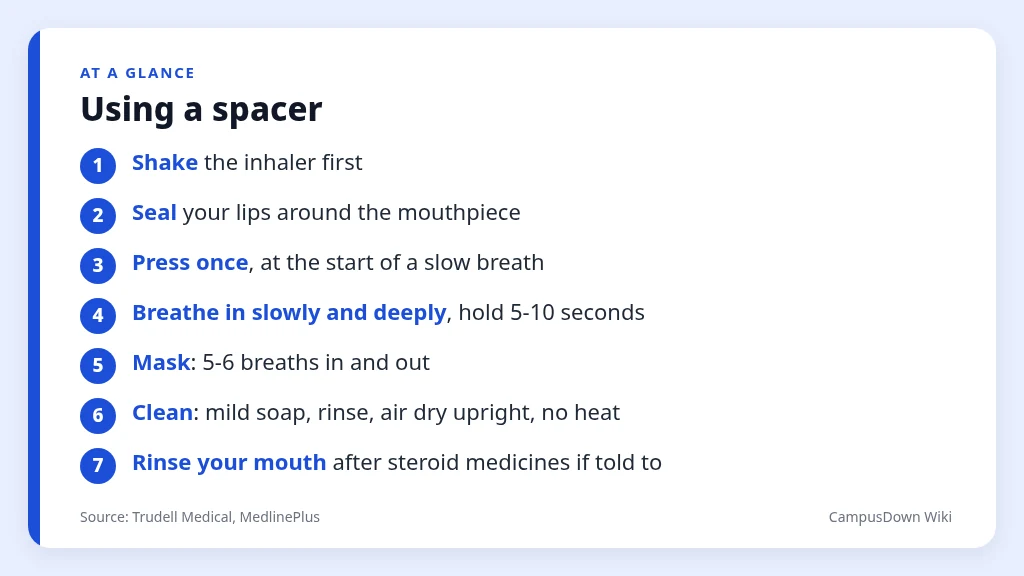
2. Shake the inhaler right before use. MedlinePlus says 10 to 15 times, unless your inhaler's directions differ. 3. Insert the inhaler into the back of the chamber. 4. Put the mouthpiece in your mouth and close your lips around it for a seal. 5. Breathe out, then press the inhaler once at the start of a slow breath. 6. Breathe in slowly and deeply through the chamber until you've taken a full breath, then hold your breath for 5 to 10 seconds before breathing out. 7. Or, as an alternative the maker describes, press once and breathe in and out through the chamber for 2 to 3 breaths with your lips sealed.
MedlinePlus says to wait about 1 to 2 minutes before the next puff of a quick-relief medicine, and to rinse your mouth with water, gargle and spit after using your inhaler to reduce side effects. Your prescription label tells you how many puffs to take.
How to use it with a mask
For a young child or someone who can't use a mouthpiece, Trudell says: remove the cap, shake the inhaler, insert it in the back of the chamber, apply the mask to the face with a good seal, press once, and breathe in and out through the chamber for 5 to 6 breaths while holding the mask in place. Trudell offers video instructions on its site. The American Thoracic Society makes a related point about nebulizer masks: don't hold a mask or mouthpiece in front of the face, because much of the medicine is lost to the air.
How to clean it
Per Trudell:
- Take it apart: remove the backpiece and twist off the front piece.
2. Hand wash: soak the parts for 15 minutes in a mild solution of liquid dish detergent and lukewarm water, agitate gently and rinse in clean water. Or dishwasher: place the parts securely on the top rack and run a normal or light cycle. Don't heat dry. 3. Shake out the water and let the parts air dry upright. Make sure they're dry before reassembly. 4. Reassemble: twist the front piece until it locks, line up the backpiece with the Flow-Vu indicator, and press firmly.
Keep the inhaler clean too: MedlinePlus says if you see powder around the spray hole, rinse the mouthpiece and cap (not the canister) in warm water and let them air dry overnight.
Common mistakes
- Skipping the shake.
- Pressing before breathing in, or pressing several times into the chamber before inhaling.
- A leaky seal; the indicator won't move.
- Breathing in too quickly, which the whistle warns about.
- Heat-drying or storing parts wet.
Compare this with a nebulizer in our nebulizer vs inhaler guide. Dry mouth after inhaled medicines? See dry mouth from medications.
Get help now if
Never use someone else's inhaler or change how many puffs you take without your doctor's approval. If your breathing gets worse, or your quick-relief inhaler doesn't help, get medical help right away. Call 911 for severe breathing trouble.
Example scenario: the flag that wouldn't move
- Who
- Barnabas, 67, a retired mail carrier in Rochester, New York, used his inhaler for asthma and kept forgetting what the pharmacist had said about the spacer. His wife, Matilda, 66, said she could hear the puff hiss and then the cough.
- What happened
- Barnabas's asthma flared up in the cold, and he'd used his quick-relief inhaler three times in one afternoon, worried it wasn't working.
- How it felt
- Barnabas felt silly asking, after years of using inhalers, whether he was doing it wrong. Matilda felt anxious each time the wheeze returned at night.
- What they did
- At the pharmacy, a pharmacist watched him and pointed out the Flow-Vu flag wasn't moving because his lips weren't sealed on the mouthpiece. He practiced a slow breath, waited between puffs, and Matilda put the chamber parts in the dishwasher's top rack each week. His doctor adjusted nothing until the technique was right, and then reviewed his plan.
- How it turned out
- Barnabas said he felt more confident once he could see the indicator move. Matilda said she stopped hearing the hiss and the cough in the same breath.
This is an illustrative example, not a real patient or a review.
Barnabas's story is an illustrative example. Technique and treatment plans differ for each person.
Most-asked questions about spacers
How do you use an AeroChamber?
Shake the inhaler, insert it into the chamber, seal your lips (or mask), press once at the start of a slow breath, and breathe in slowly and deeply, holding for 5 to 10 seconds or taking 2 to 3 breaths.
Why people ask: "aerochamber how to use" is #1 for "aerochamber how to use" (US autocomplete, November 2026).
How do you use an AeroChamber Plus?
The steps are the same: shake, insert, seal, press once, slow breath, and watch the Flow-Vu indicator move.
Why people ask: "aerochamber plus how to use" is #5 for "aerochamber how to use" (US autocomplete, November 2026).
How do you clean an AeroChamber?
Take it apart, hand wash in mild dish detergent for 15 minutes or use the dishwasher's top rack, then air dry upright without heat.
Why people ask: "how to clean aerochamber" is #1 for "how to clean aerochamber" (US autocomplete, November 2026).
Can you wash an AeroChamber?
Yes. The maker describes hand washing and a dishwasher top-rack option. Don't heat dry.
Why people ask: "can you wash aerochamber" is #6 for "how to clean aerochamber" (US autocomplete, November 2026).
Is there a spacer for an inhaler for adults?
Yes. Spacers come in different sizes, including adult mouthpiece and mask sizes. Ask your provider which is right for you.
Why people ask: "spacer for inhaler for adults" is #3 for "spacer for inhaler" (US autocomplete, November 2026).
How do you use a spacer for an inhaler?
Attach it, shake the inhaler, breathe out, seal your lips, press once and breathe in slowly, then hold your breath if you can.
Why people ask: "spacer for inhaler how to use" is #6 for "spacer for inhaler" (US autocomplete, November 2026).
Related on CampusDown
Check whether insurance helps with equipment in Medicare DME coverage, bring your devices to a brown bag review, and see the Part D cap for medicine costs.
Frequently asked questions
- Do I need a prescription for a spacer?
- Rules and prices vary. Ask your pharmacist or doctor, and ask whether your plan covers it.
- How often should I clean a spacer?
- Follow the maker's care instructions and ask your pharmacist how often is right for you.
- Can I use any spacer with any inhaler?
- Check fit and compatibility with your pharmacist before using one.
- Why isn't the Flow-Vu flag moving?
- Trudell says it moves only with a good seal. Check your lips, the mask fit and your breath.
A spacer works best with a sealed lip, a slow breath and a clean chamber. Ask your pharmacist to watch you once, and you can check it for yourself by watching the indicator move.
Browse more guides like this in the Home Medical Devices hub.
This article is for general education and does not replace advice from your own doctor, nurse or pharmacist.