
Did you take your evening pills, or was that yesterday? A weekly pill organizer answers that at a glance, which is why so many older adults and caregivers use one. But a box filled wrong can repeat the same mistake seven days in a row. A few habits make organizers much safer.

This guide uses the National Institute on Aging (NIA) page on taking medicines safely, FDA consumer medicine guidance, and tips from ISMP Canada's SafeMedicationUse.ca. It explains in detail how to set up and fill a box. Ask your pharmacist before moving any medicine out of its original container.
Choosing the right organizer
NIA lists weekly pill boxes, charts, calendars, timers and smartphone reminder apps as ways to take medicines on time. For organizers:
- Once a day: a simple 7-day box.
- Twice a day: an AM/PM box with two rows.
- Three or four times a day: boxes with morning, noon, evening and bedtime rows.
- Arthritis or weak grip: look for easy-open lids and large compartments.
- Vision problems: large letters and color coding help.
If schedules are complex or memory is a concern, an automatic dispenser may help; see the Hero pill dispenser.

Step-by-step: filling the box
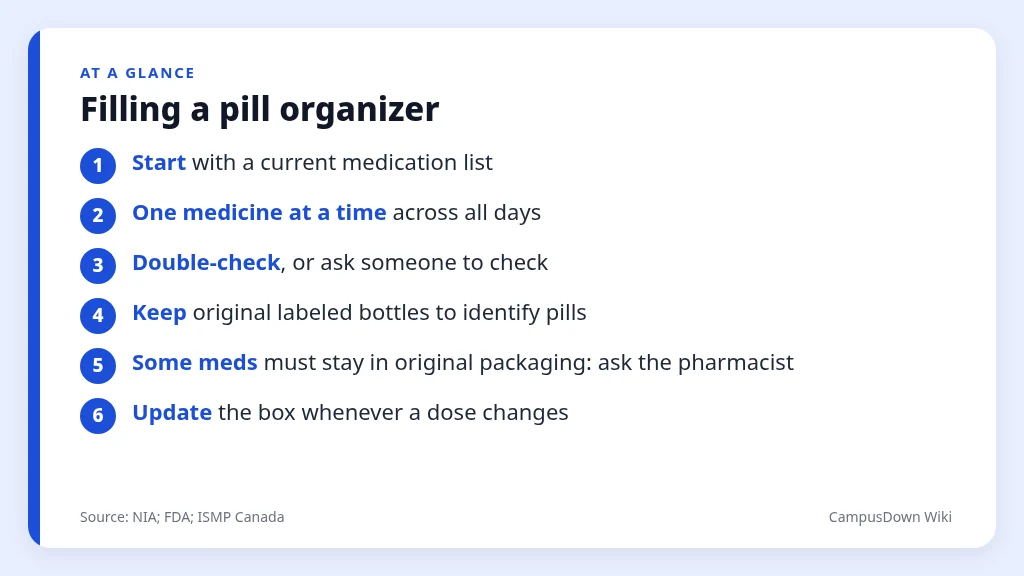
- Start with a current medication list showing each medicine, dose and time. See brown bag medication review.
2. Work in a quiet, well-lit place without interruptions. 3. Read each pharmacy label carefully. 4. Fill one medicine at a time into every day and time slot it's needed, then put that bottle away before starting the next. 5. Double-check the whole box, or ask a family member to check it with you. 6. Keep the original labeled bottles so you or anyone helping can identify each pill. 7. Update the box immediately when a doctor changes a dose.
Medicines that may not belong in an organizer
FDA advises keeping medicines in their original labeled containers whenever possible and never combining different medicines in the same bottle. Some medicines are sensitive to moisture or light and must stay in their original packaging; examples include dabigatran (Pradaxa) capsules and sublingual nitroglycerin tablets. Ask your pharmacist about each one, and check it for yourself on the label.
Get help now if
Most pill organizers aren't childproof. Store them out of reach of children, pets and anyone who may be confused, and lock up opioid pain medicines, as NIA advises.
Preventing common mistakes
- Two people, two boxes: if spouses both use organizers, choose different colors and label each with the owner's name.
- Know your pills: learn each pill's size, color and imprint, as NIA suggests.
- Don't refill early on a busy day; set a regular filling time, such as Sunday morning.
- Missed doses: don't double up later without asking a pharmacist.
- Cut the list first: fewer medicines means fewer chances for errors; see the Beers Criteria.
Pharmacy blister packs
Some pharmacies offer blister packs that are prepared and checked by the pharmacist, with doses sealed by day and time. Ask whether your pharmacy offers them and whether there's a fee. They can help when memory problems make home filling risky.
Traveling with an organizer
Travel organizers are convenient, but keep original labeled bottles or a current medication list with you, especially for flights, in case pills need to be identified. Pack medicines in your carry-on.
For other reminders, see everyday memory aids.
Example scenario: his box, her box
- Who
- Mortimer, 78, a retired bank examiner in Madison, Wisconsin, and his wife, Clarice, 76, used identical clear weekly organizers kept side by side on the kitchen windowsill.
- What happened
- One Tuesday morning, Mortimer swallowed Clarice's pills, including her blood thinner, then realized the box felt "too full."
- How it felt
- Clarice panicked, and Mortimer felt foolish and frightened. Neither knew whether he needed the emergency room.
- What they did
- Clarice called their pharmacist, who compared both medication lists, explained what to watch for and which doses to skip that day, and suggested calling the doctor. They followed the advice and he had no lasting harm.
- How it turned out
- Afterward they bought organizers in two different colors, labeled each with a name, moved them to separate shelves, and set Sunday as their filling day with a double-check. Clarice said a simple name label fixed a problem that could have been serious.
This is an illustrative example, not a real patient or a review.
Mortimer and Clarice's story is an illustrative example. If you take the wrong medicine, call your pharmacist, doctor or Poison Help (1-800-222-1222); call 911 for severe symptoms.
Most-asked questions about pill organizers
What pill organizer works for 3 times a day?
Choose a weekly box with three rows, such as morning, midday and evening, with compartments big enough for each dose.
Why people ask: "pill organizer 3 times a day" is #2 for "pill organizer" (US autocomplete, November 2026).
Which pill organizer is best for 2 times a day?
An AM/PM weekly organizer with two rows. Color-coded rows help prevent mixing up morning and evening doses.
Why people ask: "pill organizer 2 times a day" is #3 for "pill organizer" (US, November 2026).
Is there a pill organizer for 4 times a day?
Yes, four-row weekly boxes cover morning, noon, evening and bedtime. If the schedule is that complex, ask your pharmacist about blister packs or simplifying doses.
Why people ask: "pill organizer 4 times a day" is #4 for "pill organizer" (US, November 2026).
How do I use a weekly AM/PM pill organizer?
Fill from a current medication list, one medicine at a time across all seven days, then double-check each row.
Why people ask: "weekly pill organizer am pm" is #5 for "weekly pill organizer" (US, November 2026).
Can I use a pill organizer for travel?
Yes, but carry original labeled bottles or a medication list so pills can be identified, and keep medicines in your carry-on.
Why people ask: "pill organizer for travel" is #6 for "pill organizer" (US, November 2026).
Related on CampusDown
To take a closer look at reviewing your full medicine list, read brown bag medication review.
Frequently asked questions
- Should I keep the original pill bottles?
- Yes. Keep them so pills can be identified and labels checked.
- How often should I fill my organizer?
- Many people fill weekly at a set time. Update it right away when a dose changes.
- Are pill organizers childproof?
- Most aren't, so store them out of reach of children.
A pill organizer works best with a current list, one-medicine-at-a-time filling, a double-check, and a pharmacist's advice about what can safely go inside.
Browse more guides like this in the Home Medical Devices hub.
This article is for general education and does not replace advice from your own doctor, nurse or pharmacist.