
Could Medicare pay for the walker, hospital bed or CPAP your doctor just mentioned? Often yes, but only if the paperwork and the supplier are right. A single wrong step can leave you paying the full price.

This guide is based on Medicare.gov and the Medicare booklet "Medicare Coverage of Durable Medical Equipment & Other Devices" (CMS Product No. 11045, February 2025). It explains in detail what's covered and how to avoid surprise bills. Talk with your doctor about what you need, and confirm coverage with Medicare or your plan.
What counts as DME
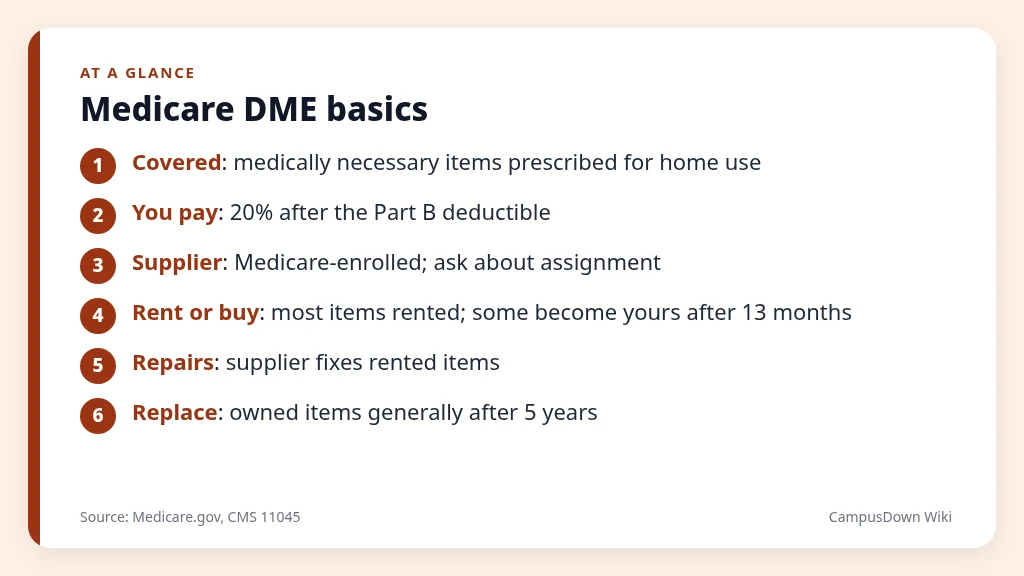
The booklet says DME is reusable medical equipment. Anyone with Part B can get DME if it's medically necessary and your doctor or treating provider (like a nurse practitioner or physician assistant) prescribes it for use in your home. A hospital or nursing home giving you Medicare-covered care doesn't count as home, but a long-term care facility can.
If you're in a skilled nursing facility on a Part A-covered stay, the facility provides DME for up to 100 days. Learn more about that benefit in our SNF rehab guide.

Covered DME list (examples)
The booklet lists, among others:
- Canes (not white canes for the blind) and crutches
- Walkers, including rollators
- Commode chairs
- Hospital beds and pressure-reducing beds, mattresses and overlays
- Manual wheelchairs and power mobility devices needed inside the home
- Glucose monitors and supplies
- CPAP devices and accessories
- Oxygen equipment and accessories
- Nebulizers and some nebulizer medications
- Patient lifts, infusion pumps, suction pumps, traction equipment and CPM machines
Compare walker types in our walker vs rollator guide, and see our cane fitting guide. CPAP users can take a closer look at the ResMed AirSense 11, and glucose monitor users at Medicare CGM coverage.
What you pay
- 20% of the Medicare-approved amount after the Part B deductible ($283 in 2026).
- The approved amount is the lower of the supplier's charge or Medicare's fee.
- Costs can be higher if the supplier doesn't accept assignment.
A Medigap policy may help with your share.
Choosing a supplier
Medicare only pays if your supplier is enrolled in Medicare and has a supplier number, even a big chain or department store. Find suppliers at Medicare.gov/medical-equipment-suppliers. The booklet suggests asking:
- Are you a Medicare-enrolled supplier?
- Do you accept assignment?
- If not, will you in my case, and what's your charge?
- Will you bill Medicare for me?
Get help now if
For rented equipment, Medicare.gov says to make sure the supplier accepts assignment for all rental months, or you may have to pay the full cost upfront and wait for Medicare to reimburse you. Also, never accept equipment pushed by a caller you don't know; report it to 1-800-MEDICARE.
Rent or buy?
The booklet says Medicare pays for most DME on a rental basis:
- It buys inexpensive or routinely bought items, like canes, walkers and blood sugar monitors, and complex rehabilitative power wheelchairs.
- For pricier items like wheelchairs and hospital beds, Medicare rents for 13 months of continuous use, then the supplier must transfer ownership to you.
- Oxygen: rental payments stop after 36 months, but the supplier must keep providing equipment and supplies for another 24 months.
Repairs and replacement
- Rented: the supplier must maintain, repair and replace it, and pick it up when you no longer need it.
- Owned: Medicare pays 80% of approved repair costs (up to replacement cost); you pay 20%.
- Owned items may be replaced if lost, stolen, damaged beyond repair, or past their reasonable useful lifetime, generally 5 years.
Tell your supplier if you change insurance or doctors, go into the hospital or a nursing home, travel, or move.
Medicare Advantage and DME
The booklet says Medicare Advantage plans must cover the same categories of medically necessary DME, but suppliers and costs depend on your plan. If a plan denies an item you need, you can appeal. Check it for yourself in your plan's Evidence of Coverage.
Example scenario: the rollator after hip surgery
- Who
- Thorsten, 79, a retired carpenter in Green Bay, Wisconsin, came home after hip replacement surgery. His wife, Aurelia, 76, had a bad knee and worried about him falling in their narrow hallway.
- What happened
- The hospital gave him a basic walker, but his physical therapist suggested a rollator with a seat for longer walks. A website offered a "free" rollator if he gave his Medicare Number over the phone.
- How it felt
- Thorsten felt impatient and a little proud; he didn't want a walker at all. Aurelia felt anxious about both the hallway and the phone offer.
- What they did
- Aurelia hung up on the caller. Thorsten's doctor wrote an order for a rollator, and Aurelia used Medicare.gov's supplier directory to find a local enrolled supplier that accepted assignment. The technician adjusted the handle height in their living room.
- How it turned out
- Thorsten paid his 20% share and used the rollator's seat to rest halfway to the mailbox. Aurelia said she finally stopped listening for falls at night, and Thorsten admitted it was "a pretty good piece of equipment."
This is an illustrative example, not a real patient or a review.
Thorsten's story is an illustrative example. Your coverage depends on your doctor's order and your plan.
Most-asked questions about Medicare DME
What does Medicare durable medical equipment coverage include?
Medically necessary, reusable equipment prescribed for home use, like walkers, hospital beds, CPAP and oxygen. You pay 20% after the Part B deductible.
Why people ask: "medicare durable medical equipment coverage" is #2 for "medicare durable medical equipment" (US autocomplete, November 2026).
How do I find Medicare durable medical equipment suppliers near me?
Use Medicare.gov/medical-equipment-suppliers and ask whether the supplier accepts assignment.
Why people ask: "medicare durable medical equipment suppliers near me" is #4 for "medicare durable medical equipment" (US autocomplete, November 2026).
Is there a Medicare durable medical equipment list?
The Medicare DME booklet lists examples like canes, walkers, hospital beds, CPAP, oxygen, glucose monitors and wheelchairs.
Why people ask: "medicare durable medical equipment list" is #6 for "medicare durable medical equipment" (US autocomplete, November 2026).
Does Medicare cover walkers with seats?
Medicare.gov says Part B covers walkers, including rollators, if you're eligible and your provider orders one for home use.
Why people ask: "does medicare cover walkers with seats" is #2 for "does medicare cover walkers" (US autocomplete, November 2026).
Does Medicare cover walkers and canes?
Yes, when medically necessary and prescribed for home use. White canes for the blind aren't covered.
Why people ask: "does medicare cover walkers and canes" is #5 for "does medicare cover walkers" (US autocomplete, November 2026).
Does Medicare cover walkers after hip surgery?
Yes, if your provider orders one as medically necessary for use at home and you use an enrolled supplier.
Why people ask: "does medicare cover walkers after hip surgery" is #6 for "does medicare cover walkers" (US autocomplete, November 2026).
Related on CampusDown
Need mobility help? You can learn more about the Drive Nitro rollator, Medicare power wheelchair rules and fall prevention at home.
Frequently asked questions
- Do I need a prescription for Medicare to cover DME?
- Yes. Your doctor or treating provider must order it for use in your home.
- Can I buy DME at any store and get Medicare to pay?
- Only if the store is a Medicare-enrolled supplier with a supplier number.
- Who repairs rented equipment?
- The supplier must maintain and repair rented equipment at no extra repair cost to you.
- How often can Medicare replace equipment I own?
- Generally after its reasonable useful lifetime, about 5 years, or if lost, stolen or damaged beyond repair.
Medicare DME coverage works best with three things in place: a doctor's order, a Medicare-enrolled supplier that accepts assignment, and a clear answer on rent vs buy. Ask those questions before anything is delivered.
Browse more guides like this in the Senior Health and Medicare hub.
This article is for general education and does not replace advice from your own doctor, nurse or pharmacist.