
Can Medicare help pay for a power wheelchair if walking across your own kitchen has become a struggle? It can, but Medicare looks closely at what happens inside your home. Many denials come down to missing details in the paperwork.
This guide is based on Medicare.gov's wheelchairs and scooters page, the booklet "Medicare Coverage of Durable Medical Equipment & Other Devices" (CMS 11045) and the Power Mobility Devices local coverage determination (LCD L33789) used by Medicare's equipment contractors. It explains in detail how coverage decisions are made. Your doctor and therapist decide what you need; this is general information.
The basic rule
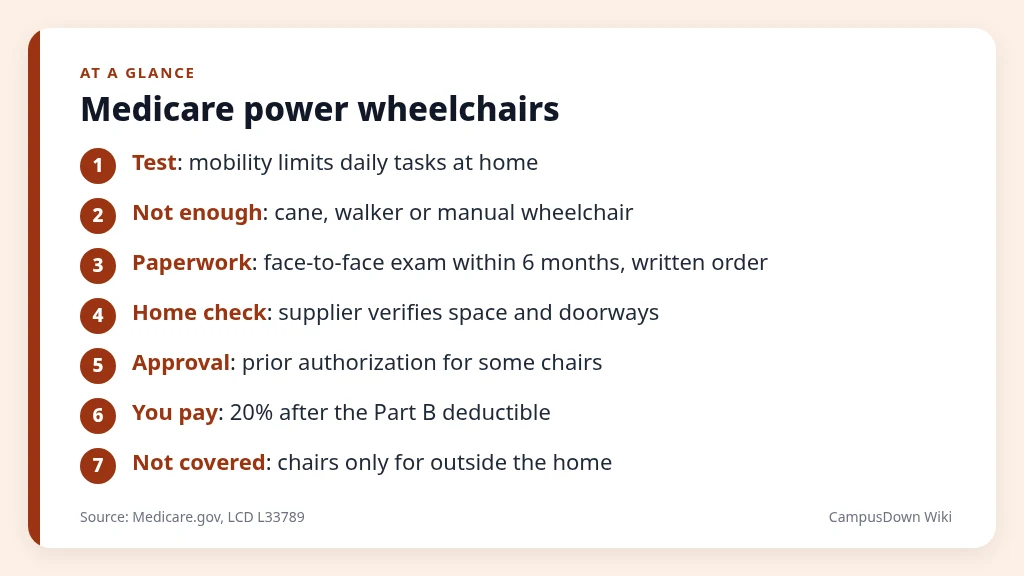
Medicare.gov says Part B covers power wheelchairs and scooters (power-operated vehicles, or POVs) only when they're medically necessary. You must have a face-to-face examination and a written prescription from a treating provider. The DME booklet says Medicare won't cover a power wheelchair or scooter you only need outside the home.

The step-by-step medical need test (LCD L33789)
The LCD says all of these must be true for any power mobility device:
- Your mobility limitation significantly impairs daily activities in your home, such as toileting, feeding, dressing, grooming and bathing. It either prevents the task, makes it unsafe, or keeps you from finishing it in a reasonable time.
2. A properly fitted cane or walker can't safely solve the problem. 3. You can't self-propel an optimally configured manual wheelchair at home during a typical day.
Compare simpler aids first in our walker vs rollator guide and our cane guide.
Scooter or power wheelchair?
Scooter (POV): the LCD says you must be able to transfer safely, operate the tiller steering, and stay stable while driving it at home. Your home must have room to use it.
Power wheelchair: considered when you don't meet the scooter criteria. You must be able to operate it safely, or have a caregiver who can't push a manual chair but can safely operate the power chair. Your home must have adequate access between rooms, space and surfaces.
For both, the device must significantly improve your daily activities at home, and you must be willing to use it there. The LCD includes extra criteria for more advanced chairs, such as a specialty evaluation by a physical or occupational therapist and a supplier with a RESNA-certified Assistive Technology Professional. It also includes criteria for certain Group 2 chairs with seat elevation systems.
The paperwork that matters
The LCD says:
- The face-to-face encounter must be within 6 months before the written order.
- The visit notes should answer: what's the mobility limitation, why a cane or walker won't work, why a manual wheelchair won't work, and why you can (or can't) safely use a scooter.
- The supplier or practitioner must do a home assessment before or at delivery to check doorways, thresholds and layout.
- For chairs approved through prior authorization, delivery must be within 6 months of the decision.
Medicare.gov says your supplier usually submits the prior authorization request for certain power wheelchairs. A request can be denied if Medicare finds you don't need one or doesn't get enough information; the supplier may resubmit.
What you pay
- 20% of the Medicare-approved amount after the Part B deductible ($283 in 2026), if the supplier accepts assignment.
- The DME booklet says Medicare buys complex rehabilitative power wheelchairs but rents many other wheelchairs for 13 months, after which you own them.
- For owned equipment, Medicare pays 80% of approved repair costs. Ask about repairs and batteries before you choose a supplier; you can take a closer look in our Medicare DME guide.
Get help now if
The DME booklet warns that some dishonest suppliers offer expensive power wheelchairs and scooters to people who don't qualify. Never give your Medicare Number to a caller or ad promising a "free" chair; read our Medicare fraud guide and call 1-800-MEDICARE (1-800-633-4227) to report it.
Example scenario: the kitchen that got too big
- Who
- Lucian, 76, a retired bookbinder in Fresno, California, had advanced COPD and severe arthritis in both shoulders. He could stand briefly but couldn't walk from the bedroom to the bathroom without stopping to catch his breath. His wife, Araminta, 74, had a bad back and couldn't push a manual wheelchair.
- What happened
- A TV ad promised a "free" power chair. Lucian almost called, but Araminta remembered a Medicare warning about those offers.
- How it felt
- Lucian felt trapped in his own house and ashamed of needing help to reach the bathroom. Araminta felt guilty that she couldn't do more.
- What they did
- At a face-to-face visit, his doctor documented why a walker and a manual wheelchair wouldn't work, and that his shoulders and balance made a scooter's tiller unsafe. A physical therapist evaluated him, and a local Medicare-enrolled supplier measured their doorways and submitted the prior authorization request.
- How it turned out
- The chair was approved and delivered weeks later. Lucian made his own coffee for the first time in a year, and Araminta said the best sound in the house was his chair humming down the hall instead of his breathing.
This is an illustrative example, not a real patient or a review.
Lucian's story is an illustrative example. Coverage depends on your documented needs and Medicare's review.
Most-asked questions about Medicare power wheelchairs
What are the Medicare power wheelchair documentation requirements?
A face-to-face exam within 6 months before a written order, notes explaining why a cane, walker, manual chair or scooter won't work, and a home assessment.
Why people ask: "medicare power wheelchair documentation requirements" is #1 for "medicare power wheelchair" (US autocomplete, November 2026).
What are the Medicare power wheelchair requirements?
Your mobility limits daily tasks at home, a cane, walker or manual chair isn't enough, and you or a caregiver can use the chair safely at home.
Why people ask: "medicare power wheelchair requirements" is #3 for "medicare power wheelchair" (US autocomplete, November 2026).
What is the Medicare power wheelchair LCD?
The Power Mobility Devices LCD (L33789) used by Medicare's equipment contractors lists the coverage criteria.
Why people ask: "medicare power wheelchair lcd" is #4 for "medicare power wheelchair" (US autocomplete, November 2026).
Does Medicare cover power wheelchairs in nursing homes?
Medicare covers DME for use in your home; a long-term care facility can count as home, but a skilled nursing facility on a Part A stay supplies equipment itself.
Why people ask: "does medicare cover power wheelchairs in nursing homes" is #2 for "does medicare cover power wheelchairs" (US autocomplete, November 2026).
Does Medicare cover electric wheelchairs?
Yes, when medically necessary for use in the home, with a face-to-face exam and a written order.
Why people ask: "does medicare cover electric wheelchairs" is #3 for "does medicare cover power wheelchairs" (US autocomplete, November 2026).
Does Medicare cover power wheelchair repairs?
For a chair you own, Medicare pays 80% of approved repair costs; for a rented chair, the supplier handles repairs.
Why people ask: "does medicare cover power wheelchair repairs" is #8 for "does medicare cover power wheelchairs" (US autocomplete, November 2026).
Related on CampusDown
Worried about falls at home? You can learn more in our fall prevention checklist and grab bar guide.
Frequently asked questions
- Will Medicare cover a scooter just for shopping trips?
- No. Medicare won't cover a power wheelchair or scooter you only need outside the home.
- Who submits prior authorization?
- Medicare.gov says your DME supplier usually submits it with your documents.
- Do I need to see a therapist?
- For more advanced chairs, the LCD requires a specialty evaluation by a PT, OT or trained practitioner.
- What if my request is denied?
- Ask the supplier what was missing; Medicare.gov says they may resubmit. Check it for yourself in your Medicare Summary Notice.
Medicare power wheelchair coverage turns on one question: what can't you do safely inside your home? Get the face-to-face visit documented well, use a Medicare-enrolled supplier, and ignore any "free chair" offers.
Browse more guides like this in the Senior Health and Medicare hub.
This article is for general education and does not replace advice from your own doctor, nurse or pharmacist.