
What if the Part B premium alone eats a big slice of your Social Security check? Millions of people with modest incomes may qualify for state help paying Medicare premiums, and in some cases deductibles and coinsurance too. Many never apply because they assume they earn too much.

This guide is based on Medicare.gov's Medicare Savings Programs page. It explains in detail what each program pays and the 2026 limits. Your state makes the final decision; apply even if you're unsure.
The four programs
| Program | What it helps pay | 2026 monthly income limit (individual / couple) |
|---|---|---|
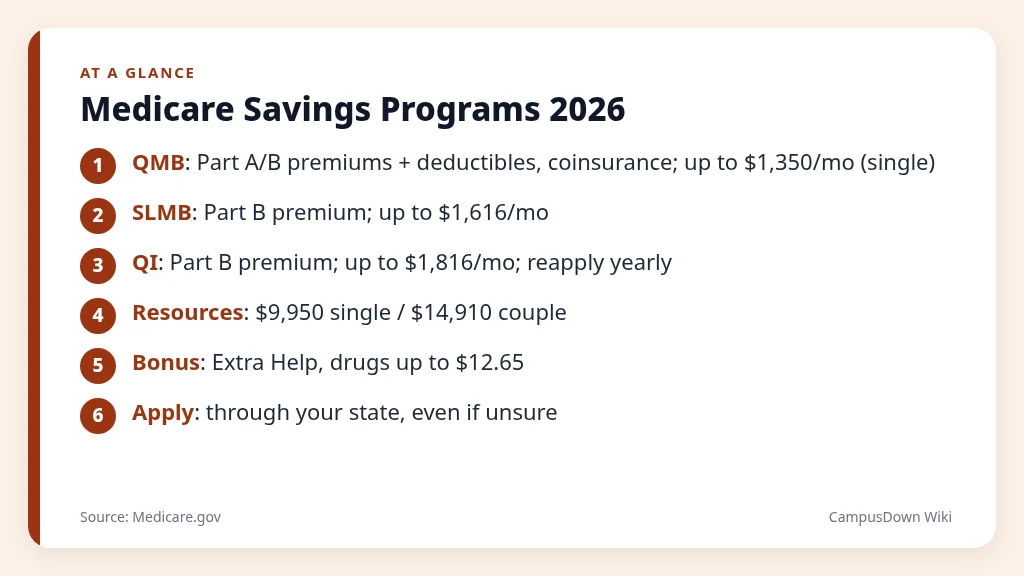
| QMB (Qualified Medicare Beneficiary) | Part A premiums (if any), Part B premiums, deductibles, coinsurance, copayments | $1,350 / $1,824 |
| SLMB (Specified Low-Income Medicare Beneficiary) | Part B premiums | $1,616 / $2,184 |
| QI (Qualifying Individual) | Part B premiums | $1,816 / $2,455 |
| QDWI (Qualified Disabled & Working Individual) | Part A premiums for certain working people with disabilities | $5,405 / $7,299 |
The resource limit for QMB, SLMB and QI is $9,950 (individual) or $14,910 (couple). Income limits are slightly higher in Alaska and Hawaii. Source: Medicare.gov.

What counts and what doesn't
Resources include money in checking, savings or retirement accounts, stocks and bonds. States don't count:
- Your home
- One car
- A burial plot and up to $1,500 set aside for burial
- Furniture and household items
Some states don't count certain income or resources at all, so check it for yourself; you may qualify even above the federal limits.
QMB billing protection
If you're in QMB, Medicare.gov says providers aren't allowed to bill you for Medicare-covered deductibles, coinsurance or copayments. If you get a bill:
- Tell the provider or debt collector you're in QMB.
- If you already paid, you have a right to a refund; contact your state Medicaid office.
- In a Medicare Advantage plan, ask the plan to stop the charges.
- If billing continues, call 1-800-MEDICARE.
Show your Medicare and Medicaid (or QMB) cards each time you get care.
Extra Help comes with it
People in QMB, SLMB or QI also get Extra Help with drug costs, paying no more than $12.65 per covered drug in 2026. Medicare.gov also says you generally won't owe a Part B late penalty if you enroll in a Medicare Savings Program; see Medicare enrollment timing.
QI's special rules
You must reapply every year for QI, and states approve applications first-come, first-served, with priority for people who had QI the year before. QI is only for people who don't qualify for other Medicaid benefits.
Get help now if
You never have to pay anyone to apply for a Medicare Savings Program. Apply through your state Medicaid office, and beware of callers asking for your Medicare number; see Medicare scams.
How to apply
Contact your state Medicaid office. A free State Health Insurance Assistance Program (SHIP) counselor can help you gather proof of income and resources. If you're planning for nursing home costs, see the Medicaid look-back.
Example scenario: $202.90 a month back
- Who
- Emmett, 72, a retired school custodian in Lubbock, Texas, lived on about $1,300 a month from Social Security after his wife died. Part B came out of his check every month.
- What happened
- He skipped a cardiology follow-up because of the 20% coinsurance and assumed a program like this was "for people on welfare."
- How it felt
- He felt embarrassed asking for help, and scared every time a medical bill arrived.
- What they did
- His neighbor, Esmeralda, a retired social worker, sat with him while he called a SHIP counselor, who helped him apply through the state with his bank statements and benefit letter.
- How it turned out
- He qualified for QMB. His Part B premium stopped coming out of his check, his doctor's office stopped billing him coinsurance, and he went back to the cardiologist. He said it felt like getting a raise.
This is an illustrative example, not a real patient or a review.
Emmett's story is an illustrative example. Eligibility depends on your state's rules.
Most-asked questions about Medicare Savings Programs
What are the Medicare Savings Program income limits for 2026?
Federal limits are $1,350 (QMB), $1,616 (SLMB) and $1,816 (QI) a month for individuals; states may allow more.
Why people ask: "medicare savings program income limits 2026" is #2 for "medicare savings program" (US autocomplete, November 2026).
How do I file a Medicare Savings Program application?
Apply through your state Medicaid office; a SHIP counselor can help.
Why people ask: "medicare savings program application" is #5 for "medicare savings program" (US, November 2026).
How does the Medicare Savings Program work in Texas?
Like other states, Texas runs its programs through its state Medicaid agency, which decides eligibility. Contact the state to apply.
Why people ask: "medicare savings program texas" is #3 for "medicare savings program" (US, November 2026).
What does QMB Medicare mean?
Qualified Medicare Beneficiary: a program that pays Part A and B premiums and Medicare cost-sharing.
Why people ask: "qmb medicare meaning" is #2 for "qmb medicare" (US, November 2026).
Who's eligible for QMB Medicare?
People with Part A whose income and resources are within state limits; the 2026 federal limit is $1,350 a month for an individual.
Why people ask: "qmb medicare eligibility" is #4 for "qmb medicare" (US, November 2026).
Can I have QMB with a Medicare Advantage plan?
Yes. If you're billed for cost-sharing, Medicare.gov says to ask the plan to stop the charges.
Why people ask: "qmb medicare advantage plan" is #8 for "qmb medicare" (US, November 2026).
Related on CampusDown
At the other end of the income scale, learn more about IRMAA surcharges. MSPs don't change home health coverage rules.
Frequently asked questions
- Should I apply if my income is a little over the limit?
- Yes. Medicare.gov says states may use higher limits or not count some income.
- Does my house count as a resource?
- No. Your home, one car, a burial plot and furniture don't count.
- Do I need to reapply every year?
- For QI, yes. Check it for yourself with your state for other programs.
Medicare Savings Programs can save hundreds of dollars a month. Check the limits, gather your documents, and apply through your state, even if you think you won't qualify.
Browse more guides like this in the Senior Health and Medicare hub.
This article is for general education and does not replace advice from your own doctor, nurse or pharmacist.