
Can you still see your Medicare doctor from your living room? Yes, for now. The rules that let most people do telehealth from home were extended, but they have an end date.

This guide is based on Medicare.gov's telehealth page, CMS's Telehealth FAQ (updated October 8, 2026) and the Medicare publication "Your Medicare in 2027: What's New & Changing." It explains in detail what's covered and what changes after 2027. Ask your provider whether a specific service can be done by telehealth.
What Medicare telehealth means
Medicare.gov says telehealth is care from a provider located somewhere else in the U.S. using audio and video (or audio-only in some cases), such as through your phone or computer. It also includes:
- E-visits: non-face-to-face messages, usually through an online patient portal
- Virtual check-ins: brief, real-time contacts that usually last 10 minutes or less

Covered through December 31, 2027
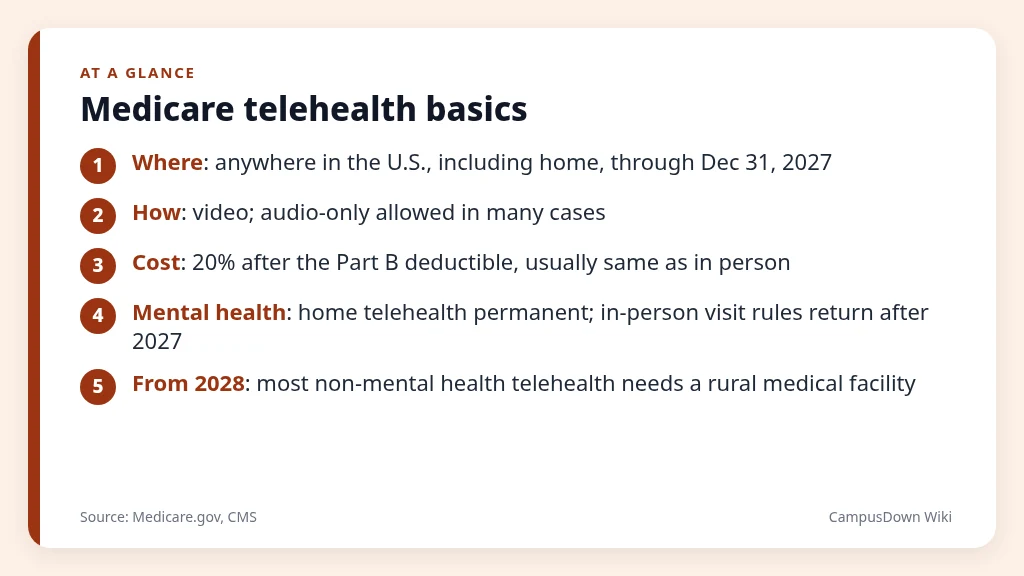
Medicare.gov says that through December 31, 2027, Medicare covers telehealth services you get from anywhere in the U.S., including your home. Examples include:
- Advance care planning
- Cardiac and pulmonary rehabilitation
- Caregiver training
- Cognitive assessments
- Depression screenings and outpatient psychotherapy
- Diabetes self-management training and medical nutrition therapy
- Speech therapy
Medicare may cover more than this list, so check with your provider. You can learn more about related care in our guides to depression in older adults and diabetes in older adults.
What you pay
Medicare.gov says you pay 20% of the Medicare-approved amount after the Part B deductible ($283 in 2026). For most telehealth services, you pay the same as in person. Your costs can depend on other insurance, whether your provider accepts assignment, and the type of facility.
Audio-only phone visits
CMS says beneficiaries may continue to get audio-only telehealth at home through December 31, 2027. Starting January 1, 2028, audio-only at home is allowed for behavioral health when your provider can do video but you can't use or don't consent to video.
Mental health telehealth: permanent, with in-person rules
Home telehealth for behavioral and mental health is permanent. CMS says the law requires an in-person visit within 6 months before the first mental health telehealth service, effective after December 31, 2027, and then generally an in-person visit within 12 months of each telehealth service, with limited exceptions.
CMS says that if you began mental health telehealth at home on or before December 31, 2027, you're considered established: no 6-month pre-visit is needed, but you'll need at least one in-person visit every 12 months after that date.
Get help now if
Telehealth is not for emergencies. Call 911 for chest pain, trouble breathing, stroke signs or thoughts of harming yourself; you can also call or text 988 for the Suicide and Crisis Lifeline. Also, never give your Medicare Number to an unknown caller offering "free telehealth tests"; see our Medicare fraud guide.
What changes January 1, 2028
CMS says that starting January 1, 2028, except for behavioral health, beneficiaries will generally need to be in a medical facility in a rural area to get Medicare telehealth. Congress could change this again, so check it for yourself on Medicare.gov late in 2027.
Medicare Advantage and ACOs
Medicare.gov says Medicare Advantage plans and some Original Medicare providers in an Accountable Care Organization (ACO) may offer more telehealth than basic Original Medicare. Ask your plan or practice.
Making a telehealth visit work
- Test your device, camera and internet before the visit.
- Keep your medication list and readings (like blood pressure or glucose) nearby.
- Ask a family member to join if you'd like help hearing or taking notes.
- Ask whether a follow-up should be in person.
Example scenario: counseling across the snow
- Who
- Alistair, 68, a retired grain elevator manager outside Havre, Montana, had trouble sleeping and lost interest in everything after selling the family farm. The nearest counselor was over an hour away on winter roads. His wife, Theodora, 66, noticed he'd stopped going to church breakfasts.
- What happened
- His doctor screened him for depression and suggested counseling, but Alistair said he'd "never drive that far to talk about feelings."
- How it felt
- He felt ashamed and stuck. Theodora felt lonely in the same house and scared about how quiet he'd become.
- What they did
- His doctor's office set up weekly video psychotherapy from home, with phone visits when the internet went down in storms. Theodora helped with the tablet for the first visit, then gave him privacy. The office explained that he'd need an in-person visit each year to keep home mental health telehealth after 2027.
- How it turned out
- By spring, Alistair was back at church breakfasts and said Tuesdays were "the hour I don't have to be fine." Theodora said she got her husband's laugh back, and they planned his yearly in-person visit around a trip to town for pie.
This is an illustrative example, not a real patient or a review.
Alistair's story is an illustrative example. Your provider will decide whether telehealth fits your care.
Most-asked questions about Medicare telehealth
Does Medicare cover telehealth in 2026?
Yes. Through December 31, 2027, Medicare covers telehealth from anywhere in the U.S., including your home.
Why people ask: "medicare telehealth 2026" is #2 for "medicare telehealth" (US autocomplete, November 2026).
Is there a Medicare telehealth services list?
Medicare.gov lists examples like advance care planning, cognitive assessments, depression screenings, psychotherapy and speech therapy; Medicare may cover more.
Why people ask: "medicare telehealth services list" is #3 for "medicare telehealth" (US autocomplete, November 2026).
How do I find Medicare telehealth providers?
Ask your current doctor first; many offer telehealth. Medicare Advantage plans and ACO practices may offer more.
Why people ask: "medicare telehealth providers" is #7 for "medicare telehealth" (US autocomplete, November 2026).
Was Medicare telehealth extended past 2026?
Yes. Medicare.gov and CMS say home telehealth flexibilities run through December 31, 2027.
Why people ask: "medicare telehealth 2026 extension" is #4 for "medicare telehealth 2026" (US autocomplete, November 2026).
What does Medicare telehealth coverage cost in 2026?
Usually 20% of the approved amount after the Part B deductible, the same as in person for most services.
Why people ask: "medicare telehealth 2026 coverage" is #9 for "medicare telehealth 2026" (US autocomplete, November 2026).
What are the 2026 Medicare telehealth rules for behavioral health?
Home mental health telehealth is permanent. In-person visit requirements apply after December 31, 2027, with rules for people already established.
Why people ask: "medicare telehealth 2026 behavioral health" is #10 for "medicare telehealth 2026" (US autocomplete, November 2026).
Related on CampusDown
Caring for someone at home? Take a closer look at caregiver burnout and CBT for insomnia, and bring telehealth questions to your annual wellness visit.
Frequently asked questions
- Can I do telehealth from home with Original Medicare?
- Yes, through December 31, 2027, from anywhere in the U.S.
- Does Medicare cover phone-only visits?
- CMS says audio-only telehealth at home is allowed through December 31, 2027, and for behavioral health after that in certain cases.
- Do I pay more for telehealth?
- Medicare.gov says for most services you pay the same as in person.
- Will home telehealth end in 2028?
- CMS says that, except for behavioral health, you'll generally need to be in a rural medical facility starting January 1, 2028, unless the law changes.
Medicare telehealth from home is covered through 2027, and mental health telehealth at home is permanent. Use it while it fits your care, keep in-person visits on the calendar, and watch for rule changes before 2028.
Browse more guides like this in the Senior Health and Medicare hub.
This article is for general education and does not replace advice from your own doctor, nurse or pharmacist.