
What if your heart or cancer medicine costs more each month than your Social Security check? Until recently, Part D had no ceiling. Now it does, and the cap is rising to $2,400 in 2027. For people on expensive brand-name drugs, it can mean the difference between rationing pills and filling every prescription.

This guide uses Medicare.gov's Part D cost page to explain how the cap works, what counts toward it, and how the Prescription Payment Plan helps with cash flow. If your drug costs are high early in the year, take a closer look at the payment plan section.
The three Part D coverage stages
Medicare.gov describes three stages for Medicare drug plans and Advantage plans with drug coverage:
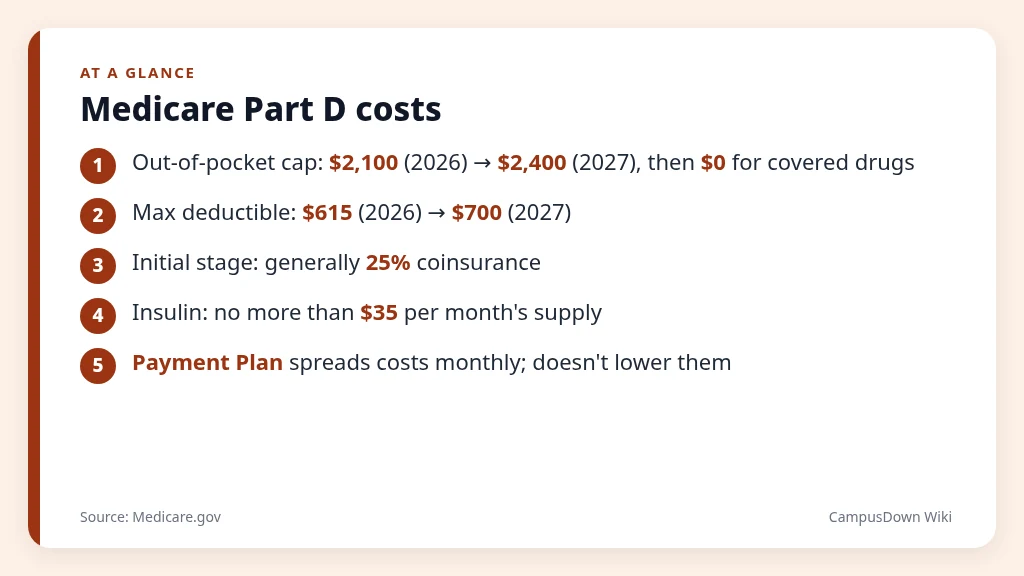
- Deductible stage: you pay full costs until you meet your plan's deductible. No plan may have a deductible above $615 in 2026 or $700 in 2027, and some plans have none.
2. Initial coverage stage: you generally pay 25% coinsurance for generic and brand-name drugs until your out-of-pocket spending on covered drugs reaches $2,100 in 2026 ($2,400 in 2027), including certain payments made on your behalf, such as through Extra Help. 3. Catastrophic coverage: you pay nothing for covered Part D drugs for the rest of the calendar year.
Your plan's actual copays may differ within these rules. Your monthly Explanation of Benefits shows your stage and what has counted toward the cap.

Insulin and other protections
Medicare.gov says covered insulin costs no more than $35 for a one-month supply, with no deductible. Recommended adult vaccines covered by Part D are generally free. See insulin types for the products themselves.
What does not count
Medicare.gov notes that if you use a discount card or cash program instead of your plan, that spending does not count toward your deductible or out-of-pocket maximum. Premiums also do not count toward the cap.
Knowing the cap exists is half the help; managing cash flow is the other half. That is where the Prescription Payment Plan comes in.
Example scenario: the January pharmacy shock
- Who
- Elaine, 70, a retired librarian with Part D coverage, was prescribed an expensive brand-name medicine for heart failure in December.
- What happened
- When she picked up her first January fill, she was told she owed most of her plan's deductible plus coinsurance, hundreds of dollars at once.
- How it felt
- She felt panic at the counter and embarrassment at asking for help, and she considered skipping the medicine until spring.
- What they did
- Her pharmacist explained the yearly cap and the Medicare Prescription Payment Plan. Elaine called her plan to enroll, and she also checked whether she might qualify for Extra Help.
- How it turned out
- Her costs were spread into monthly bills through the year instead of a few large payments, and she never missed a dose. By late spring her spending reached the cap, and her later fills cost $0 for covered drugs.
This is an illustrative example, not a real patient or a review.
Elaine's story is an illustration, not a real case. Your plan's deductible, copays and timing may differ.
The Medicare Prescription Payment Plan
According to Medicare.gov, it is a voluntary payment option, offered by all Medicare drug plans and Advantage plans with drug coverage, that spreads your out-of-pocket drug costs across the calendar year (January to December). You pay $0 at the pharmacy for covered drugs and get a monthly bill from your plan. It does not save money or lower drug costs; it changes when you pay. People with high costs early in the year are most likely to benefit. Read your plan's explanation of how monthly bills are calculated in detail before enrolling.
Get help now if
Never stop a prescribed medicine because of cost without talking to your prescriber or pharmacist. Ask about the payment plan, Extra Help, lower-cost alternatives and manufacturer programs first.
Most-asked questions about the Part D cap
What is the Medicare Part D out-of-pocket maximum for 2027?
$2,400, up from $2,100 in 2026. After you reach it, you pay nothing for covered Part D drugs for the rest of the year.
Why people ask: "medicare part d out of pocket maximum 2026" is #1 and "medicare part d out of pocket maximum 2027" is #2 for "medicare part d out of pocket max" (US autocomplete, November 2026).
Does the Part D cap include premiums?
No. The cap counts your out-of-pocket spending on covered drugs, plus certain payments made on your behalf, but not monthly premiums.
Why people ask: "part d out of pocket threshold" is #6 and "part d out of pocket cap" is #7 for "part d out of pocket" (US, November 2026).
Does Extra Help count toward the cap?
Yes. Medicare.gov says certain payments on your behalf, like through Extra Help, count. With Extra Help in 2027, you pay up to $5.80 per generic and $14.40 per brand-name drug until total costs reach $2,400. See Medicare Extra Help.
Why people ask: "medicare extra help 2027" is #7 for "medicare extra help" (US, November 2026).
Is the cap the same for Medicare Advantage drug coverage?
Yes, the same Part D cost rules apply to Advantage plans that include drug coverage.
Why people ask: "medicare advantage vs original medicare" is #4 for "medicare advantage vs" (US, November 2026).
During open enrollment, check it for yourself: enter every drug and dose into Medicare's Plan Finder for next year, because plan formularies and pharmacies change.
Related on CampusDown
Compare coverage paths in Medicare Advantage vs Medigap, review plans during Medicare Open Enrollment, and see how a costly brand drug like Jardiance is priced under Medicare's 2026 negotiated prices.
Frequently asked questions
- When does the cap reset?
- Every January 1, with the new year's amount.
- Do I have to apply for catastrophic coverage?
- No. Medicare.gov says you get it automatically when you reach the threshold.
- Can I join the Prescription Payment Plan any time?
- You can opt in before or during the year; contact your plan. It is voluntary.
- Does a discount card help me reach the cap faster?
- No. Purchases outside your plan don't count toward your deductible or out-of-pocket maximum.
The Part D cap turned an open-ended risk into a known yearly number. Learn more about your plan's stages each January, and ask your pharmacist about the payment plan before cost ever stands between you and a refill.
Browse more guides like this in the Senior Health and Medicare hub.
This article is for general education and does not replace advice from your own doctor, nurse or pharmacist.