
How much of your Social Security check will Medicare take next year? For most people on Medicare, the answer comes from one number: the standard Part B premium. It is going up again in 2027, and the deductible is rising too.

This guide lists the official 2026 and 2027 figures from Medicare.gov and CMS, explains who pays more, and shows where to get help. If your income changed recently, such as after retiring, take a closer look at the IRMAA section.
The numbers for 2026 and 2027
According to Medicare.gov's cost page:
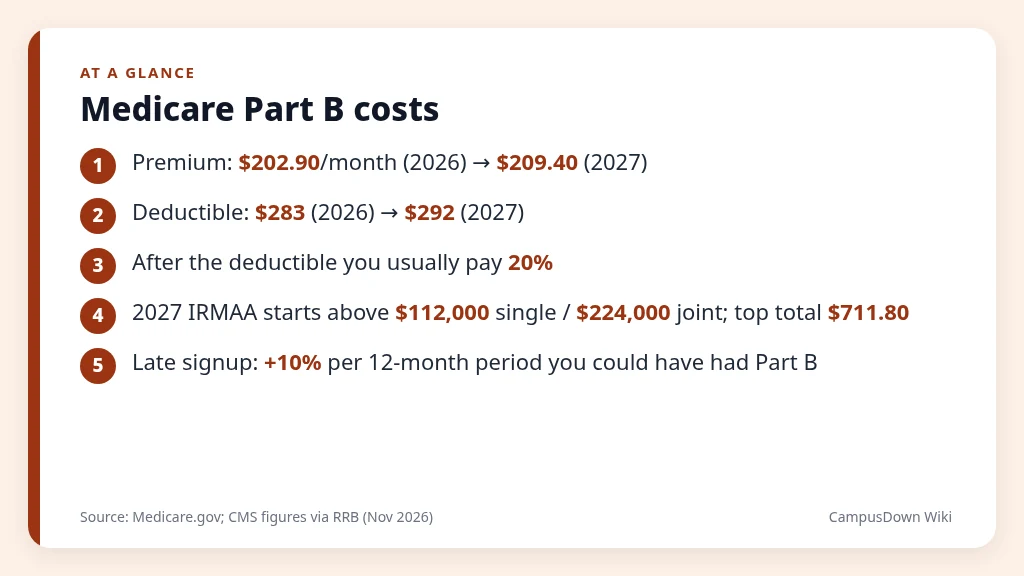
- Standard Part B premium: $202.90 a month in 2026, $209.40 in 2027.
- Part B deductible: $283 in 2026, $292 in 2027, paid once a year.
- Coinsurance: after the deductible, you usually pay 20% of the Medicare-approved amount for covered services.
CMS says the increases are mainly due to projected increases in health care spending. The Railroad Retirement Board's November 2026 release notes that some current enrollees may pay less than the standard amount, because by law their Part B premium cannot rise by more than their Social Security cost-of-living increase (often called the hold-harmless provision).
For comparison, Part A is premium-free for most people. The Part A hospital deductible is $1,736 per benefit period in 2026 and $1,776 in 2027.

How you pay it
Medicare.gov says most people have the Part B premium deducted automatically from their Social Security or Railroad Retirement Board benefit. If you do not get those benefits yet, Medicare sends a bill, every 3 months for Part B only. You pay the premium every month even if you use no Part B services.
Higher premiums based on income (IRMAA)
If your modified adjusted gross income is above certain limits, you pay an income-related monthly adjustment amount. Social Security generally uses your tax return from two years earlier, so 2027 premiums usually reflect 2025 income. The 2027 brackets for individual and joint filers:
- Up to $112,000 / $224,000: $209.40 (standard)
- Above $112,000 to $141,000 / $224,000 to $282,000: $293.10
- Above $141,000 to $177,000 / $282,000 to $354,000: $418.80
- Above $177,000 to $212,000 / $354,000 to $424,000: $544.40
- Above $212,000 and below $500,000 / $424,000 and below $750,000: $670.00
- $500,000 or more / $750,000 or more: $711.80
CMS estimates about 9% of beneficiaries pay these income-adjusted premiums. Part D enrollees above the same thresholds also pay an extra $15.40 to $96.40 a month in 2027. If your income dropped because of a life-changing event like retirement, read how to appeal IRMAA in detail.
Numbers like these feel abstract until a letter arrives. Here is what that can look like.
Example scenario: the letter after retirement
- Who
- Frank, 66, a retired electrician, and his wife Linda, 64, a former school secretary, both living mostly on Social Security and a small pension.
- What happened
- In late 2026 Frank received a notice saying his 2027 Part B premium would include an income-related surcharge, because their 2025 joint income included his final year of overtime and a one-time pension payout.
- How it felt
- Linda felt a knot in her stomach; they had built a tight budget and the extra amount felt like a penalty for working hard. Frank was irritated and worried he had filed something wrong.
- What they did
- They called Social Security, learned that work stoppage counts as a life-changing event, gathered his retirement letter and their expected 2027 income, and asked about filing form SSA-44.
- How it turned out
- Their request was reviewed and the surcharge was removed based on their lower current income. Linda now marks every November on the calendar to check the new Medicare figures and their Part D plan.
This is an illustrative example, not a real patient or a review.
Frank and Linda's story is an illustration, not a real case. Whether an IRMAA appeal succeeds depends on your documents and Social Security's decision.
Penalties and help with costs
- Late enrollment penalty: Medicare.gov says you pay an extra 10% for each full 12-month period you could have had Part B but did not sign up, for as long as you have Part B. A Special Enrollment Period usually applies if you or your spouse are still working with job-based coverage. See signing up while still working.
- Help paying: if your income and resources are limited, your state's Medicare Savings Programs can pay the Part B premium and sometimes more.
Get help now if
Watch for scams. Medicare and Social Security will not call to demand immediate payment or ask for your Medicare number to "lock in" a lower premium. Hang up and call the number on your official letter.
Most-asked questions about the Part B premium
What is the Medicare Part B premium for 2027?
$209.40 a month for most people, up from $202.90 in 2026, with a $292 deductible. Higher-income beneficiaries pay more.
Why people ask: "medicare part b premium 2027" is the #1 Google suggestion for "medicare part b premium," and "medicare part b premium 2026" is #2 (US autocomplete, November 2026).
What are the 2027 income limits for higher Part B premiums?
The surcharge starts above $112,000 for individual filers and $224,000 for joint filers, with six total levels topping out at $711.80 a month.
Why people ask: "medicare part b premium 2027 income limits" is #2 for "medicare part b premium 2027," and "medicare part b premium 2027 irmaa" is #7 (US, November 2026).
Will my Social Security check go down because of the higher premium?
The premium is usually deducted from your benefit, but the hold-harmless rule means most current enrollees' Part B increase cannot exceed their dollar increase from the cost-of-living adjustment.
Why people ask: "medicare part b premium 2027 schedule" is #5 and "medicare part b premium 2027 chart" is #4 for "medicare part b premium 2027" (US, November 2026).
Does a Medigap plan pay the Part B deductible?
Plans C and F, which cover it, cannot be sold to people who became eligible for Medicare on or after January 1, 2020. Plan G and Plan N leave the Part B deductible to you. See Plan G vs Plan N.
Why people ask: "plan g vs plan n cost" is #2 for "plan g vs plan n" (US, November 2026).
Each fall, check it for yourself: compare the new premium with your Social Security notice and review your plan during Medicare Open Enrollment.
Frequently asked questions
- Is the Part B premium the same for everyone?
- No. Most pay the standard amount, people with higher incomes pay more, and some current enrollees may pay less because of the hold-harmless rule.
- When do the 2027 amounts start?
- January 1, 2027.
- Can I stop paying Part B if I don't use it?
- You pay the premium each month even if you don't use services. Dropping Part B can lead to penalties and gaps; get advice first.
- Where can I get free help?
- Your State Health Insurance Assistance Program (SHIP) offers free, unbiased Medicare counseling.
The Part B premium is predictable once you know where the numbers come from. Learn more about your own costs each November, and ask your SHIP counselor before making any change.
Browse more guides like this in the Senior Health and Medicare hub.
This article is for general education and does not replace advice from your own doctor, nurse or pharmacist.
References
- Medicare.gov: What does Medicare cost?
- Railroad Retirement Board: Medicare Part B Premiums and Deductible to Increase in 2027 (CMS figures, November 2026)
- Medicare.gov: How to pay Part A & Part B premiums
- Social Security Administration: Medicare Income-Related Monthly Adjustment Amount, Life-Changing Event (SSA-44)