
Is it worth paying more every month for Plan G just to avoid a $20 copay? That is the question behind one of the most-searched Medicare comparisons, and the honest answer depends on how often you see doctors, whether they accept Medicare's approved amount, and how much the premium difference really is in your ZIP code.

This guide sticks to the official, standardized benefits from Medicare.gov and the federal "Choosing a Medigap Policy" guide. Premiums vary by company and state, so we do not quote any. If you are turning 65, take a closer look at the open enrollment rules, because timing matters more than plan letters.
What Medigap is
Medicare Supplement Insurance (Medigap) is extra insurance from private companies that helps pay your share of Original Medicare costs, like deductibles, coinsurance and copays. You generally need Parts A and B to buy it. In most states plans are standardized and named by letters, so Plan G from one company has the same benefits as Plan G from another; only price and service differ. Medigap plans sold today do not include prescription drug coverage, so most people add a Part D plan.

Plan G vs Plan N, benefit by benefit
Per Medicare.gov's comparison chart, both Plan G and Plan N pay 100% of:
- Part A coinsurance and hospital costs up to an additional 365 days after Medicare benefits are used
- Part A deductible, hospice coinsurance, skilled nursing facility coinsurance and the first 3 pints of blood
- 80% of foreign travel emergency costs, up to plan limits
The differences:
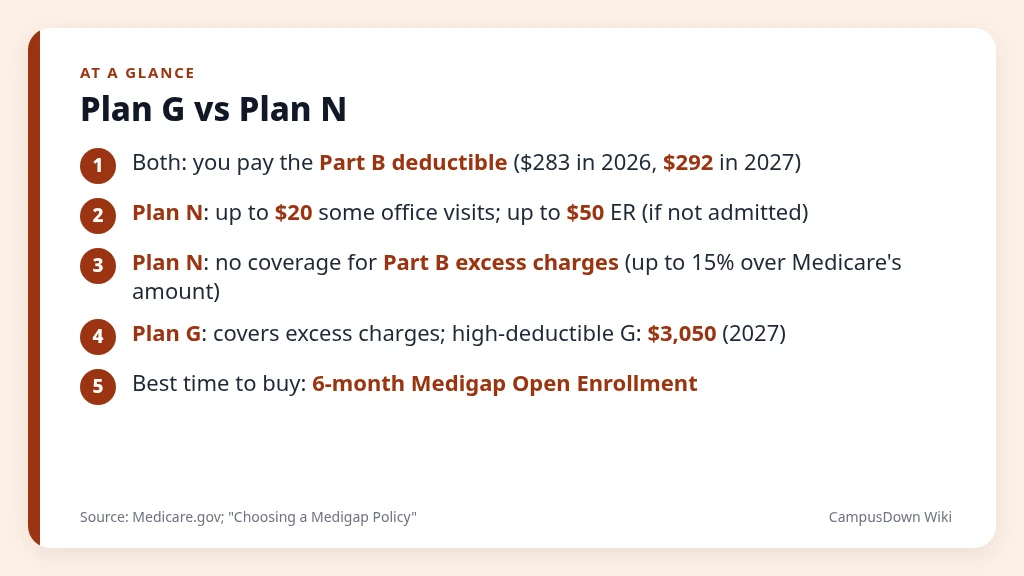
- Part B coinsurance: Plan G pays it in full. Plan N pays it except for a copay of up to $20 for some office visits and up to $50 for emergency room visits that do not result in inpatient admission.
- Part B excess charges: Plan G covers them; Plan N does not. Medicare.gov explains that doctors who do not accept assignment can, in many cases, charge up to 15% above the Medicare-approved amount (the "limiting charge").
- Part B deductible: neither covers it.
Plan G also comes in a high-deductible version in some states: you pay up to $2,950 in 2026 ($3,050 in 2027) in Medicare-covered costs before the policy pays.
Charts are tidy; real years are not. Here is how the trade-off can feel in practice.
Example scenario: the specialist who didn't take assignment
- Who
- Bernadette, 67, a retired bank teller in good health, chose Plan N at 65 because the premium was lower and she rarely saw doctors.
- What happened
- In her second year she developed knee pain, saw an orthopedic surgeon several times, needed imaging and physical therapy, and went to the ER once after a fall.
- How it felt
- She was annoyed at the stack of small copays and then alarmed by a bill for an excess charge from a surgeon who did not accept assignment; she worried she had chosen the wrong plan forever.
- What they did
- She called her State Health Insurance Assistance Program counselor, learned to ask each office whether it accepts assignment, and compared her total copays and excess charges with the yearly premium difference for Plan G.
- How it turned out
- Her total extra costs that year were less than the premium gap, so she kept Plan N, found an orthopedist who accepts assignment, and now keeps a small "copay fund." She also learned that switching later could require medical underwriting in her state.
This is an illustrative example, not a real patient or a review.
Bernadette's story is an illustration, not a real case. Your numbers depend on your premiums, health and doctors.
Timing: the 6-month Medigap Open Enrollment Period
The federal guide says your 6-month Medigap Open Enrollment Period starts the first month you have Part B and are 65 or older, and it does not repeat. During it, a company cannot refuse to sell you a policy or charge more because of health problems. After it ends, in many states companies can use medical underwriting, so you may not be able to switch from N to G later. Some states have extra rights; read them in detail in Medigap birthday rules.
Get help now if
Do not drop a Medigap policy before a new one is approved in writing. You could be left with no supplemental coverage, or unable to get it back.
Most-asked questions about Plan G vs Plan N
Which costs less overall, Plan G or Plan N?
It depends on your premiums and how often you use care. Plan N's premium is often lower, but you pay up to $20 per some office visits, up to $50 for ER visits without admission, and any excess charges. Add up a typical year for both.
Why people ask: "plan g vs plan n cost" is #2 for "plan g vs plan n," and "plan g vs plan n chart" is #4 (US autocomplete, November 2026).
Plan G vs Plan F: what is the difference?
Plan F also covers the Part B deductible, but it cannot be sold to people who became eligible for Medicare on or after January 1, 2020.
Why people ask: "plan g vs plan f" is #4 for "plan g vs" (US, November 2026).
Is high-deductible Plan G worth it?
It has lower premiums but you pay up to $3,050 in 2027 before it pays. It may fit people with savings who want protection against large bills; compare carefully.
Why people ask: "plan g vs plan g high deductible" is #5 for "plan g vs" (US, November 2026).
Plan G vs Medicare Advantage: which is better?
They work differently: Medigap pairs with Original Medicare and any provider that accepts Medicare, while Advantage plans use networks and often prior authorization. See Medicare Advantage vs Medigap.
Why people ask: "plan g vs medicare advantage" is #6 for "plan g vs," and "medicare advantage vs plan g" is #8 for "medicare advantage vs" (US, November 2026).
Before deciding, check it for yourself: get Plan G and Plan N quotes from the same companies, ask your regular doctors if they accept assignment, and estimate your yearly visits.
Related on CampusDown
See the 2026 and 2027 Part B premium, how plans change during Medicare Open Enrollment, and why hospital status matters in observation vs inpatient.
Frequently asked questions
- Do Plan G and Plan N cover prescriptions?
- No. Medigap plans sold today do not include drug coverage; you need a separate Part D plan.
- Are Plan G benefits the same with every company?
- Yes, in most states standardized benefits are identical; premiums and customer service differ.
- Does Plan N charge a copay for urgent care?
- Plan N's copay of up to $20 applies to some office visits; ask the insurer how it handles urgent care visits.
- Can I switch from Plan N to Plan G later?
- Possibly, but outside special protected situations the insurer may use medical underwriting. Check your state's rules.
Plan G buys predictability; Plan N trades small bills for a lower premium. Learn more about your own doctor visits and local prices, and talk to your SHIP counselor before you sign.
Browse more guides like this in the Senior Health and Medicare hub.
This article is for general education and does not replace advice from your own doctor, nurse or pharmacist.