
Why do two neighbors, both 66 and both healthy, make opposite choices about Medicare and both feel sure they are right? Because Medicare Advantage and Medigap trade different things: one usually offers lower monthly costs and extras with a network, the other offers broad choice of doctors and predictable bills for a higher premium.

This guide compares them using Medicare.gov's official side-by-side chart and the federal Medigap guide. It does not recommend specific plans. If you are about to turn 65, take a closer look at the switching rules, because they decide how reversible your choice is.
Two ways to get Medicare
- Original Medicare (Parts A and B) can be paired with a Medigap (Medicare Supplement) policy and a separate Part D drug plan.
- Medicare Advantage (Part C) plans are offered by private companies approved by Medicare. They must cover all medically necessary services Original Medicare covers, and most include Part D.

Side by side, from Medicare.gov
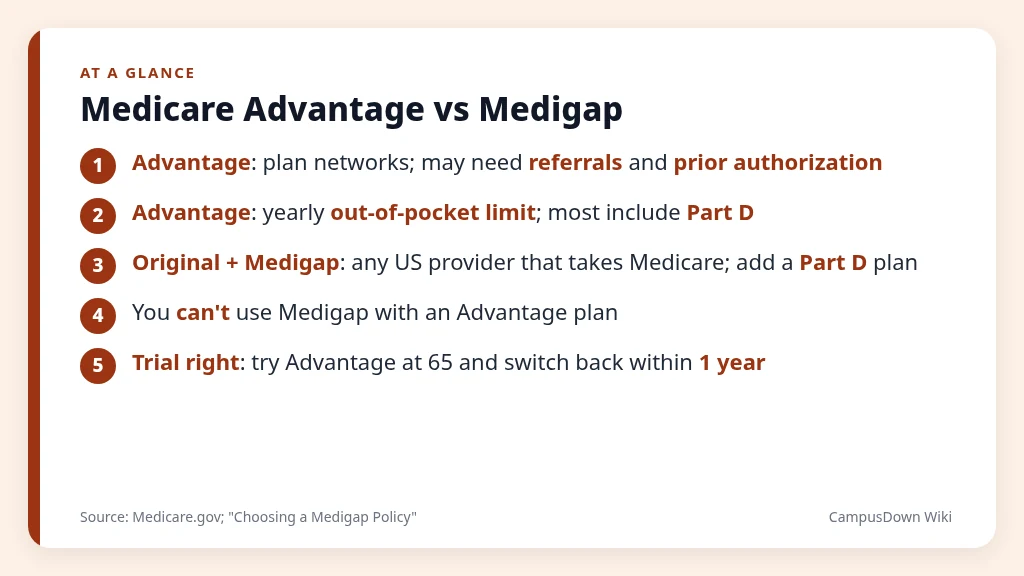
- Doctors and hospitals: Original Medicare lets you use any doctor or hospital that takes Medicare anywhere in the US. Advantage plans may require you to use in-network providers for non-emergency care, and you may need a referral to see a specialist.
- Approvals: in most cases Original Medicare does not require prior authorization; Advantage plans may require approval before covering certain services or supplies.
- Out-of-pocket limit: Original Medicare has no yearly limit unless you have supplemental coverage such as Medigap. Advantage plans must have a yearly limit on covered services; after you reach it you pay nothing for covered services that year.
- Premiums: with Original Medicare you pay the Part B premium plus any Medigap and Part D premiums. With Advantage you pay the Part B premium and may pay a plan premium; some plans have a $0 premium.
- Extras: Advantage plans may offer some vision, hearing and dental benefits that Original Medicare does not cover.
- Travel: Original Medicare generally does not cover care outside the US, but some Medigap policies cover foreign travel emergencies. Advantage plans generally do not, though some offer it as an extra.
- Medigap with Advantage: you cannot buy Medigap to cover Advantage plan costs.
Comparisons like these only matter when something happens. The story below shows why the fine print on switching deserves attention.
Example scenario: the referral that took three weeks
- Who
- Curtis, 65, a retired truck dispatcher who had just started Medicare, joined a $0-premium Medicare Advantage HMO because it included dental and a gym benefit.
- What happened
- Ten months later he needed a cardiologist; his preferred heart doctor was out of network, and a stress test needed prior authorization.
- How it felt
- He felt trapped and anxious waiting for approvals, and his wife was frustrated by the phone calls; Curtis worried he had made a costly mistake he could never undo.
- What they did
- A SHIP counselor explained the trial right: because he joined Advantage when first eligible at 65 and was still within his first year, he could switch to Original Medicare and buy any Medigap policy sold in his state without health questions.
- How it turned out
- Curtis switched to Original Medicare, a Medigap plan and a Part D plan, saw his preferred cardiologist, and budgeted for the higher premiums. He tells friends to read the network list before choosing any plan.
This is an illustrative example, not a real patient or a review.
Curtis's story is an illustration, not a real case. Many people are happy with Advantage plans; the right choice depends on your doctors, health, budget and location.
Switching rules that matter
The federal "Choosing a Medigap Policy" guide describes protected rights to buy Medigap in certain situations, including:
- your one-time 6-month Medigap Open Enrollment Period, starting the first month you have Part B and are 65 or older
- the trial right: if you joined an Advantage plan when first eligible at 65 and want to switch to Original Medicare within the first year, you can buy any Medigap policy sold in your state
- if you dropped a Medigap policy to try Advantage for the first time and leave within a year, you may be able to get your old policy back
Outside protected situations, insurers in many states can use medical underwriting and deny or price a Medigap policy based on your health. You can change Advantage and Part D plans each fall during Medicare Open Enrollment.
Get help now if
Never sign up for a plan because of a phone call or TV ad that pressures you. Check providers and drugs in Medicare's Plan Finder or with your SHIP before enrolling.
Most-asked questions about Medicare Advantage vs Medigap
What are the pros and cons of Medicare Advantage vs Medigap?
Advantage often has lower premiums, an out-of-pocket limit, built-in drug coverage and extras, but uses networks and prior authorization. Medigap plus Original Medicare offers nationwide provider choice and predictable costs, but higher premiums and a separate Part D plan.
Why people ask: "medicare advantage vs medigap pros and cons" is #2 for "medicare advantage vs medigap" (US autocomplete, November 2026).
Medicare Advantage vs a Medicare Supplement: are they the same?
No. "Medicare Supplement" is another name for Medigap, which works with Original Medicare. Advantage replaces how you get Parts A and B.
Why people ask: "medicare advantage vs supplement" is the #1 suggestion for "medicare advantage vs" (US, November 2026).
Medicare Advantage vs Plan G: which costs less?
It depends on premiums in your area and how much care you use. Compare Plan G's premium plus a Part D premium with the Advantage plan's premium, copays and yearly out-of-pocket limit. See Plan G vs Plan N.
Why people ask: "medicare advantage vs medigap plan g" is #4 for "medicare advantage vs medigap" (US, November 2026).
Can I switch from Medicare Advantage back to Original Medicare?
Yes, during set enrollment periods, but buying Medigap afterward may involve health questions unless you have a protected right such as the trial right.
Why people ask: "medicare advantage open enrollment period" is #1 for "medicare advantage open enrollment" (US, November 2026).
Before you choose, check it for yourself: list your doctors, hospitals and prescriptions, then confirm each one in the plans you are considering.
Related on CampusDown
You can learn more about Part B premiums, the Part D out-of-pocket cap, and how hospital status affects rehab coverage in both kinds of plans.
Frequently asked questions
- Can I have both Medicare Advantage and Medigap?
- No. Medicare.gov says you can't buy Medigap to cover Advantage plan costs.
- Do Medicare Advantage plans cover everything Original Medicare does?
- Plans must cover all medically necessary services Original Medicare covers, but costs, networks and rules differ.
- Is a $0-premium Advantage plan free?
- No. You still pay the Part B premium, plus copays and coinsurance up to the plan's yearly limit.
- Where can I get unbiased help?
- Your State Health Insurance Assistance Program (SHIP) offers free counseling.
Neither path is right for everyone; the best choice fits your doctors, health and budget, and stays flexible. Learn more about your local options with a SHIP counselor before each enrollment season.
Browse more guides like this in the Senior Health and Medicare hub.
This article is for general education and does not replace advice from your own doctor, nurse or pharmacist.